OpenClaudia Skills aims to turn the terminal into a marketing department with more than 70 skills. Its analytics proposition sounds especially appealing: query real GA4 data from a coding agent. But there is fine print: you need OAuth, access to the property, and considerably more setup than downloading a folder.

TL;DR: The No-Nonsense Summary
- What it is: an MIT-licensed package of marketing skills for coding agents, including one for GA4 reporting and analysis.
- What it requires: installing the instructions in a compatible environment and completing Google OAuth with access to the Analytics property.
- What it does not prove: its 700 stars reflect interest in the repository, not active users, GA4 module installs, or business results.
- Who it suits: technical teams that want to query data from the terminal and are willing to review permissions, instructions, and results.
In this article
| What it is | An open-source collection of more than 70 marketing skills for coding agents: from SEO audits and post writing to GA4 and Search Console reports, all without leaving the terminal. |
|---|---|
| Official website | https://openclaudia.com/ |
| Repository | repo |
| License | MIT |
| Price | free |
| Alternative to | Switching between multiple SaaS marketing dashboards for repetitive tasks |
| GitHub stars | 700 |
| Launch year | 2026 |
| Maintained by | Quanlai Li (according to the OpenClaudia README) |
| Platforms | Local terminal; compatible with several AI agents |
| Requirements | Claude Code installed and authenticated |
| Integrations | Slack, Teams, Lark, iMessage, WhatsApp, Discord, and Telegram |
Reviewed on 2026-09-25
This tool is included in these collections: Marketing skills for Claude Code and Codex · Skills for Claude Code, Codex and Coding Agents by Task
The Problem It Solves
OpenClaudia Skills brings together marketing instructions so an agent can handle much of the work without forcing you to jump from one tool to another. The official OpenClaudia Skills repository includes SEO, content, advertising, email, and analytics modules under an MIT license.
Within the package, the Google Analytics skill is designed to pull GA4 reports and conclusions. In plain English: you ask the agent to query analytics and help you interpret them from the terminal, rather than manually working through every report in the interface.
That can ease a fairly laborious task for an agency or small team: entering different properties, finding dimensions, sorting metrics, and turning tables into a useful explanation. But easing the task does not mean making the decision. The agent can organize the work; interpreting a drop, an odd attribution pattern, or a poorly tagged channel still needs someone who knows what they are looking at.
OpenClaudia presents more than 70 skills in its documentation. The 700 stars recorded on September 25, 2026 indicate interest in the collection. They do not prove adoption of the GA4 skill on its own. Mixing those two things would turn a GitHub counter into market research. Very creative. Not very serious.
Getting Started
The README explains how to install the whole package with npx openclaudia install --all and how to add individual skills using the skills tool. Being documented does not mean it has been tested in every compatible environment. Watch that leap.
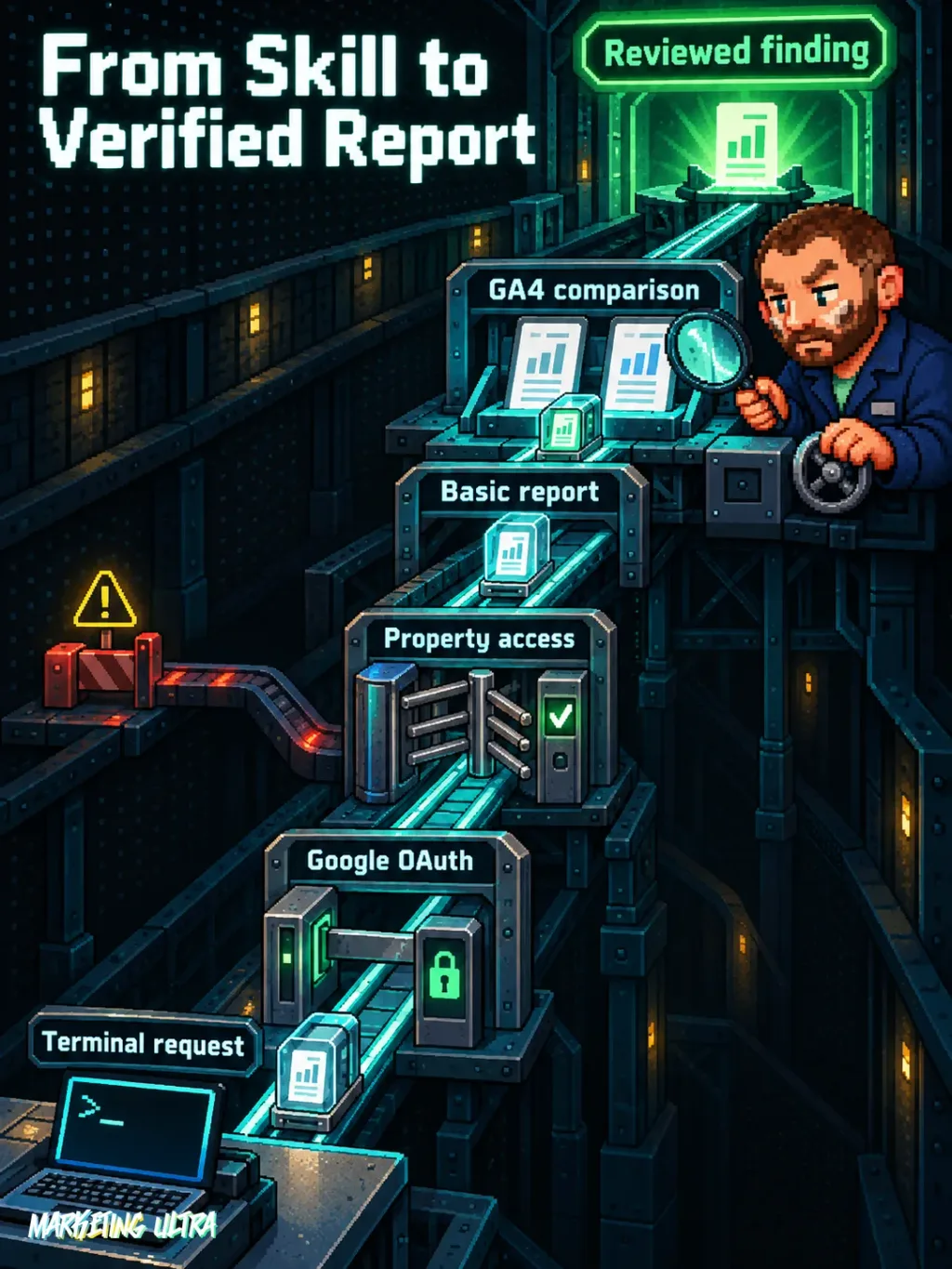

For GA4, downloading the instructions does not magically open a property. You need to complete Google OAuth and have real access to the property you want to query. Credentials must be handled without exposing secrets in chat or adding them to the repository.
Compatibility comes with fine print. Claude Code and OpenAI Codex have explicit paths for skills. Grok CLI, Gemini CLI, Cursor, and Windsurf can use the content as custom instructions or rules. Does that mean they work the same way? NO. Dependencies, credentials, and tool execution must fit each environment.
Copy this and paste it into Claude Code, Cursor, or your favorite coding assistant:
Install OpenClaudia Skills from https://github.com/OpenClaudia/openclaudia-skills and enable google-analytics.
Guide me through setting up Google OAuth without showing or storing secrets in chat.
Verify access by requesting a basic GA4 report and flag any data you cannot verify.
You must supervise the process. The assistant can guide installation, configuration, and checks, but you will need to grant access and validate the result.
The supplied documentation does not describe a specific uninstall command. For CLI installations, review the help for the version in use first; do not casually improvise commands.
Using It in Real Marketing
The sensible scenario is a regular acquisition review: request a GA4 report, identify variations, and turn them into questions for the analyst. The google-analytics skill, described in the repository, is the package component intended for that workflow.
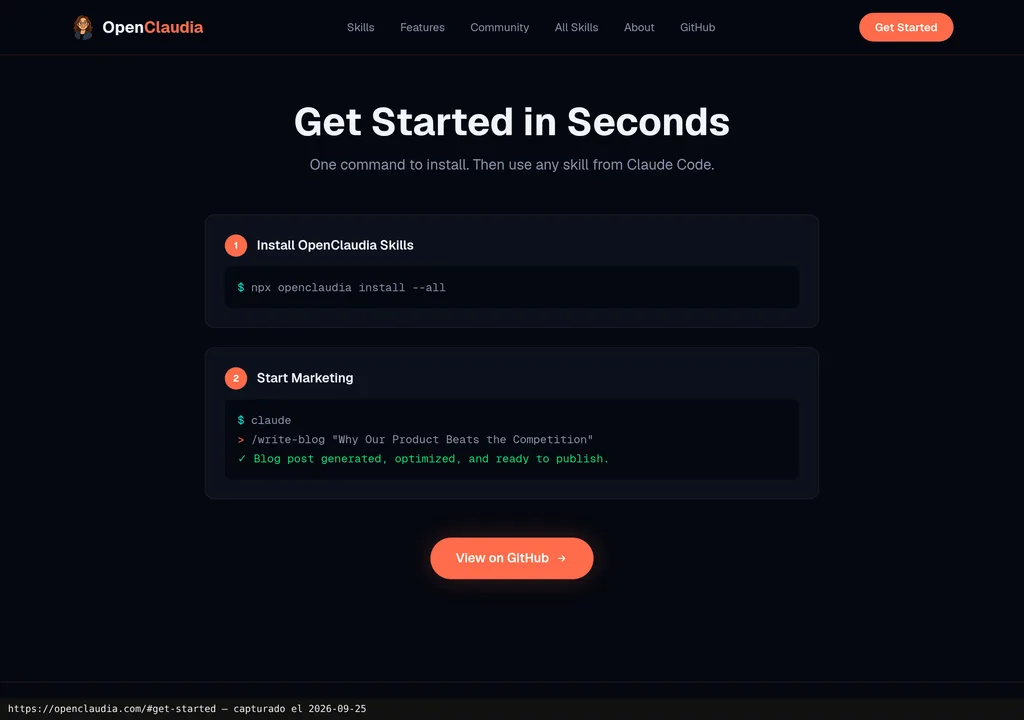
A reproducible test would begin by installing that skill, configuring OAuth, and requesting a simple report on an authorized property. You would then compare the figures with GA4, note the period, and check dimensions, filters, and time zone. Without that comparison, an answer that looks flawless is still an unvalidated answer.
The dossier does not document any execution. So there is no hands-on test or results to sell here. Nor do we know whether the module detects measurement, attribution, or consent issues. The documentation confirms what it is for, what it requires, and how to install it. That is as far as it goes.
As an entry point to the ecosystem, OpenClaudia Skills also fits into the roundup of marketing skills for coding agents and the general guide to skills for Claude Code and Codex. It is the same resource, not four reviews disguised as GA4, SEO, email, and advertising coverage.
What They Do Not Tell You
The license is not the barrier to entry. OpenClaudia Skills is distributed under an MIT license that lets you review and adapt the material. The work comes afterward: preparing credentials, granting the right access, and watching what the agent does with sensitive data.
And what do people who use it say? The dossier provides no verifiable discussions from Reddit, Hacker News, or other communities. Without them, it is impossible to separate everyday use from criticism or simple promotion, let alone treat adoption of the package or the specific GA4 workflow as proven.
The most interesting risk is a false sense of depth. An agent can write a very convincing explanation of a poorly requested report. If nobody checks filters, dates, and what the metrics mean, you have simply sped up the mistake. Boom.
Alternatives
The immediate alternative is much less exotic: keep using the marketing dashboards the team already relies on for repetitive tasks. It is less compact, yes, but it preserves each provider's interfaces, access controls, and safeguards.
Sticking with the GA4 interface makes more sense if the team does not want to maintain local credentials or needs to visually review every setting. OpenClaudia fits when the terminal is already part of daily work. Outside that context, its supposed convenience can become another thing to maintain.
Verdict
OpenClaudia Skills is worth a controlled trial if your team already works with coding agents and wants to bring GA4 into that environment. It makes sense. But I would start with google-analytics alone on a non-critical property, compare every figure, and only then decide whether it deserves to expand.
I would not use it as analytics autopilot or as a replacement for a specialist. Nor would I sell its stars as proven adoption. OpenClaudia Skills can organize the work, but real data depends on OAuth and the decision remains yours. Without judgment, you will only make mistakes faster.
Frequently Asked Questions
Does downloading the skill grant access to a GA4 property?
No. You need to complete Google OAuth and have access to the property.
Do the 700 stars prove that many people use the GA4 skill?
No. They are stars for the full repository, dated September 25, 2026; they are not equivalent to users, installations, or module adoption.
Does it work the same way in Claude Code, Codex, Cursor, and Windsurf?
That has not been demonstrated. Claude Code and Codex have explicit paths for skills; in other environments, the content can be used as instructions or rules if credentials and dependencies are compatible.