Meta has jumped headfirst into the AI coding agent wars. Muse Code arrives with its own model, parallel subagents, and pricing that, on paper, makes the competition look expensive. But the fine print on the "contributor" tier deserves more attention than the agent itself. When something costs 10 times less, the question isn't "what do I gain?" It's "what am I actually paying?"

TL;DR: The No-Nonsense Summary
- Muse Code: Meta's terminal-based coding agent, powered by Muse Spark 1.2 with persistent subagents that work in parallel.
- Real performance: 59.3% on DeepSWE, behind GPT 5.6 Turbo and Opus 5. Meta calls it a "moderate improvement."
- Two-tier pricing: standard rate ($1.25/M input) or contributor tier at 10x cheaper ($0.10/M), but Meta trains on your code.
- Privacy alert: according to an article cited on Hacker News, Muse Code sends data to Meta by default.
In this article
What Is Muse Code and Why Is Meta Entering Now?
Muse Code is Meta's terminal-based coding agent, powered by the Muse Spark 1.2 model. It plans, writes, debugs, and validates code by splitting tasks across subagents that run in parallel. It installs on macOS and Linux with a single curl command and has been available in beta since early August 2026.
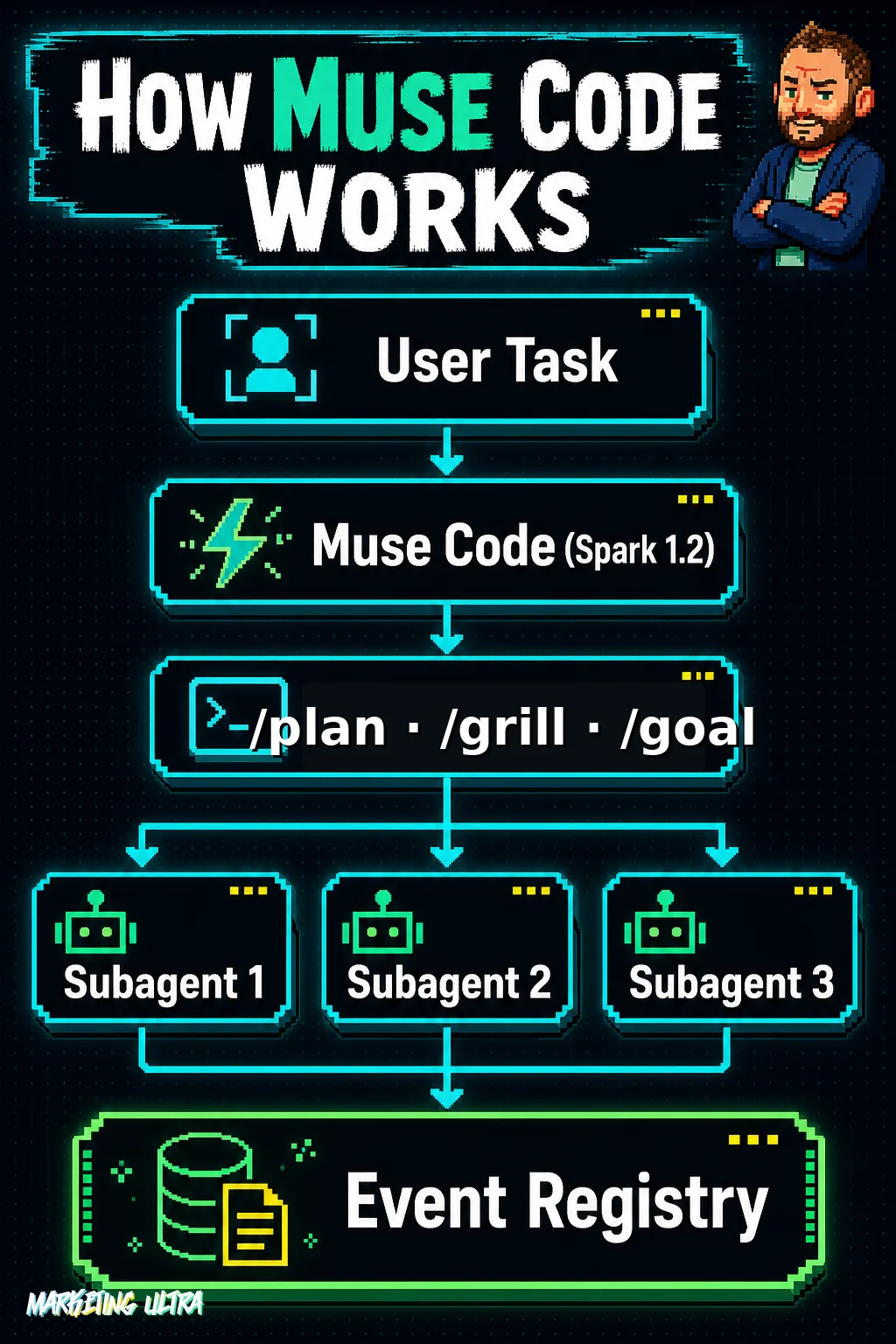
Its most distinctive feature is persistent subagents: Muse Code can distribute a complex project across multiple agents that stay active throughout the entire session, reducing latency and manual intervention. It comes with commands like /plan (turns a task into an approvable plan), /grill (stress-tests that plan), and /goal (drives toward a specific objective). Everything gets logged in a local event registry that lets you replay sessions and pick them back up after a failure.
Why now? Because the AI coding agent race is the hottest battlefield in tech in 2026. Anthropic's Claude Code, OpenAI's Codex, and now Muse Code. Three giants fighting to be the terminal where developers live.
And the first thing Meta does on launch is publish its DeepSWE score: 59.3%. Behind both GPT 5.6 Turbo and Opus 5. Meta itself calls it a "moderate improvement." It's rare for a company to ship a product while openly admitting it isn't the best on the market.
Muse Code Pricing: Pennies for Your Code
Here's the crux of it. Muse Code offers two pricing tiers. The standard rate runs $1.25 per million input tokens and $4.25 for output. Competitive, nothing remarkable. But the "contributor" tier drops to $0.10 input and $0.20 output. That's 10 to 20 times cheaper.
The catch? Meta uses your prompts and outputs to train its AI models. Code, instructions, business logic, everything you feed it ends up training the next Muse Spark.
An article cited on Hacker News warned that Muse Code sends instructions to Meta by default. And on LinkedIn, one analysis summed it up with a line worth reading twice: "Claude Code could have the better model and still lose to Muse Code. Because Meta isn't only competing on the model."
I'd bet that line is more right than it sounds. Meta doesn't care about having the best coding model. What it wants is the best coding DATA. The contributor tier is exactly that: a trade where you put in the lines and they put in the pennies. It's Meta's classic playbook, subsidize the product, harvest the data. They did it with Instagram. They did it with WhatsApp. Now they're coming for your terminal.
If you work at an agency or handle client code, this should set off every alarm you have. It's not illegal. But you're handing over someone else's intellectual property in exchange for saving a few dollars a month.
Is Muse Code Worth Trying Today?
On the standard tier and with its limitations accepted, Muse Code works. Persistent subagents are a genuinely interesting concept and the audit log is well thought out. If you're curious how Meta approaches agent orchestration, it's worth a look.

But as a production tool, not today. A 59.3% on DeepSWE, trailing both GPT 5.6 Turbo and Opus 5, is a real gap. This is a beta, and Meta knows it.
Where does it make sense? For personal projects or prototypes with no sensitive data involved, yes. For client code in production, the competition is still ahead.
That said, this agent war is good news for those of us who use these tools. As I explain in my guide on AI automation at scale, the tool is only part of the system, the judgment of whoever uses it is what makes the difference. If you're already using Claude Code or Codex to review your plans, Muse Code doesn't give you a reason to switch today. If you're just getting started with AI agents in your workflow, it makes sense to try it on the standard tier and see what it brings.
Copy this and paste it into Claude Code, Cursor, or your favorite coding assistant:
Install Muse Code with curl -fsSL https://dev.meta.ai/install.sh | sh, configure your Meta AI API key, and run /plan in my current repository to see how it breaks the project into subtasks.
You don't need to know how to code. The assistant handles the installation, configuration, and testing.
Meta's first serious move in the coding agent space, and it doesn't win the benchmarks. Its most aggressive bet comes with a data toll that should make anyone who handles other people's code very nervous.
But Meta plays the long game. It ALWAYS has.
Whether Muse Code is good or bad today is almost beside the point. What matters is how many millions of lines of code Meta is going to accumulate through that contributor tier. And what it's going to build with them.