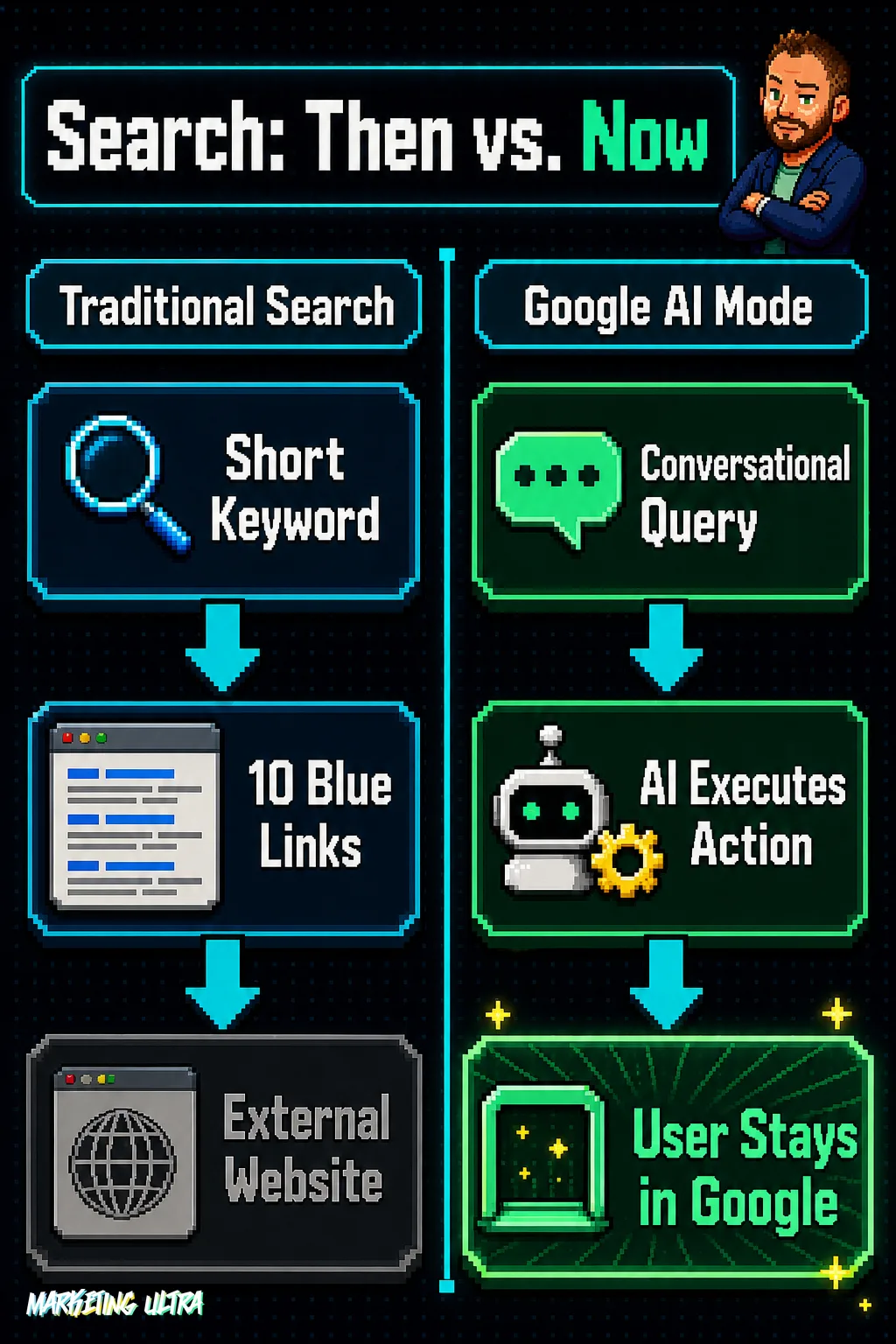
Google is no longer satisfied with giving you ten blue links. Or even summarizing the answer in an AI-generated block. Now it wants to execute actions on your behalf: add products to a cart, save playlists, interact with third-party apps without ever leaving its page. That's what it just activated with app integration in AI Mode. And the implications for anyone investing in search are serious.

TL;DR: The no-fluff summary
- Connected apps: AI Mode integrates Instacart, Canva, and YouTube Music to execute actions without leaving Google.
- 93% zero-click rate: the vast majority of users never leave the AI interface. Brands cited in the response see a 35% higher organic CTR.
- Paid search shifts model: conversational intent replaces the short keyword. Ads are inserted inside the AI response.
- Not confirmed outside the US: the feature is only verified in the United States. Google talks about global rollout, but there is no official confirmation for markets outside the US.
In this article
Which Apps Google AI Mode Connects Today
Google AI Mode is Google's conversational search interface that, powered by Gemini, lets you hold conversations with the search engine and, since July 2026, execute actions in third-party apps directly from the results page. The first three integrated apps, as TechCrunch confirms, are:
- Instacart: ask for a recipe and add the ingredients to your cart without opening another tab.
- Canva: search for design templates or brainstorm project ideas within the conversation.
- YouTube Music: request a soundtrack for your event and it gets saved to your library, ready to play.
Notice the lineup: groceries, design, and music. Three verticals where users buy fast and without friction. Google says it's working with more developers to expand the list, but this first batch is no coincidence. These are categories where users convert quickly and where the "never leave Google" experience delivers genuine value.
From Search Engine to Middleman: How It Works
The system breaks down the user's query into subtopics, pulls data from the search index, the Knowledge Graph, and the Shopping Graph, synthesizes a response, and passes instructions directly to the third-party platform to execute the action. Exactly what AI agents in marketing do: receive an instruction and carry it out. Only now the agent is the search engine itself.
AI Mode can cross-reference your personal data: Gmail, Calendar, Maps, YouTube. It personalizes responses using your schedule, your history, and your preferences. Call it what you want, but that's no longer a search engine. It knows you, and it acts without asking.
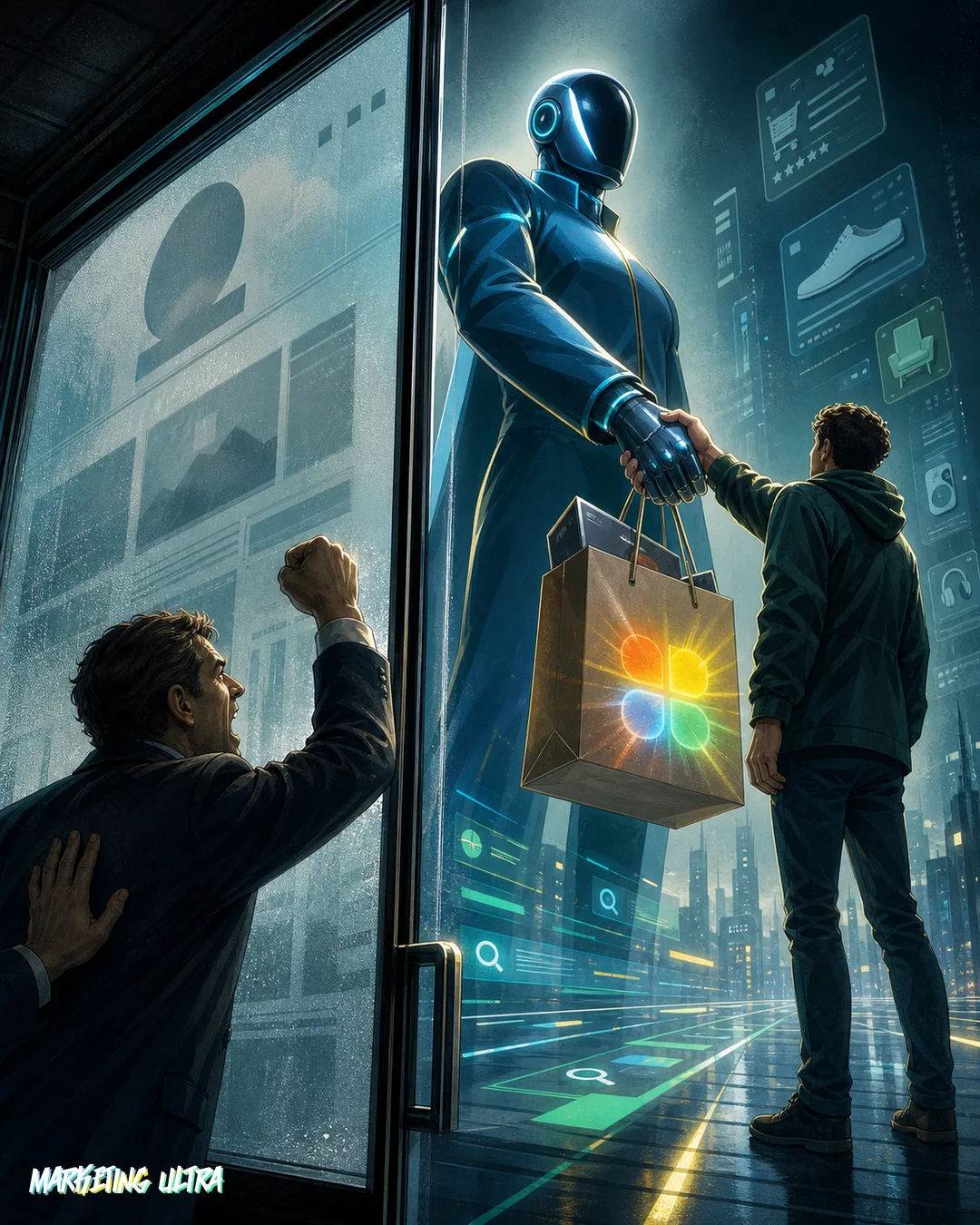
The result? More funnel stages stay inside Google. Users no longer need your website to research OR to buy.
I'll wager Google isn't building this just to make your life easier. It's capturing the transactional layer. Until now it controlled the top of the funnel: it showed you options and you decided where to buy. With AI Mode executing actions, it takes control of the close too. Your brand stops being a destination and becomes a supplier inside Google's ecosystem. Instacart doesn't gain visibility here, it cedes the point of contact with its own customer. For any brand that lives off a direct relationship with the end user, that's a serious problem.
93% Zero-Click Rate: The Number That Changes Everything
AI Mode sessions record a zero-click rate of 93%. Nine out of ten users never click outside Google. The number is staggering. But there's a catch.
Brands cited inside an AI response see a 35% increase in organic CTR. And when that brand also runs ads, paid CTR jumps 91%. This is the "halo effect": being cited in the AI response multiplies the performance of the rest of your ad spend.
Anyone still fighting only for the first-page link is optimizing for a game that no longer exists. This is pure agentic search, and what it means for your SEO and content strategy is straightforward: if the AI doesn't cite you, users don't know you exist.
What Changes for Your Paid Search Campaigns
Agentic search breaks the exact-match, short-keyword logic that most Google Ads accounts are built on. When users converse with the AI instead of typing three words, queries get longer and more action-oriented.
- Ads appear inside the response: ad formats in AI Mode are inserted within the AI-generated text, not beside it. Creative that directly answers the user's question will outperform generic promotional messaging.
- Intent beats keyword: optimizing by behavior, context, and funnel stage carries more weight, something we've already been seeing with AI segmentation in Google Ads. First-party data and solid conversion tracking become non-negotiable.
And then there's coherence. If the AI cites you and the user lands on your page, any disconnect between the AI response, your ad, and that landing page kills the conversion. The user goes back to Google. Which isn't letting go.
If you manage Google Ads accounts, this hits you directly, and in the complete Google Ads guide we've been making this clear: autopilot without expert judgment is the perfect recipe for burning budget.
Availability (July 2026): app integration in AI Mode is confirmed for users in the United States. Google mentions a global rollout, but there is no official confirmation that the feature is live in the EU or any other market outside the US. Don't assume otherwise.
Search No Longer Informs: It Acts
Google has gone from "here's the information" to "I'll handle it for you." Convenient for the user, perfect for Google. For brands, the uncomfortable question is different: how much of your direct relationship with the customer are you willing to hand over in exchange for visibility inside an AI response?
If your strategy still depends on three-word keywords and generic landing pages, this is going to hurt. If you understand that the game is winning the citation, you have an edge. Google wanting to be the middleman for everything doesn't mean you have to let it.