
Publishing an AI-written article often looks easy, until the sources, broken links, CMS formatting and that toothpaste-ad copy show up. Claude Blog turns that pile of headaches into a coordinated editorial workflow for Claude Code, although the final judgement remains human. Thank goodness.

TL;DR: The No-Nonsense Summary
- Complete suite: brings together 31 sub-skills for researching, writing, reviewing, localising and maintaining articles.
- Controlled delivery: applies five validation gates and can retry work up to three times before escalating a failure.
- Clear requirements: requires Claude Code CLI and Python 3.11 or later; Codex compatibility is not documented.
- The key limitation: its internal score measures compliance with its own rules, it does not guarantee editorial quality, rankings or citations by AI assistants.
In this article
| What it is | A suite of 31 sub-skills that researches, writes, validates and scores blog posts from the terminal, with output tailored to Next.js, WordPress, Hugo and more. |
|---|---|
| Official website | https://claude-blog.md/ |
| Repository | repo |
| Licence | MIT |
| Price | free |
| Alternative to | Jasper, Copy.ai, Writesonic |
| GitHub stars | 2,256 |
| Launch year | 2026 |
| Maintained by | AgriciDaniel (individual) |
| Platforms | macOS, Linux and Windows |
| Requirements | Claude Code CLI and Python 3.11+ |
| Integrations | Claude SEO, Google APIs, NotebookLM and Gemini |
| Language | Multilingual publishing, including Spanish adaptation |
Reviewed on 2026-09-26
This tool is included in these collections: Marketing skills for Claude Code and Codex · Skills for Claude Code, Codex and Coding Agents by Task
The Problem It Solves
Claude Blog aims to avoid the usual editorial chaos: one person researches, another writes, someone wrestles with formatting, and the broken link stays there waiting for a reader to find it. The public Claude Blog package uses an orchestrator to distribute research, writing, auditing, images, structured data, translation and updates across 31 sub-skills.

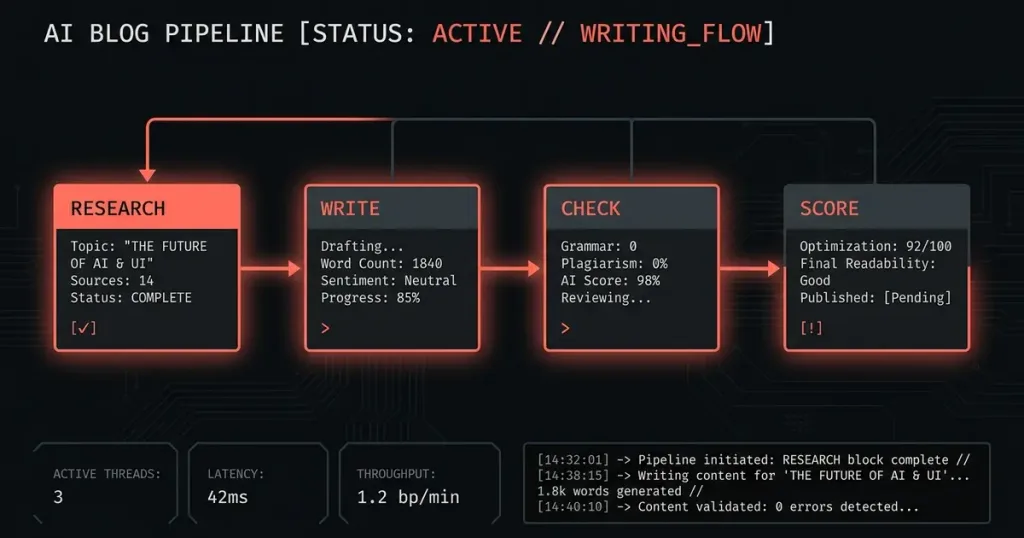
In plain English: you give it a blogging task and it splits the work across specialised components instead of trusting everything to one enormous prompt. The result can be prepared for WordPress, Next.js MDX, Astro, Hugo, Jekyll, Ghost, 11ty, Gatsby or static HTML.
Its central piece lives in skills/blog/SKILL.md. This file interprets commands, detects the destination and loads only the references it needs. That places it among marketing skills for coding agents, though its verified compatibility is limited to Claude Code.
Getting Started
To install it, you need Claude Code CLI already configured and Python 3.11 or later. The project’s documentation offers two routes: add its plugin catalogue and install it from there, or clone the repository and run the installer.
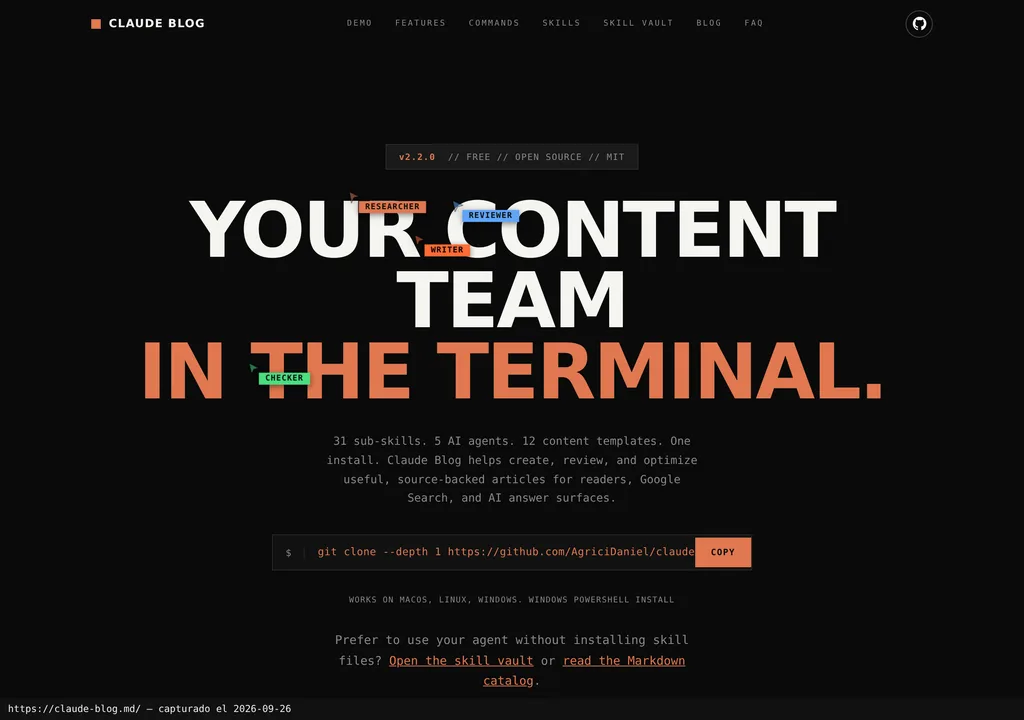
Want an installation you can repeat without rolling the dice? Clone the repository, pin version 2.2.0 and inspect what the installer does before running it. Then restart Claude Code. There are also uninstall tools for Unix, macOS and Windows. It sounds obvious, but plenty of solutions remember the exit door only once your storage room is already full.
Claude Blog is free and distributed under the MIT licence. That does not make optional services free: some features depend on external APIs or tools, and the dossier provides no reproducible bill for calculating those costs.
Copy this and paste it into Claude Code. It is the compatible environment documented by the project; Cursor and other assistants sit outside that guarantee.
Review Claude Blog at https://github.com/AgriciDaniel/claude-blog and check that I have Claude Code CLI and Python 3.11+.
Install version 2.2.0 using the clone, review and run flow documented in the README.
Try /blog write with a short article and verify the generated files, screenshots, links and review report.
You do not need to be a programmer, but you do need to be comfortable in the terminal. The assistant can guide you through installation, setup and testing.
Using It in Real Marketing
At an agency or on a small team, asking for “an article about SEO” solves very little. The value appears when you coordinate the whole journey, from brief to publication-ready files, without losing sources, voice, internal links, images or formatting along the way.

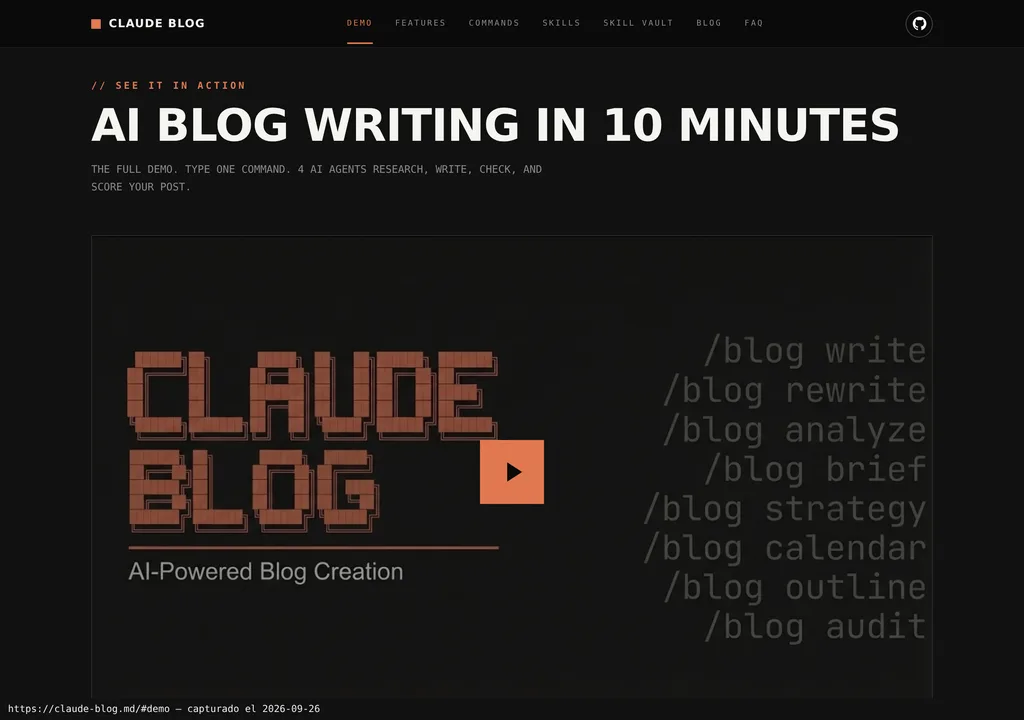
A sensible scenario would be to create the strategy and brief first, generate the article, run the factual check and then adapt the Spanish version. The suite can also consume data from Claude SEO, a useful integration when the audit comes before the editorial calendar. We have already examined how Claude SEO works with its agents; here, it acts as a source of findings rather than a replacement for the editorial workflow.
There is a fairly clear way to put it under pressure: use version 2.2.0 on a familiar topic and then inspect everything it leaves in the final folder. You should find Markdown, HTML and PDF files, the cover image, three screenshots, the review report and the technical preflight-report.json file. This review does not include an independent test run. We have the author’s procedure and deliverables list. Nothing more. Assuming it will work flawlessly in every installation would be wishful thinking.
What They Do Not Tell You
The attractive number can mislead. Claude Blog scores drafts out of 100, blocks delivery below 90 and retries up to three times. Be careful: that score is an internal heuristic. It does not prove the article is good, will rank or will end up cited by ChatGPT, Perplexity or Google.
The system can check structure, file presence, links and technical consistency. The hard part remains outside that spreadsheet: deciding whether a thesis deserves publishing, spotting a misleading conclusion and stopping a brand voice from becoming a collection of verbal tics. Automating a mediocre review merely produces mediocrity with British punctuality.
There is also a practical barrier: this is not a website where you type something and forget about it. It works from the terminal, requires Claude Code and needs Python for its validators and renderers. And the fact that SKILL.md is Markdown does not establish that it works in Codex, Cursor or other agents.
Is there enough independent backing to speak of consensus? Not based on this review’s evidence. The dossier contains no verifiable discussions from Reddit, Hacker News or other communities, and the author’s promotion tells only part of the story. It is useful for seeing how the product is framed. To know how it ages outside its own home, you need external criticism.
Alternatives
Jasper, Copy.ai and Writesonic are listed as alternatives. They make sense for anyone who prefers a content platform to a workflow assembled inside Claude Code, but this dossier cannot compare current prices, quality or features without inventing a horse race.
Claude Blog has another sibling from the same creator, Claude Ads, though it plays a different game: it handles advertising audits. Sharing a creator and ecosystem does not turn two repositories with different purposes into the same product. To place these tools without mixing apples and oranges, see the guide to skills for Claude Code and coding agents.
Verdict
Claude Blog turns editorial production into a traceable process, and it does so with considerable good sense. Its modular architecture, output for several CMSs and pre-delivery checks tackle real problems. No fireworks required.
Would I use it? Yes, if the team already works with Claude Code and needs to coordinate many moving parts without losing files, sources and reviews along the way. I would not choose it for an occasional writer looking for a simple interface, nor would I let it decide on its own what deserves publishing.
Claude Blog can organise the workshop. The strategy, voice and bloody judgement are still yours.