Alibaba has open-sourced a JavaScript library that embeds an AI agent directly inside the webpage. Its core in-page approach doesn't require a headless browser or extensions. Page Agent lives in the DOM and executes natural language instructions. Sounds too good to be true. Let's find out.

TL;DR: The No-Nonsense Summary
- In-page architecture: the agent runs inside the page itself, without requiring a headless browser or browser extensions.
- Natural language: control the web interface with plain-text instructions, no CSS selectors or XPath.
- Open source & MIT: free code from Alibaba, with over 29,000 GitHub stars.
- Cost: €0 for the library; you only pay for the language model API you connect.
- Entry barrier: requires JavaScript and setting up an LLM. The documentation reviewed is developer-oriented, and no accessible tutorials for non-developers were verified.
In this article
| What it is | Alibaba JavaScript library that embeds an AI agent directly in the webpage to control the interface via natural language, without requiring a headless browser or extensions. |
|---|---|
| Official website | https://github.com/alibaba/page-agent |
| Repository | repo |
| License | MIT |
| Price | open source |
| Alternative to | browser-use, Puppeteer and other server-side web automation tools |
Reviewed on 2026-10-06
This tool is included in these collections: Open Source Apps That Replace Paid Software
The Problem It Solves
Page Agent is an open-source JavaScript library developed by Alibaba that injects an AI agent directly into the webpage to control the interface using natural language. That's the project's promise. The repository confirms the in-page GUI agent. It doesn't prove that the agent perceives the interface the way a human does.
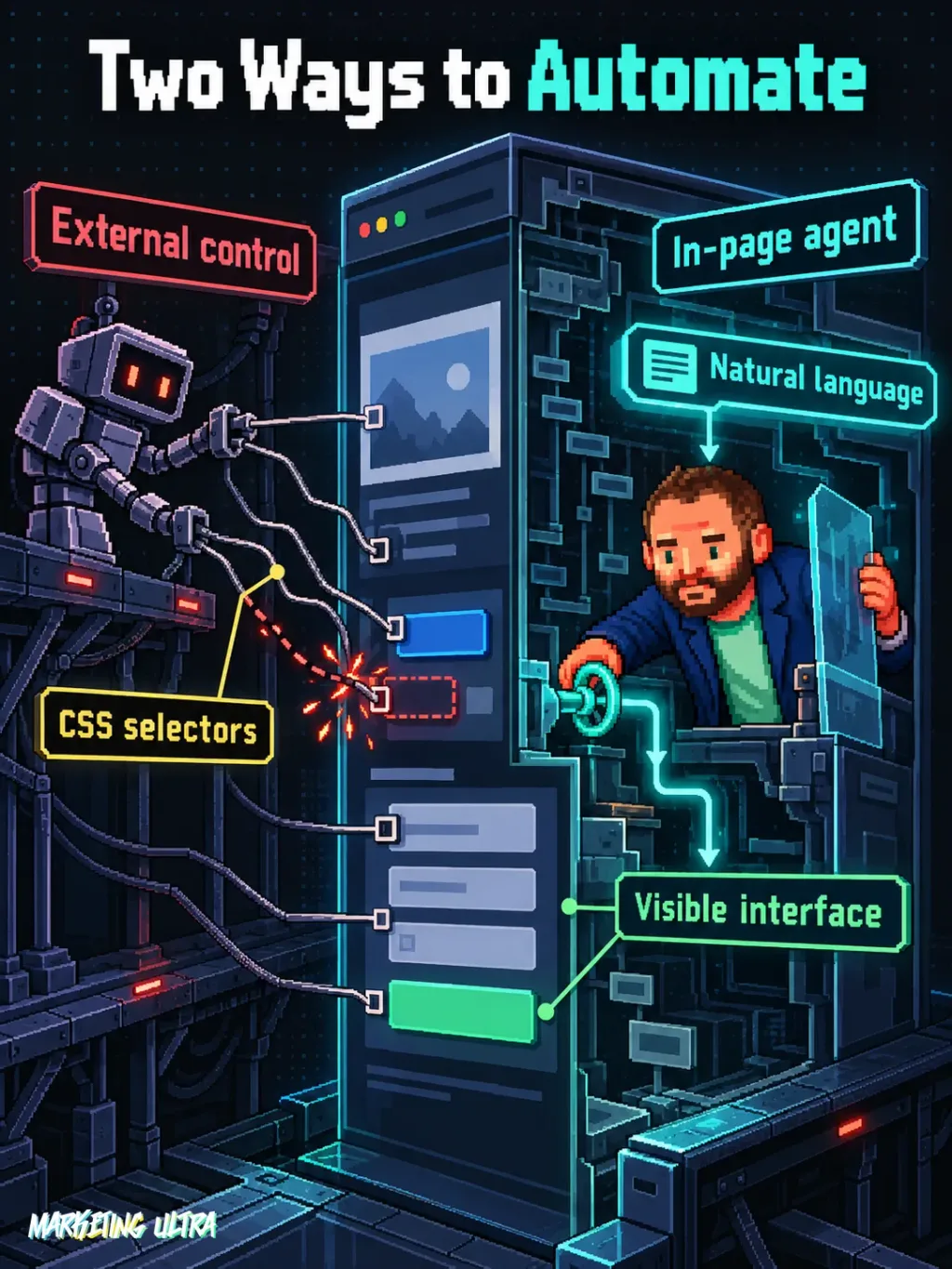
Page Agent's pitch is its in-page architecture. Puppeteer, Playwright and browser-use take different approaches to browser automation, so lumping them together as tools that rely only on headless browsers and technical selectors would be inaccurate. The repository supports Page Agent's architectural claim. A feature-by-feature comparison with every alternative is another matter.
Page Agent flips that around. Instead of driving the web from an external process, it puts the agent inside the DOM. You control it with plain text: "click send", "fill in the email with X".
Why should you care? Because many marketing tools don't have an API. Uploading creatives, pulling data from a dashboard, checking a landing page on mobile. Tasks a human does by hand that an in-page agent could execute without needing to understand the HTML structure.
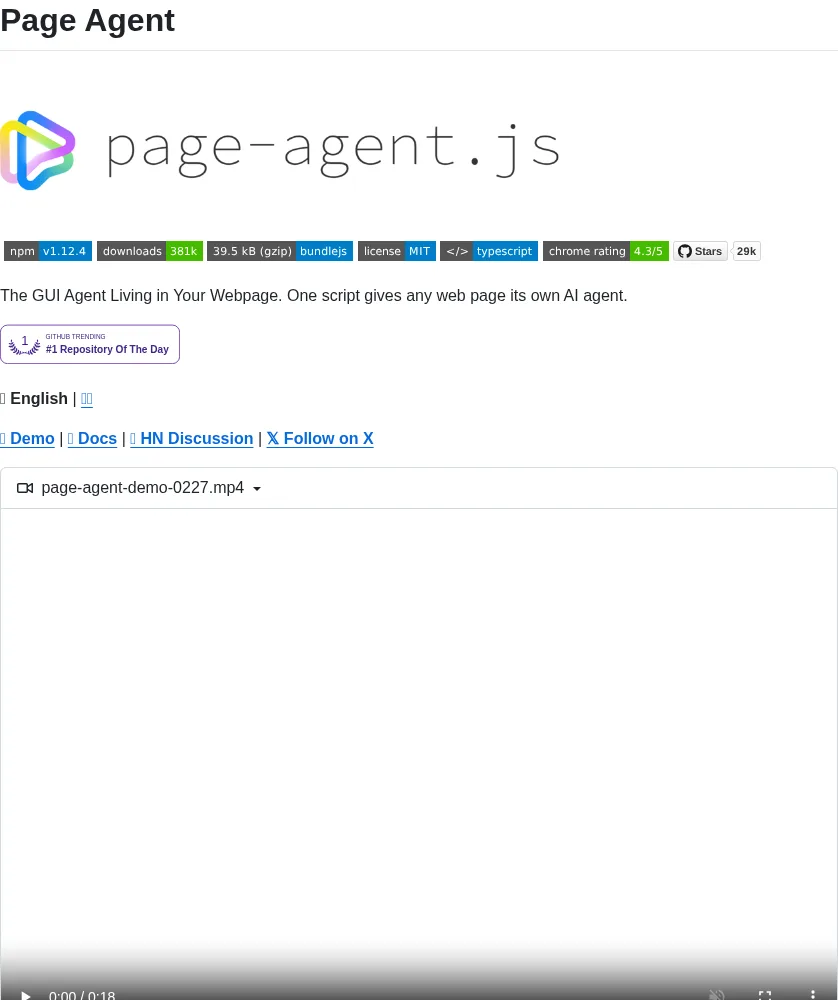
Over 29,000 GitHub stars and 2,600 forks, with 53 open pull requests as of October 2026. The idea has struck a nerve and the community is pushing hard.
Getting Started
Page Agent is a JavaScript package organized as a monorepo (the repository's packages/ folder points to several modules). The foundation is the official GitHub repository, which includes documentation in docs/ and the files CLAUDE.md and AGENTS.md.
Worth noting: the repository includes files aimed at coding agents. If you already use AI coding agents in your workflow, those files may be useful context, but their presence alone doesn't establish dedicated compatibility with Claude Code or Cursor.
Page Agent is JavaScript and carries an MIT license, so the library costs €0. Whether every dependency is also open source wasn't verified. The real cost comes from the language model API you connect. The library: €0. The brain behind it: whatever the LLM costs per use.
Honest caveat: the detailed configuration, which model to connect, how to inject the agent, what parameters it accepts, requires consulting the full README and the docs/ folder. I'm not going to invent steps I haven't verified. The starting point is the repository.
Copy this and paste it into Claude Code, Cursor or your favorite coding assistant:
Clone https://github.com/alibaba/page-agent and install the monorepo dependencies. Show me the project structure and set up a basic Page Agent test to automate a simple task on a local example webpage.
This prompt is only a starting point. Page Agent still requires JavaScript knowledge and an LLM API setup; the evidence reviewed does not show that a coding assistant can complete the installation for a non-developer.
Using It in Real Marketing
I haven't tested Page Agent first-hand, so there's no point building a fictional case study. What I can do is map out where it would fit in a real marketing team.
Picture an agency managing campaigns across several platforms. Every morning, someone logs into three or four dashboards, downloads reports, checks creatives and updates a spreadsheet. These are repetitive tasks on interfaces with no public API. An in-page agent that receives "log into X's dashboard, download yesterday's report" could handle that work without 200-line scripts packed with selectors that break every time the platform changes a div.
That's the promise. The reality today is that you need someone who knows JavaScript and understands language model APIs. It's not plug-and-play.
The in-page approach could be less brittle when an interface changes. A CSS selector may break when the underlying markup changes, while Page Agent is designed to act from page context and natural-language instructions. Sounds promising. Whether that translates into better reliability when dashboards change remains unproven here.
What They Do Not Tell You
Documentation is the first wall. The repository shows over 1,100 commits, but the material reviewed here is aimed at developers. If you're not comfortable with JavaScript and API configuration, you'll need reinforcement.
The language model isn't free. Page Agent is open source, but the brain interpreting your instructions has a usage cost that varies by provider and volume. Here, the library costs €0. The LLM API doesn't.
Support is centered on GitHub: the repository shows 43 open issues and includes a Discussions section. Their activity and usefulness weren't assessed, and no accessible walkthrough tutorials for non-developers were verified.
And the point I'd bet nobody mentions: security. Embedding an AI agent inside a third-party page raises questions about permissions and data handling. Depending on the implementation and browser permissions, it may interact with sensitive information exposed to the page context. Access to session tokens or cookies wasn't verified. If you're automating a panel with client data, check exactly what the agent can access and where it sends information.
Alternatives
The Page Agent sheet positions it as a direct alternative to browser-use, Puppeteer and other server-side web automation tools.
browser-use is one of the alternatives listed for AI browser automation. Calling it the closest competitor would need a feature-by-feature comparison.
Puppeteer and Playwright are considered here as classic web automation alternatives. Their maturity, documentation and communities weren't compared with Page Agent.
Page Agent's proposed architectural difference is that it acts from within the page. No direct comparison was performed, so Playwright's control model and the relative reliability of each approach for large-scale scraping or one-off interactions remain outside the scope of this review.
Verdict
Page Agent puts forward a powerful idea: embed the AI agent inside the page instead of controlling it from outside. And yes, it solves real problems for anyone who's ever dealt with an API-free interface or a selector that breaks every Tuesday.
Today it's a tool for technical profiles. The documentation reviewed is aimed at developers, and the real cost depends on which LLM you connect. For a marketing team without a developer, it's not an immediate option.
Worth watching? Absolutely. The repository is hosted under Alibaba's GitHub organization, carries an MIT license and has accumulated over 29,000 stars. That's a lot of attention. If the entry barrier drops, this could change how we interact with marketing platforms that refuse to give us a decent API.