Google has opened a genuinely useful window: you can now see how your social profiles appear in Google Search Console. Be careful, though, this does not turn Search Console into analytics for Instagram, TikTok, X or YouTube. It measures something else: how Google discovers, displays and sends traffic to that content.

TL;DR: The no-nonsense summary
- New properties: Search Console supports Instagram, TikTok, X and YouTube accounts as standalone properties.
- Global availability: Google confirmed on July 29, 2026, that the feature was available worldwide.
- Google data: it measures clicks, impressions, CTR, position, queries and posts discovered through search.
- Key limitation: it does not replace each social network's native analytics or measure reach within the platform.
In this article
Availability in Spain/EU: Unconfirmed
The source does not confirm availability in Spain/EU. Rollout phase unspecified.
What are social profiles in Google Search Console?
Social profiles in Google Search Console are platform properties that let you analyse an account or channel's performance across Google surfaces. Each profile is added and verified separately.
Google introduced this property type on July 7, 2026, following an earlier experiment with social channels. The official announcement covers four platforms: Instagram, TikTok, X and YouTube.
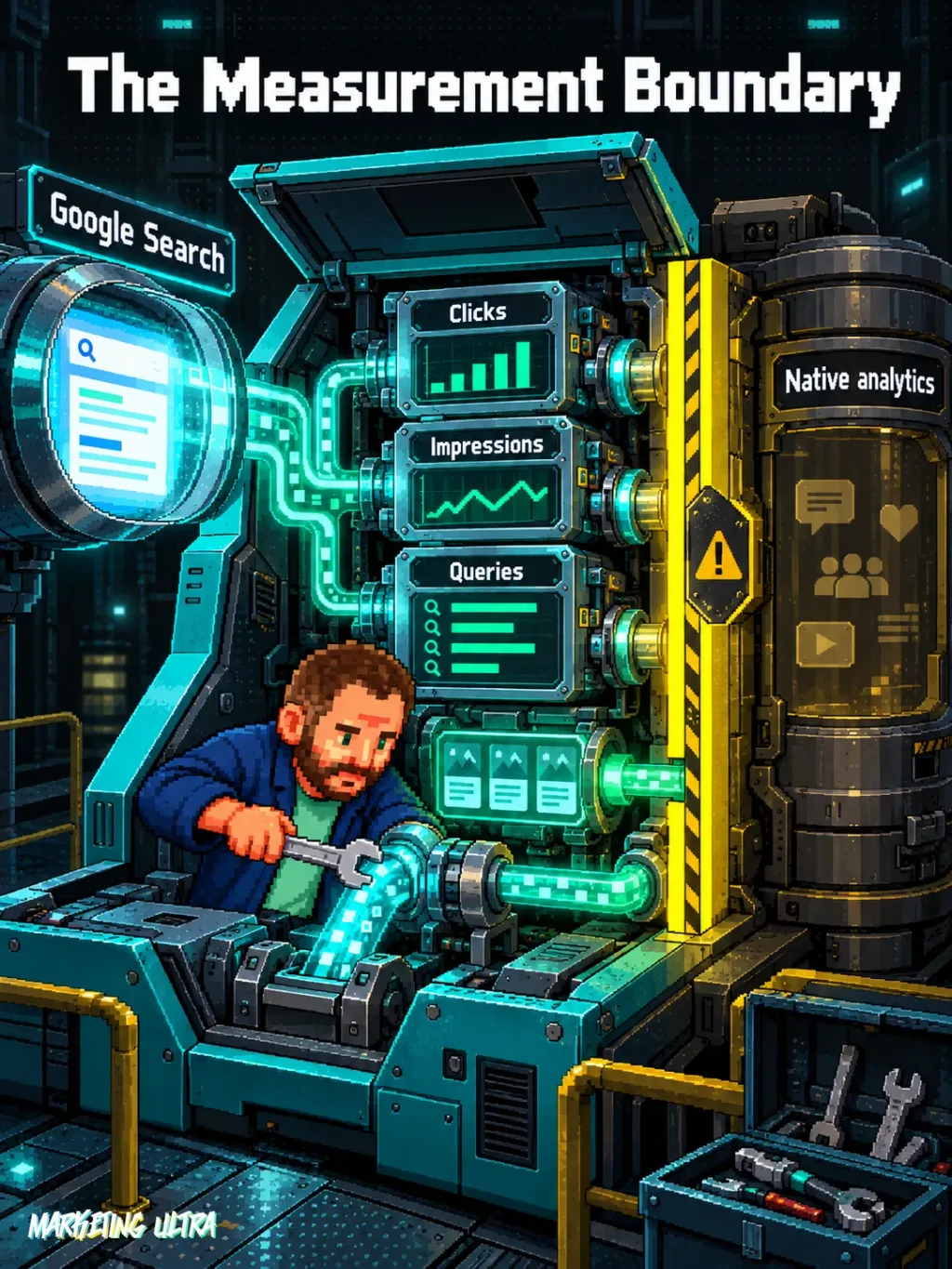
Once the account is connected, the Performance report shows clicks, impressions, average CTR and average position. It also lets you identify the queries that surfaced the content and the posts that received traffic.
Here is the key point: a platform property measures the organic discovery of social content through Google. What happens inside the network is another story. A TikTok view and a Google click through to TikTok are different beasts, even if they sit on the same strategy dashboard.
Is it available in Spain and the European Union?
Yes. Google confirmed global availability of platform properties on July 29, 2026, without excluding Spain or the European Union.
Availability in Spain and the EU: confirmed.
Phase: global rollout completed.
Confirmation date: July 29, 2026.
There is a small documentation tangle here. The help page still carries a notice about a gradual rollout, but Google's later official communication explicitly says the feature is now available to everyone. The most recent dated information takes precedence.
The initial uncertainty did not last long. On July 7, a gradual rollout was announced and, on the 29th, Google declared it complete. There is no need to turn an old screenshot into a geopolitical mystery.
What can you analyse, and what is left out?
Search Console lets you study which queries, countries, devices, dates and URLs generate visibility for each social profile. The official analysis guide also suggests comparing long-form videos with Shorts and Instagram posts with Reels.
Insights summarises recent trends, queries and standout content. Achievements tracks click-based milestones. If there is enough traffic, Discover and Google News reports may also appear, according to the platform properties documentation.
What is left out? Views, likes, comments and reach generated within the network itself. Search Console answers one question only: what role does Google play in the discovery of your social content?
The difference seems obvious until someone combines both reports into a pretty chart and starts drawing creative conclusions. A Reel can perform brilliantly within Instagram and receive barely any Google impressions. Another may get modest in-platform engagement but answer a search query perfectly, continuing to attract clicks for months.
How to use this data without fooling yourself
The useful part begins when you identify which social content has search demand and which format can turn that demand into clicks. Then it is time to get granular: queries, countries, devices and individual pieces.
I would start by separating search intent from social performance. If a query surfaces a video, I would check whether that topic deserves a more complete piece on the website. And if the profile gets impressions but few clicks, I would look at the title, visible text and the promise Google is showing before blaming the algorithm. The usual drill, really.
The trap is treating this report as a scoreboard for deciding which social network “wins”. It is not. Every platform has different formats, audiences and distribution mechanics. Search Console only shows their overlap with Google.
Social profiles still help build an audience and a brand, then direct those people to the website or whichever destination we want. This feature sheds some light on a part of the journey we could barely see before.
When does the first data appear?
Reports may take a few days to show information after you create a property. Google does not guarantee an exact timeframe, and the report's default date range is 28 days.
The secondary source that prompted this story says data is available within 36 hours and outlines the process for adding social profiles. I would not treat those 36 hours as a promise: the official documentation only says collection and processing may take several days.
If you connect a profile today and find an empty report, do not start tearing everything down. Wait, check verification and look again. Search Console has many virtues, but real-time anxiety is not one of them.
Social SEO is no longer a conversation in the dark
This feature does not prove that every social post will rank or that Google will hand you traffic. What it gives you is far more down to earth: first-party data to check which social assets genuinely play a role in organic search.

It also fits with a Search Console that is getting better at separating formats and surfaces, as with the Search Console multimodal Web filter. The more precise the segmentation, the less room there is to credit results to the smoke and mirrors of “omnichannel content”.
Connect Instagram, TikTok, X or YouTube. Let the reports gather data and look for patterns, not pretty screenshots for a presentation. Social profiles in Google Search Console help you understand how people find you. Everything else, for now, still calls for judgement.