Meta Ads Super Burst promises something any brand would want to buy: concentrated attention and fewer elbows from competitors. But booking a burst of reach is not the same as buying results. Before reaching for the wallet, separate what has been announced, what Meta has measured in its own tests, and everything that still remains conveniently out of frame.

TL;DR: The No-Nonsense Summary
- Concentrated reach: Super Burst lets brands reserve windows of 3 to 24 hours for specific brand moments.
- Optional exclusivity: category blocking can be purchased, but it is not automatically included with every reservation.
- Meta data: Meta reported median lifts in recall and intent in its tests, not guaranteed profitability.
- Uncertain availability: the rollout is gradual, and Spain, the EU, pricing, and minimum spend have not been confirmed.
In this article
What is Meta Ads Super Burst and what does it actually reserve?
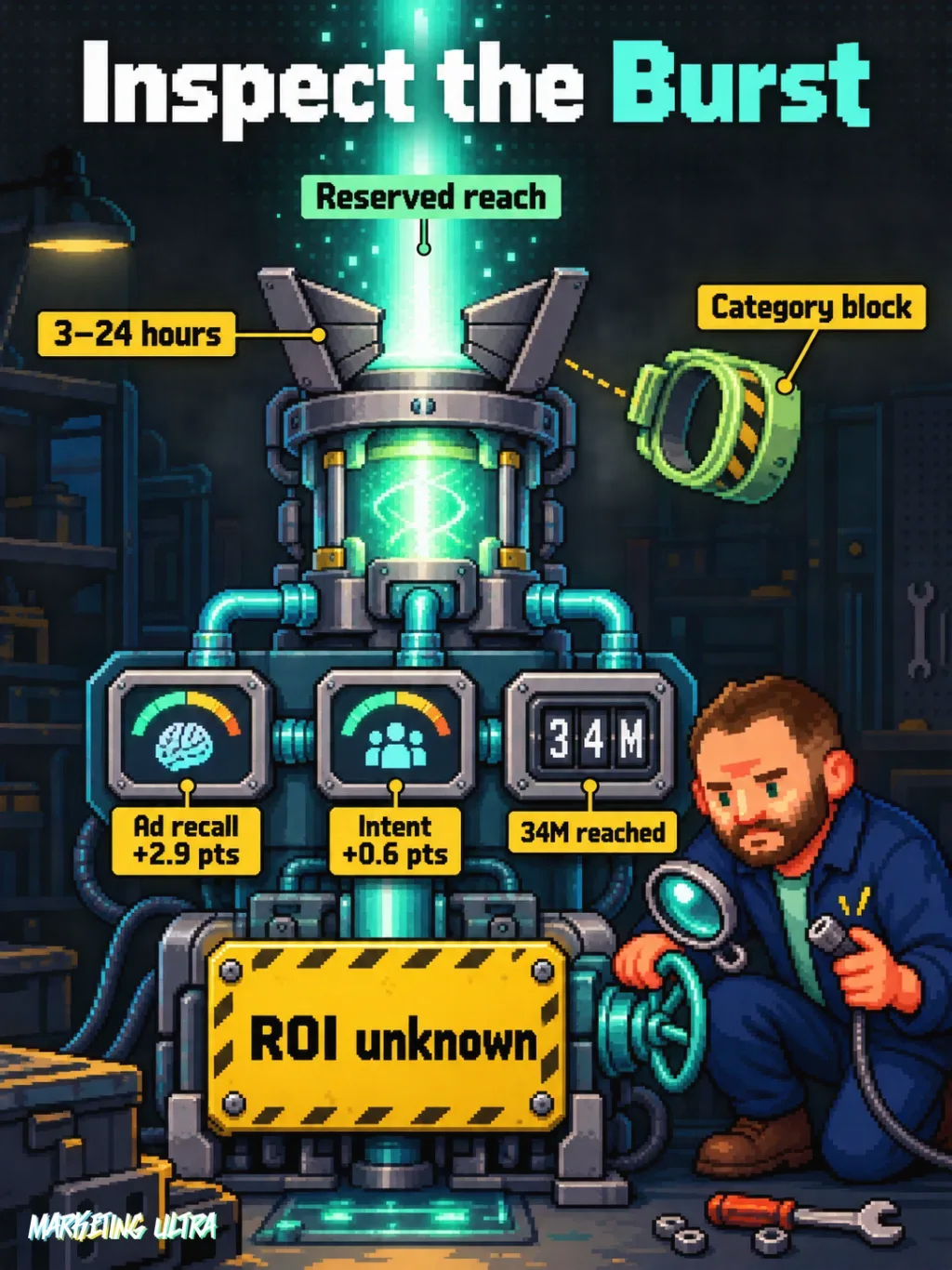
Meta Ads Super Burst is a reserved-buy format that concentrates reach within a 3-to-24-hour window. It is designed for launches, events, or brand moments with a fixed date, not as a replacement for an always-on campaign.
Planning takes place in Reach Planner, where Meta provides price and reach estimates. Meta ties guaranteed delivery to those estimates, according to reporting by PPC Land. Inventory depends on the date and can sell out, so booking late may also mean watching from the sidelines.
Category exclusivity is an option. That distinction matters: the headline “Meta shuts out your competitors for 24 hours” sounds great, but it overstates the case twice. The window may last just three hours, and exclusivity is not necessarily included.
We also do not know how Meta defines each category, what that block costs, or whether it affects only other Super Burst reservations or competitors’ auction-bought ads too. This is not fine print. It is the heart of the commercial proposition.
Is Meta Ads Super Burst available in Spain?
There is no confirmation that Meta Ads Super Burst is broadly available in Spain or the European Union. Meta announced on October 15, 2026, that it would expand availability during that month, gradually, though, and without publishing a list of included markets or accounts.
Search Engine Land also reported on the gradual launch. No pricing, CPM, minimum spend, or rollout end date was announced. A Spanish-language announcement or someone showing the option in an account does not prove broad access. We have seen this party before.
Before presenting anything to a client, open Reach Planner and check the account’s actual access. If it is not there, ask your Meta representative. If it is, save the quote, available inventory, and delivery terms. Planning first and asking questions later is a very creative way to land yourself in trouble.
What results has Meta reported?
Meta reported median lifts of 2.9 points in ad recall, 0.6 points in intent, and 34 million people reached per ad activation. The 14% equivalent refers specifically to US adults connected during one day, not 14% of every market.
These are aggregated results from Meta tests. We do not know the number of studies, the spread of results, starting benchmarks, or a complete methodology that would make ROI calculable. Nor are they a forecast for Spain, your category, or mediocre creative.
The trap is turning an awareness metric into a business story the data does not tell. You can produce a recall spike and sell no more. You can reach millions and overpay for reach you were already getting through other campaigns. Plenty of noise, sure. Revenue? We will see.
Meta has incentives to create more products, more inventory, and more reasons to increase ad spend. I am a fan of automation and testing new formats, but platforms automate where it suits them and demand craftsmanship where it benefits them. With Meta, keep one eyebrow raised. The same critical lens applies to the use of Advantage+ in Meta Ads: platform convenience does not replace advertiser judgment.
Super Burst, First Impression Ads, and Aggregated View Time are not the same thing
The three announcements from the Brand Building Summit cover different products or tests. Mixing them together creates a kind of advertising Frankenstein with more headlines than certainty.
First Impression Ads was still an early test in the United States. It limits the first ad position a person sees when opening the Facebook feed to one brand per day. It is not a Super Burst feature, and no broad availability has been announced.
Aggregated View Time was still in alpha. The metric adds up the time a person spends with a brand’s content over a week, rather than judging each view separately. Meta claimed that five accumulated seconds drove 32% more offline sales than one continuous five-second view, according to a summary by Jon Loomer.
That 32% comes from internal research with no published methodology. It is NOT a Super Burst performance metric. Putting both figures on the same slide does not turn them into cause and effect, however pretty it may look to the sales team.
What to check before planning a Super Burst campaign
The decision starts with three far less glamorous questions: what it really costs, what incremental reach it adds, and how on earth you will measure the impact. Super Burst is a better fit when there is a valuable, short-lived brand moment; it is a worse fit when used as a confetti cannon to fix a weak strategy.

I would require at least six answers: access and included markets, total price, expected reach, frequency, the exact category definition, and the real scope of exclusivity. I would also ask about compensation terms if Meta delivers less than estimated, because that point has not been published either.
Then comes the part people tend to forget: creative ready for the window, a website able to absorb the spike, customer service availability, and measurement using control groups or lift studies. A Meta executive described the product as a spike added to an always-on campaign, not a replacement for one, according to AdExchanger. That is probably the most sensible reading of the entire announcement.
Meta Ads Super Burst makes sense for a major brand with an important date, budget, and robust measurement in place. Without those three things, you are simply paying to show up a lot for a few hours. And showing up a lot, on its own, has never been a strategy.