AI in Black Friday is shaping up to become the new shop assistant: it searches, compares and flags discounts while shoppers make sure it is not trying to pull a fast one. The opportunity for brands is huge, but mistaking assistance for autonomy would be shooting themselves in the foot.

TL;DR: The No-Nonsense Summary
- AI-powered discovery: among surveyed prospective shoppers, searching for prices, verifying discounts and comparing products are far more acceptable than delegating the purchase itself.
- The figure that dampens the party: only 6% of surveyed prospective shoppers would let AI buy without asking first.
- Information over gimmicks: price, availability, features, shipping and returns must be clear and up to date.
- Human control: recommendations can be automated; the decision and payment should remain with the shopper.
In this article
AI in Black Friday means using assistants such as ChatGPT or Gemini to discover, assess and compare deals before buying. That distinction matters: helping someone choose is very different from deciding, adding to cart and paying on their behalf.
What role will AI play in Black Friday 2026?
AI is set to be far more accepted as a research tool than as an autonomous shopper. The YouGov report on Spain says that 55% of people planning to shop during Black Friday or Cyber Monday consider using it to make the most of discounts.
This is not a sample of all of Spain. It covers prospective shoppers for those campaigns, and the key delegation figures come from a sample of 447 people within an online survey of 996 adults. It is worth saying so, because a percentage without a denominator is a wonderful headline-making machine.
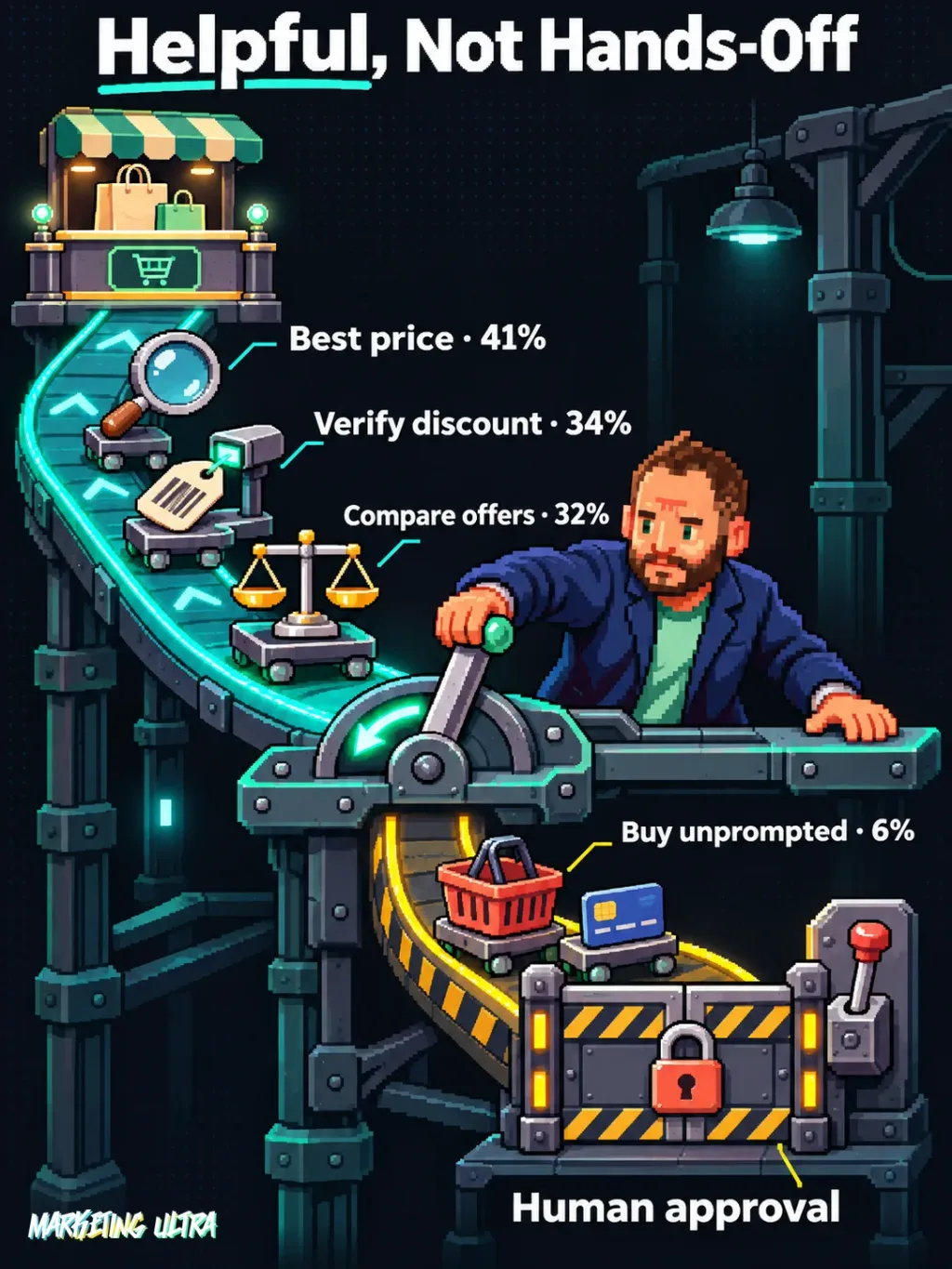
The best-received uses are finding the best price, at 41%; checking whether a discount is genuine, at 34%; and comparing similar products or offers, at 32%. ChatGPT leads intended use within this group at 61%, followed by Gemini at 45%. The question allowed multiple responses: these are not market shares or penetration figures for the whole population.
And that much-discussed 6%? It is the share of prospective shoppers who would feel comfortable letting AI make purchases without asking them first. Another 6% would allow it to add items to the basket, and only 5% would accept it completing a purchase after approval.
There it is. Plenty of curiosity for research, very little desire to hand over the card and look the other way.
How to prepare products for AI-powered discovery
Preparing a catalogue for AI assistants means giving them precise, verifiable information. This study does not provide a proven formula for appearing in ChatGPT or Gemini, but it does support one very sensible editorial conclusion: if your data is confusing, AI will not magically turn it into a reliable recommendation.
I would start with the boring stuff, which is usually where the money lives: an unambiguous product name, brand, model, identifier, current price, real availability, variants, shipping costs, delivery time and return terms. Everything should be visible, up to date and free from having to decipher three asterisks in microscopic print.
Features also need to be comparable. If you sell a monitor, state its size, resolution, connections, refresh rate and warranty using consistent names. If one page says one thing, the catalogue another and the ad a third, you do not have an AI strategy. You have a Frankenstein.
Then add verifiable context: who the product is for, what problem it solves, where its limits lie and why it costs what it costs. For practical support, see our guide to AEO and AI visibility.
I would also look after discount traceability. The study does not prove that this improves visibility. It is simply a very logical editorial recommendation: shoppers want to check whether a price reduction is real and compare prices between stores.
Trust cannot be fixed with more automation
The problem is not that AI does too little. It is that it can get things wrong or recommend what best serves whoever pays. The YouGov publication records concerns about inaccurate or outdated information and biased or sponsored recommendations.
Both issues are cited by 35% of people already using AI to shop and 38% of those who would consider doing so. The most frequently mentioned safeguard is being able to compare prices between stores: 37% of current users and 49% of potential users want it.
The message is quite clear. A useful assistant does not lock users into one recommendation. It shows alternatives, cites its sources and explains how it got there. If there is sponsorship, it is labelled. If the price changes, it is shown. If a product is unavailable, it does not keep making a zombie promise just to lure in a click.
I am a fan of automation. What I do not buy is the fantasy of automating absolutely everything and calling any moment when a person wants to retain control “friction”. Trust needs craftsmanship: clean data and understandable terms. The final word should be human.
The same caution should apply as commerce moves towards systems capable of taking action. As a complementary framework, see these limits worth setting before delegating to AI agents. In shopping, the minimum reasonable standard is simple: shortlisting, comparing and notifying can be automated; confirming the variant, accepting the terms and paying require explicit approval.
Discovery yes, autopilot no
Brands should adapt to the new storefront without inventing a consumer who does not yet exist. The MarketingDirecto article covering the study rightly identifies the tension: interest in ChatGPT and Gemini is growing, but distrust of full delegation remains.

The trap will be becoming obsessed with “appearing in AI”. Why should anyone trust that recommendation? Exactly. A well-structured product page can make information easier to interpret, but the study does not prove that it guarantees inclusion in an answer. A defensible price, a clear explanation and reliable terms can help the user keep moving forward.
I would not treat the increase from 33% in 2025 to 55% in 2026 as a perfect comparison either. YouGov changed the wording of the question: previously it referred to major discount events, whereas it now explicitly mentions Black Friday and Cyber Monday. There is a growth signal, yes. A consistent time series, no.
AI in Black Friday will be most powerful precisely where the shopper stays in control: searching faster, checking more effectively and comparing without having to wade through twenty tabs. Give the machine good information and the human a clean decision. Anything else is just automating distrust.

