Gartner says 40% of enterprise applications will have integrated AI agents before the end of 2026. This is not a slide deck projection for nervous investors, it is a market thermometer reading a shift from polished demos to signed budgets. Agentic AI is already generating real numbers, but the ROI figures making the rounds need context. That is where it gets interesting.

TL;DR: The no-fluff summary
- Agentic AI: systems that do not just respond, they plan and execute actions with genuine autonomy. The next level beyond generative AI.
- Vertical market: 46% annual growth. From $7.8 billion to $52 billion in five years.
- ROI in the fine print: $3.50 per dollar invested on average, but the number depends entirely on which process you are automating.
- Retail as proof: companies running agents grow online sales 4x faster than those that do not.
What is agentic AI, and why is it not just another chatbot?
Agentic AI refers to artificial intelligence systems that understand their environment and take action to reach a goal with minimal human oversight. They decide and execute. On their own.
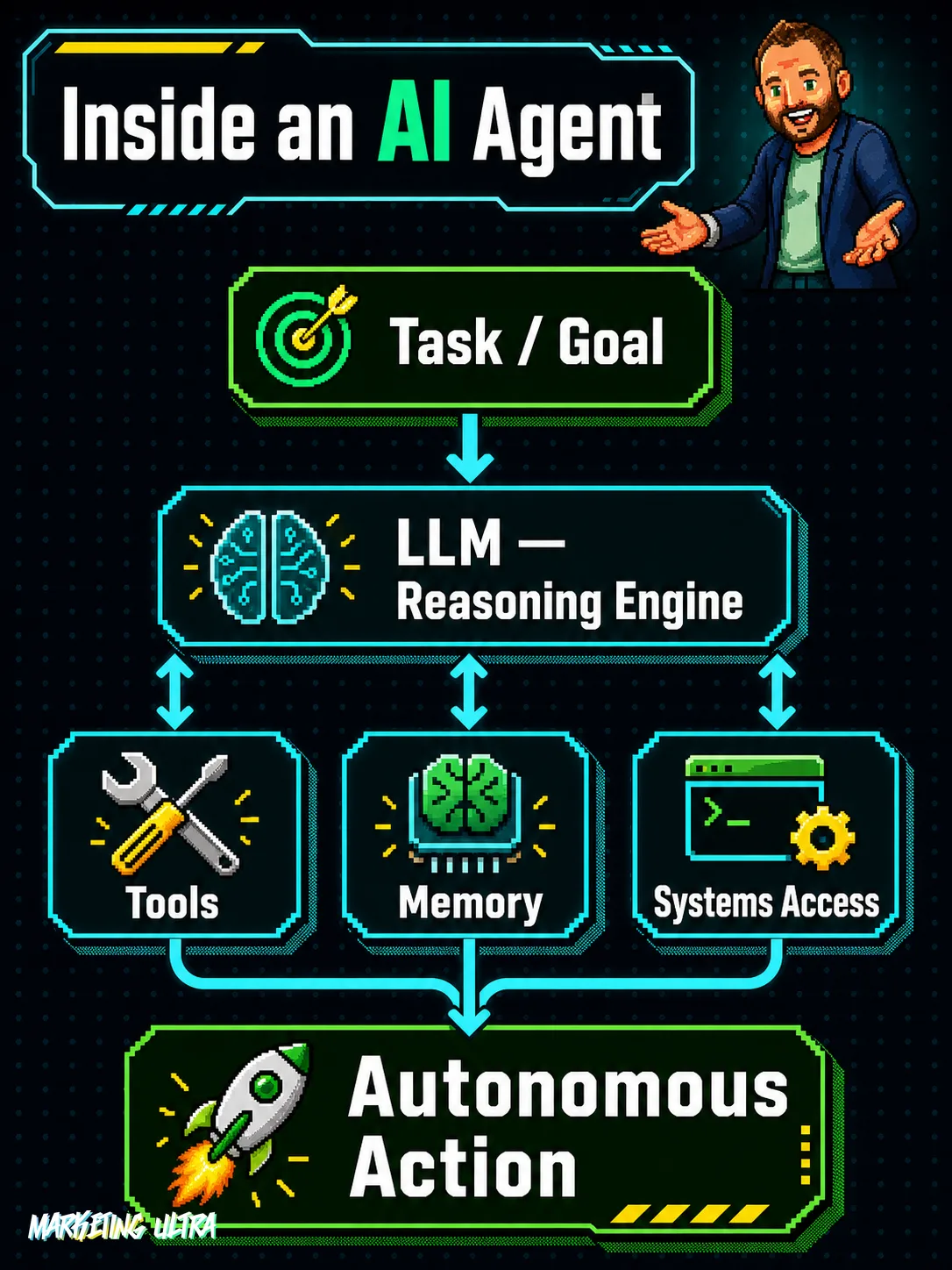
The difference from a conventional chatbot is that an agent decides WHAT to do, not just how to respond. At its core you typically find an LLM (GPT, Claude, Gemini) acting as the reasoning engine, but the LLM is just the brain. What makes it an agent is everything surrounding it: tools, memory, and access to your systems. A CRM, an ad platform, whatever you need.
This is not science fiction. It is what happens when you set up a system that checks your Google Ads account, detects an anomaly in cost per conversion, adjusts bids, and alerts you. Without you touching a thing.
As I explain in the guide to automating content with AI at scale, the key is not the technology. It is the process underneath it.
Agentic AI by the numbers in 2026
The AI agents market is growing at a compound annual rate of 46%. In figures: from $7.8 billion in 2025 to over $52 billion by 2030, according to Fortune Business Insights.
Gartner projects that 40% of enterprise applications will have integrated agents by the end of this year. In 2025, the figure was below 5%. PwC adds that 35% of organizations already report broad adoption, with 17% deploying agents at company-wide scale.
The figure that hits hardest: according to a roundup by Ecosistema Startup (aggregating data from multiple industry sources), retail companies running agents grow online sales roughly four times faster than those without. Those same estimates point to agents resolving 7 out of every 10 interactions without escalating to a human, and implementation timelines cut in half.
Impressive numbers. But there is a question almost nobody asks.
The ROI trap that reports never explain
Every report trots out the same line: returns of several dollars for every dollar invested in agents. The most bullish ones throw out multipliers that sound like an open bar. The usual consulting suspects pad in revenue uplifts to close the PowerPoint.
Sounds incredible. But compared to what?
Compared to doing nothing? To the manual process that was already working? Automation ROI inflates when the baseline is chaos. And that part never makes it into the report.
My bet is that most of that "8x ROI" comes from companies that FIRST had solid processes and THEN brought in agents. Not the other way around. If your workflow is a mess before you introduce AI, the agent will scale the mess. Faster, granted.
Agentic AI does not fix broken processes. It accelerates them.
And accelerating a broken process is the most expensive way to make mistakes. It happens more often than you would think: companies that want to "add AI" to optimize bids without being clear on which conversion they are even measuring. The result? An agent optimizing toward a phantom metric. Highly efficient. Completely useless.
Those ROI figures may well be accurate. Without context, they are dangerous. And the variable no study mentions is the quality of the process the agent is automating.
Where agentic AI makes sense, and where it does not
If you want to deploy AI agents with real returns, there are four areas where the technology is proven and the numbers add up.

Customer service is the most battle-tested case. Agents that handle requests and resolve them without escalating to a human. The autonomous resolution rates (70%) come from here.
Marketing and lead qualification. Automated research, B2B contact identification, and genuinely personalized outreach. Agentic AI intersects here with paid advertising and the sales funnel. At Marketing Ultra we have already analyzed how AI agents are transforming campaign management in practice.
Financial operations: fraud detection and analysis of data volumes that would take a human weeks to process. And supply chain: demand forecasting and inventory optimization. Less glamorous, more profitable.
Where does it NOT make sense? In any area where you do not have a clear process to automate. Buying an agent tool to "see what happens" is burning budget. Define the process, measure how it performs now. Then decide whether an agent actually improves it.
On the mindset of breaking things before you scale, I wrote something that fits here perfectly: agentic AI and learning by breaking things.
Agentic AI is not a fad. The numbers are too consistent to dismiss. But between the Gartner report and your P&L there is a gap that no technology crosses for you.
The technology is ready. The one that usually is not is the company.