Since August 2, 2026, every piece of text Claude generates carries an invisible statistical pattern. You can't see it. It doesn't change the reading experience or the quality, but it's there. And if you're using AI to produce content, Claude watermarks affect you directly: your search rankings, your credibility, and how you work with language models.

TL;DR: The no-fluff summary
- Invisible mark in the text: Anthropic biases word choices using a cryptographic key. No quality impact, no extra cost.
- Measurable SEO impact: An August 2026 study shows watermarked content ranking 5 positions lower on Google and cited half as often in AI responses.
- Removable, but paradoxically so: Deep edits and aggressive paraphrasing can erase the mark, which rewards opacity over transparency.
- Anthropic's global policy: Watermarks activated from August 2, 2026 to comply with the EU AI Act. Applies worldwide, not just in Europe.
In this article
What Are Claude Watermarks and How Do They Work?
Claude watermarks are invisible statistical patterns that Anthropic embeds in text during generation. They work by subtly biasing the model's word choices using an internal cryptographic key. You won't notice it. Neither will your reader. But a detector with that key can calculate the probability that Claude was involved in creating the text.
For images (.png, .jpg, .svg), Claude attaches provenance metadata using the C2PA standard, the same one Google uses. For text, the mark travels with the content: it survives copy-paste and light edits.
According to Anthropic, the watermark has no impact on quality or generation speed. No extra cost, no user-identifying data. On paper, clean.
The nuances matter. Detection is less reliable with short texts, technical content, or code, where word choices are constrained by the subject matter. And aggressive paraphrasing, deep edits, or full translations can weaken or erase the mark. All Claude models released from August 2, 2026 onward include it, and Anthropic is working to apply it to earlier models. The policy is global.
Claude Watermarks and SEO: The Study That Has Marketers Worried
Watermarked content ranks lower on Google. At least, that's what a First Page Sage study from August 2026 found: unwatermarked content averaged position 6, compared to position 11 for watermarked content. In AI answer surfaces, unwatermarked content was cited nearly twice as often, 12% versus 7%.
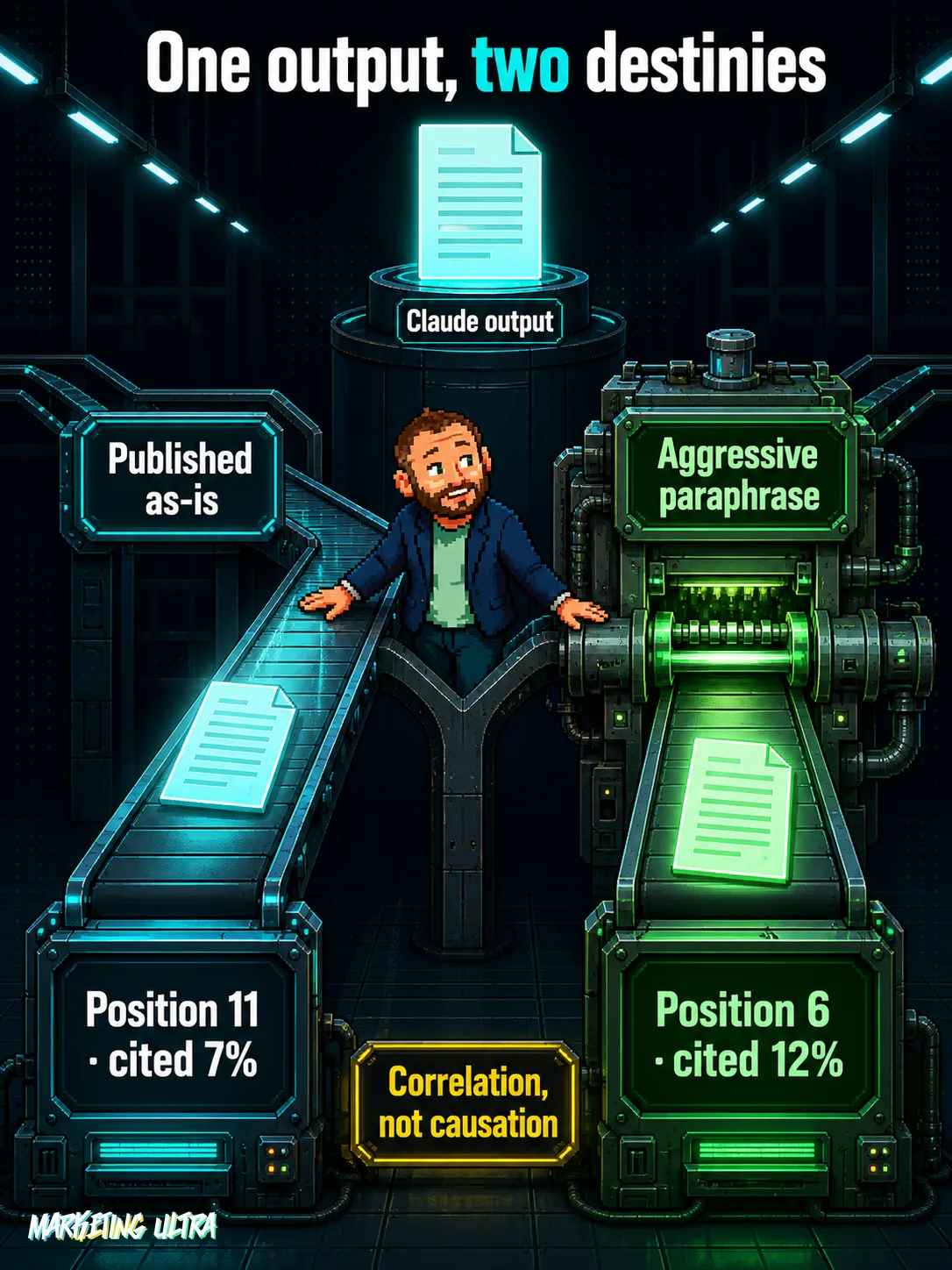
Caveat: these are correlational data points, not causal ones. Google has not confirmed it uses watermark detection as a ranking signal. But the correlation is striking enough to pay attention to if you're producing AI content at scale.
Google isn't going to "penalize" watermarked content outright. But it may increase scrutiny on sites with high volumes of AI-generated text and tighten quality filters. If your content is genuinely good, grounded in real experience, covering a unique angle, the watermark shouldn't be the deciding factor. If you're publishing filler at scale, watermarks are the least of your problems.
There's another front that concerns me more: agentic search. AI engines cite watermarked content less often. In an environment where AI share of voice depends on an LLM choosing to cite you, that 12% versus 7% gap may matter more than a few positions in traditional rankings.
Can Claude Watermarks Be Removed?
The mark survives copy-paste. It's designed to travel with the text, not stay locked inside the Claude interface.
But the internet didn't wait a week to respond. On TikTok, a video by @sabrina_ramonov with over 127,000 views showcases a tool for "cleaning" Claude-generated texts. On Hacker News, a thread with 65 points and 94 comments debates whether watermarks will expose people who use AI at work or in school.
Here's the irony: the watermark penalizes the transparent user, the one who generates a draft, edits it, and publishes, while rewarding whoever bothers to run the text through aggressive paraphrasing to erase it. That's the exact opposite of what the regulation is supposed to encourage.
Anthropic's own documentation acknowledges that significant edits can weaken or remove the mark. So yes, they can be removed. The real question is how much extra friction you're willing to add to your editorial workflow to do it.
What Claude Watermarks Mean If You Produce AI Content
I'll put my stake in the ground here. I generate articles nightly with Claude in production for Marketing Ultra's editorial pipeline. Every one of those texts, as of today, carries a watermark.

Does it concern me? Yes and no.
The correlation with search performance concerns me. The transparency aspect doesn't, I've never hidden that I use AI as a tool. But the real problem is something else entirely.
Watermarks lump together the person using Claude as a writing assistant, fixing grammar, reorganizing ideas, with the person churning out 500 pieces of filler without changing a comma. To the detector, both are "Claude-processed content." As Forbes points out: even if Claude only "polishes" a paragraph you wrote, the mark is already there. Whatever you call it, that's an attribution failure.
Worth noting too: Anthropic hasn't launched a public detection tool yet. The mark exists in the text, but only systems with Anthropic's cryptographic key can verify it. Third-party detectors that have appeared are black boxes, no auditing, no accountability.
I'll wager this design creates more problems than it solves. Not because marking AI content is a bad idea, it isn't. But because treating the person who uses Claude as an editorial assistant the same as someone using it as a spam factory is confusing the thermometer with the disease. What has always mattered is whether the text is worth reading. Who wrote it is beside the point.
My approach, for what it's worth:
- Don't obsess over removing the mark. Focus on making your content deliver something Google and LLMs don't already have: first-hand experience, proprietary data, argued opinion.
- Document your editorial process. If a human reviews, edits, and applies judgment, the watermark doesn't define authorship.
- Watch your performance metrics, but don't assume any drop is the watermark's fault. Correlation is not causation.
Claude watermarks aren't going away. Regulation is pushing in that direction and other providers will follow. If your content is genuinely valuable, the mark is irrelevant. And if it isn't, the watermark is the least of your problems.
Frequently Asked Questions About Claude Watermarks
What is the C2PA standard used in Claude watermarks?
C2PA (Coalition for Content Provenance and Authenticity) is an open standard that certifies the provenance of digital files. Claude applies it to images to sign metadata proving the file was processed by AI. Google and Adobe use it too.
Can you check if a text carries a Claude watermark?
As of August 2026, Anthropic has not launched a public detection tool. The mark exists in the text, but only systems with Anthropic's cryptographic key can verify it. Third-party detectors in circulation don't have access to that key and operate using their own statistical methods, which are less reliable.