OpenAI has just added the missing pieces to ChatGPT Ads, the ones that finally make it worth a serious agency's attention. Conversion-focused oCPC bidding, geo-exclusions, automatic budget pacing, and native integration with AppsFlyer and Adjust. The platform has gone from a curiosity to a structural competitor against Google and Meta in digital advertising. The question is no longer whether OpenAI is serious. It's whether you should be serious about it right now.

TL;DR: The no-fluff summary
- Functional parity: ChatGPT Ads now includes oCPC, geo-exclusions, automatic budget distribution, and app attribution with AppsFlyer and Adjust. The tools to run real campaigns are in place.
- Only Free and Go users see ads: paid subscribers (Plus, Pro, Business, Enterprise, Edu) get no ads. For high-ticket B2B, this is a serious limitation that almost nobody talks about.
- CTR well below Google: 0.68% average vs. Google Ads' 4-6%. Conversational intent may compensate, but efficiency data at scale simply doesn't exist yet.
- Low competition, open window: contained CPCs and few advertisers. A real advantage for those who move strategically.
What Has Changed in ChatGPT Ads (and Why It Matters Now)
ChatGPT Ads is OpenAI's advertising platform that inserts contextual ads inside ChatGPT conversations. Until recently, it was little more than a showcase with limited targeting. Now it has rolled out four major features at once that, together, make it a place where you can actually run campaigns. Not "test to see what happens", run.
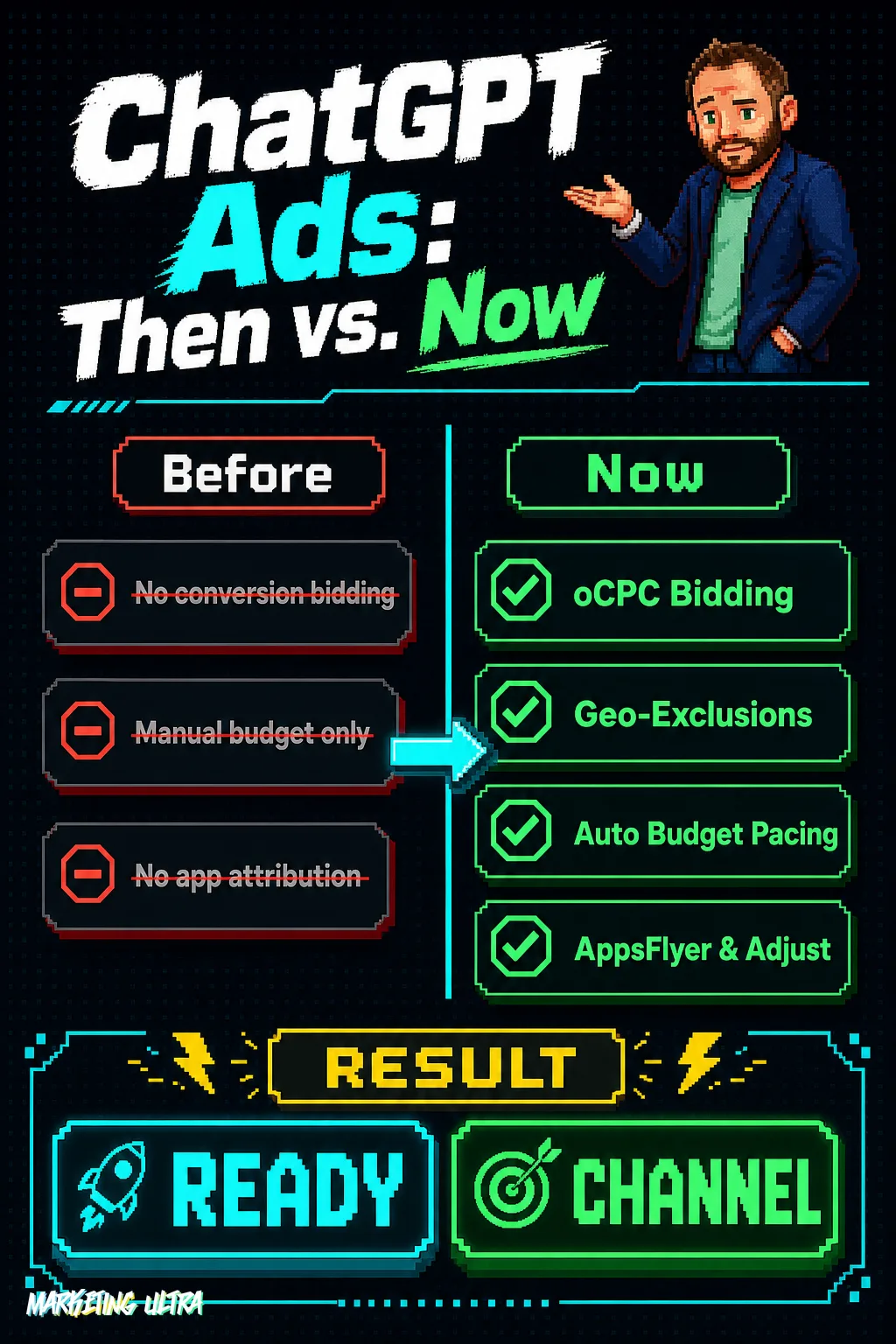
The most important is oCPC (optimized cost-per-click). The system prioritizes clicks most likely to generate a real conversion, while you still pay per click. It's the same model Google and Meta have been running for years. Alongside it come geo-exclusions, automatic budget management with daily averages across seven-day windows, and native integration with AppsFlyer and Adjust for measuring installs and in-app events.
Is it revolutionary? No. All of this has existed in Google Ads for years. And that is exactly the point. ChatGPT Ads has just reached the minimum functional parity for a paid media manager to sit down and take it seriously.
A channel. Not a toy.
ChatGPT Ads: Which Advertiser Profiles Should Pay Attention
Mobile apps, products that need explanation before purchase, and high-ticket B2B. Those are the three profiles with something to gain from ChatGPT Ads right now. But not all three with the same conviction.
Mobile apps: with AppsFlyer and Adjust integrated, you have real attribution. You can measure installs and in-app events just like any other acquisition channel. If you run user acquisition for apps, this is a channel worth testing. No excuses.
Products with high informational intent: financial services, education, consumer tech. ChatGPT users are solving a problem, not scrolling through content. If your product needs to be understood before it's bought, the conversational context works in your favor.
High-ticket B2B: this is where you need to pump the brakes. A 2026 Invoca report notes that ChatGPT generates phone leads with a 49% qualified call rate, 10 points above the average. The number sounds promising.
But there is a major catch.
ChatGPT Ads only shows ads to Free and Go plan users. Plus, Pro, Business, Enterprise, and Edu subscribers see no advertising at all. And who do you think pays for the premium tiers? Senior profiles, decision-makers, the people with actual budget to buy your high-value B2B solution.
The result: your ChatGPT ads only reach the segment that pays the least for the tool. A negative filter that neither Google nor Meta apply. For high-ticket B2B, that should concern you A LOT before you scale spend.
The Real Dilemma: When to Move Budget to ChatGPT Ads
A pilot with 5-10% of budget on the right profiles and obsessive CPA tracking from day one. That is the short answer for any agency managing someone else's money. The longer answer has more nuance.

The numbers, today, do not flatter. ChatGPT Ads' average CTR hovers around 0.68%, with the best advertisers reaching 1.57%. Compare that to Google Ads' 4-6%, and up to 7.94% in top positions. The gap is BRUTAL.
Competition on the platform is still low. Genuinely low. That is an early-mover advantage for those who get there first, but also a signal that volume is not there yet.
Few people are calculating what really matters here. The bottleneck is not the technology: it is auction density. A platform can have every feature in the book, but if there are not enough advertisers competing, the oCPC algorithm is flying blind.
Meta had exactly the same problem in its early ad years: the tools existed, but the data volume needed for machine learning to work properly took time to build up. Get in now and you get cheap CPCs with an immature algorithm. Wait, and you arrive when the algorithm is dialed in, but with more competition and higher costs.
There is no universal playbook here. It depends on how much your client can afford to pay for that learning curve. The campaign management fundamentals we cover in the complete Google Ads guide apply here too: structure, measurement, and optimization do not change just because the channel does. And if you need a benchmark, the Google Ads statistics for 2026 give you a solid reference point.
ChatGPT Ads is no longer a toy. The tools are in place and the conversational context plays in its favor. What it does NOT have is an efficiency track record anywhere close to platforms with a decade's head start.
Anyone telling you it's time to shift 30% of your Google budget to ChatGPT does not manage real accounts. Anyone telling you this has nothing to do with you is not paying attention. Start small, measure everything, and scale when the numbers say so, not when the latest guru tells you to.