For years, Google has been selling the idea that its platform "manages itself." Every update brings more automation, more AI, more promises that one button is all it takes. And some people believe it. The real problem runs deeper: a Google Ads consultant in 2026 isn't someone who clicks buttons for you, they're someone who stops Google from clicking the ones that benefit Google. Because yes, there is a conflict of interest. And no, the platform is not going to resolve it on its own.

TL;DR: The No-Fluff Summary
- Conflict of interest: Google designs its automation so you spend more, not smarter. A consultant is your counterweight.
- $850B market: Google controls 39% of global PPC, yet only 40% of SMBs compete in search. The gap is wide open for those who enter with a strategy.
- 200% ROI: two dollars back for every dollar spent, on average. Without expert management, that return erodes fast.
- Automation ≠ autopilot: Performance Max, Smart Bidding, and auto-recommendations all need human oversight. AI optimizes; the consultant decides what to optimize for.
In this article
Why You Need a Google Ads Consultant More Than Ever
A Google Ads consultant is the person who gets inside your account and makes sure every dollar works for your business, not for the algorithm. In 2026, that role matters more than ever.
Global digital ad spend will surpass $850 billion in 2026, with Google commanding 39% of the PPC market. Performance Max adoption jumped from 60% to 71% in a single year. The platform has never been more powerful. It has also never been more opaque.
Average CPC climbed to $5.26 in 2025, while the average conversion rate sits at 7.52%. That sounds decent, until you look at the ugly number: only 36% of industry professionals say they can measure ROI with any real precision. Most businesses don't actually know whether their ads are making or losing money.
On a platform moving these numbers, that should concern you.
Google Wants You on Autopilot (and Charges for the Fuel)
Google has a massive incentive for you to leave things alone. Every layer of automation, Smart Bidding, Performance Max, auto-recommendations, performs better the more you spend. The platform is built to make you spend MORE. Not smarter.
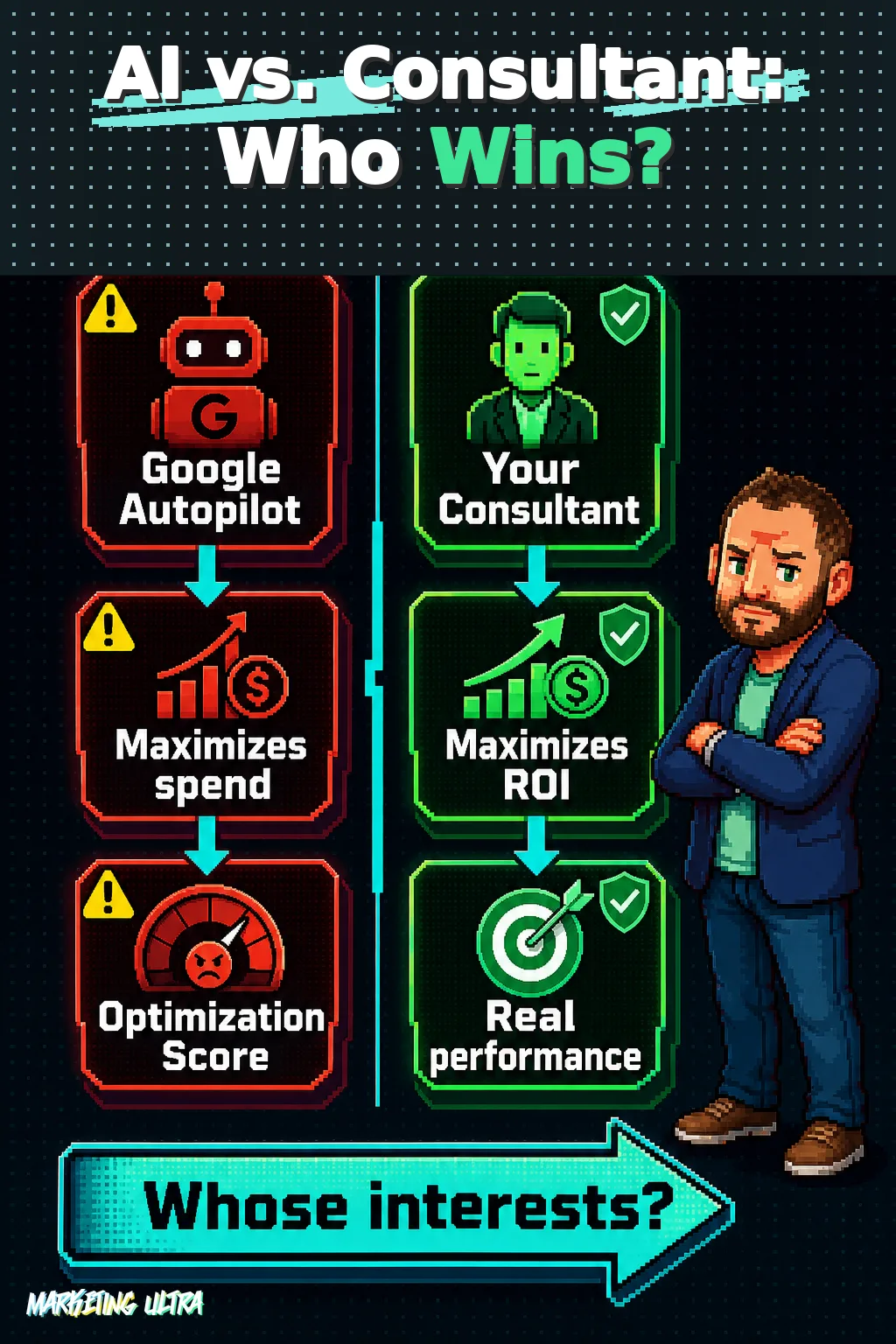
And here's the kicker: automatic recommendations are on by default. Google's account managers also have their own incentives to push you toward activating them (purely in your best interests, of course).
The Optimization Score, that grade that turns red when you don't comply, doesn't measure whether your account performs. It measures whether you're doing what the algorithm wants. As we covered with the change to budget control by ad scheduling, Google moves the goalposts quietly whenever it suits them.
Automation doesn't eliminate decisions. It hides them. Which conversion to optimize for, which audience signals to feed, which creatives to prioritize: all of that remains a human call, but now it's buried under layers of "leave it, the AI's got this."
A decision nobody makes is a decision Google makes for you. Guess whose interests it has in mind.
A good consultant knows this playbook cold. They know which recommendations to accept and which to kill before they do damage. They don't fight the AI. They put it to work.
What a Google Ads Consultant Solves That AI Cannot
Google's AI optimizes extremely well within whatever rules you set. The catch: someone has to define those rules. And that someone cannot be the AI itself.
What a consultant brings to the table that no algorithm replaces:
- Business judgment. AI maximizes conversions. A consultant asks: "Are these conversions actually moving the revenue needle?" A qualified lead is not the same as a form filled out of idle curiosity. The difference between a 200% ROAS and a 50% ROAS usually lives there, not in the bidding strategy.
- A check on the platform. As I break down in the complete Google Ads guide, the platform has its own commercial interests. A consultant is your advocate in that game.
- Cross-channel perspective. With projections placing AI Overviews in 47% of queries and an average 12% drop in organic CTR, paid strategy cannot exist in a silo from SEO. A consultant connects those dots. A Google account manager does not.
And the stat that stings most: only 40% of SMBs invest in search advertising. That leaves a wide-open lane for anyone who enters the space with a plan. The average Google Ads ROI is 200%: two dollars back for every one spent. But that "average" hides a vast gap between those who manage with intent and those who leave the account on God Mode.
When to Hire a Google Ads Consultant
The clearest signal: if you can't explain why your account is spending what it's spending, you need help. If you don't know which bidding strategy is currently active, you need help. If Google calls to "optimize" your account and you agree to everything, you need help, urgently.

You don't need a full-time consultant. Sometimes a quarterly audit covering structure, bidding, audience segmentation, and the quality of signals you're feeding the algorithm is enough. A consultant's cost is measured in audit hours. The cost of not having one is measured in burned budget and decisions the algorithm made while you weren't looking.
According to the Google Ads statistics for 2026, users who click on ads are 50% more likely to buy than organic visitors. The opportunity is right there. The question is whether your business manages it, or Google does.
Google Ads in 2026 is a brilliant system. It also plays for Google. A good Google Ads consultant doesn't fight that: they understand it and make sure the upside stays in your business, not in Mountain View. If your account has gone months without anyone questioning it, you're not saving on consultancy. You're handing over the wheel.