Shopify just dropped its Spring 2026 Edition with over 150 new features. One hundred and fifty. When someone throws a package that size at you all at once, they have either been working extremely hard or they are burying you in noise so you miss what actually matters. I went through every update and here is what deserves your attention.

TL;DR: The No-Fluff Summary
- Agentic commerce: Shopify Catalog structures your products so AI assistants can find, compare, and sell them. Catalog-powered searches convert twice as well as scraping-based ones.
- Redesigned checkout: single page, less scrolling on mobile, 21.8% higher conversion than the previous multi-step checkout.
- Campaign Autopilot: AI that plans, runs, and optimizes campaigns across Meta, email, and Shop. Powerful, but it needs human oversight.
- Native A/B tests: finally compare versions of your store and checkout without third-party tools.
Shopify Catalog and Agentic Commerce: Your Products Talk to AIs
Shopify Catalog is a system that uses language models to organize your store's product data and make it readable by AI shopping agents. In plain English: when someone asks ChatGPT or Perplexity "find me trail running shoes in a size 9 under $120," your product can show up, get compared, and get purchased, without the user ever visiting your site.
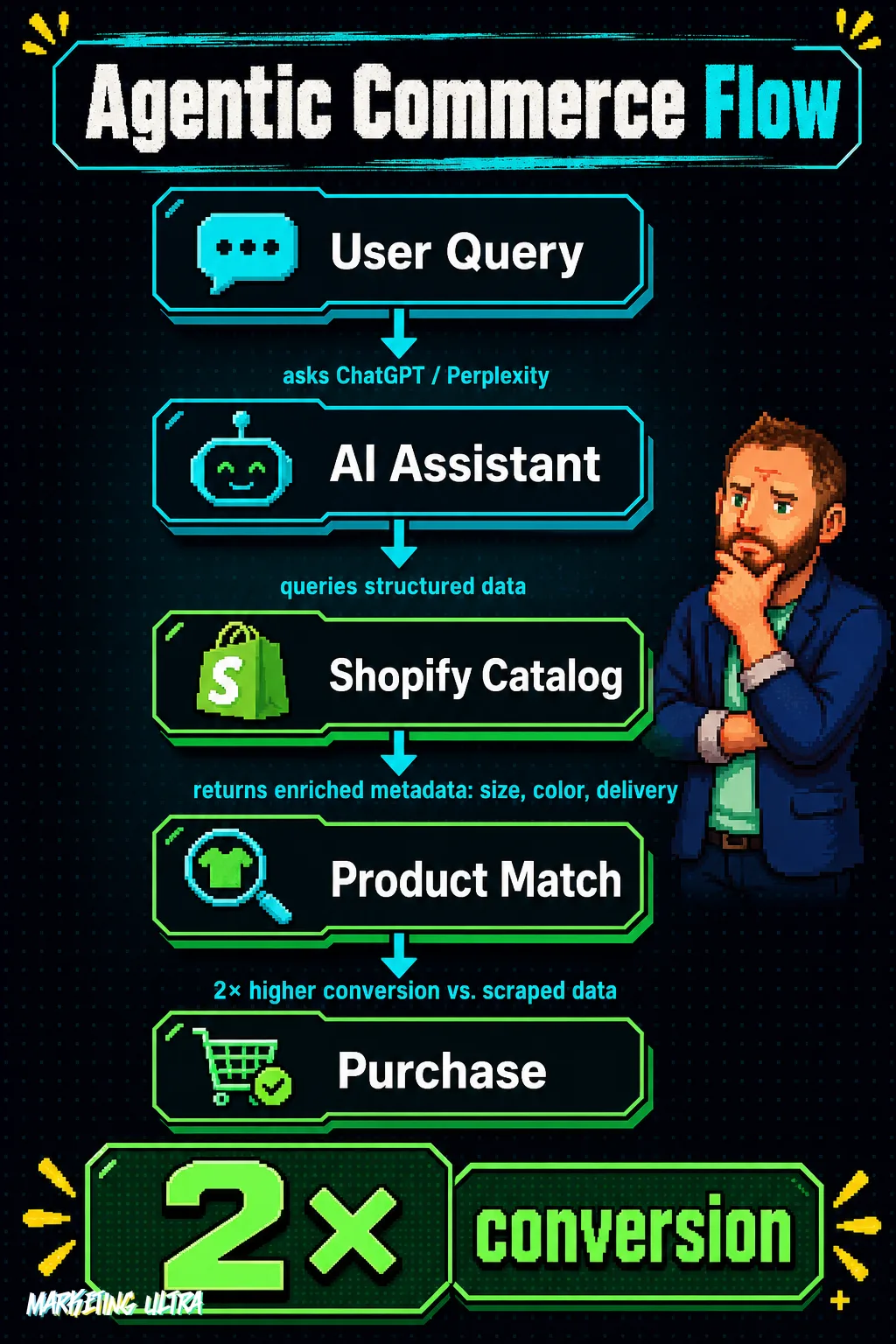
Shopify calls this "agentic commerce," and the numbers are compelling: AI searches powered by Catalog convert twice as well as those using scraped data. The system includes image search, multimodal search (text + image), and enriched metadata: size, color, estimated delivery.
What does this mean for you? That classic SEO is no longer the only discovery channel. AI assistants are a new storefront, and if your product listings are not optimized for an LLM to understand them, rich metadata, quality images, clear descriptions, they will be ignored the same way Google ignores an unindexed page. We covered how to prepare your content for AI discovery in our article on AEO.
My read: Shopify is positioning itself as the data layer that feeds every AI agent in the market. That is a pure platform play. Whoever controls how product data is structured for AI controls the funnel from the very top. This is the real headline of this edition, even if it is not the flashiest.
The Redesigned Checkout and a Number That Hurts
Shopify's new single-page checkout converts 21.8% better than the previous multi-step version. That is the difference between losing most of your carts and actually recovering real sales.
What changed? A more compact design, less scrolling on mobile, easy-to-scan shipping options, and a payment button that does not hide. Branding is now unified across checkout, customer account, and login pages. It sounds obvious, but visual consistency through the payment flow is still an open question for most stores.
Shop Pay is also expanding beyond the Shopify storefront and now reaches over 250 million shoppers. Roughly 7% of users abandon a purchase because they cannot find their preferred payment method. Every option you add is direct conversion you recover.
Worth noting: a clean checkout does not save a weak value proposition. If your product is not compelling, it does not matter how smooth the payment flow is. But if your product already sells and your checkout is a minefield on mobile, there is money sitting on the table here.
Campaign Autopilot: The Autopilot Promise (Again)
Campaign Autopilot is Shopify's push to automate multichannel marketing with AI. It plans and launches campaigns across Meta, Shop, and email, adjusting budgets and creatives on the fly. More channels are coming, ChatGPT Ads and Microsoft Advertising among them.
Sound familiar? It should. It is the same promise ad platforms have been making for years: "let AI handle it and focus on strategy." We covered this pattern with Google Ads Ask Advisor and the story repeats itself: the platform managing your budget is the same one deciding how to spend it.
I am not saying it does not work. I am saying that autopilot without oversight is the perfect recipe for burning through budget without noticing. Automation tools work when there is a professional behind them who understands what the machine is doing and why. Without that, you are handing business decisions to an algorithm whose incentives do not always align with yours.
Natural-language audience segmentation and AI-generated email copy are useful additions. But AI writing subject lines does not replace someone who actually knows their audience. It is an accelerator, not a replacement. For the record.
Native Analytics and A/B Tests: The Feature Nobody Is Celebrating
Shopify is expanding its analytics dashboards with new charts, daily insights, annotations, and ShopifyQL Notebooks for advanced queries. The interesting part is elsewhere: native A/B tests for store pages and checkout.

Being able to compare versions of a product page or payment flow without relying on third-party tools is a real day-to-day change. Design decisions grounded in your own data, not assumptions or the boss's gut feeling that "the green button looks better."
The native analytics? My bet is these improved dashboards still fall short on multichannel attribution and true profitability. That has historically been their weak spot. Better-looking charts are not the same as truly understanding which channel is driving margin. But native A/B tests solve a real problem. If you could only activate one feature from this entire edition, that would be my pick.
Availability (check your dashboard before enabling anything)
Shopify announces this edition as globally available in GA for all merchants. However, the official source does not specify whether every feature is live in every market. Availability cannot be confirmed or ruled out until Shopify provides explicit detail by region. Before enabling anything, check your Shopify admin to see which features are active for your store.
150 features sounds like a lot. It is. But the underlying move in this Shopify Spring 2026 Edition is one: taking over AI discovery. If you are not preparing your product listings for that, you are already behind.
Shopify is betting hard on becoming the invisible infrastructure of AI commerce. The question is not whether this affects you. The question is whether you are going to steer it, or let the algorithm decide for you.
Frequently Asked Questions About Shopify Spring 2026
What is ShopifyQL Notebooks?
ShopifyQL Notebooks is a data query tool built into Shopify that lets you write custom queries, in a proprietary language called ShopifyQL, to explore sales metrics, inventory, and customer behavior. It is designed for advanced users who need analysis that standard dashboards do not cover.
What is Shop Pay and how is it different from other payment methods?
Shop Pay is Shopify's accelerated checkout that lets customers buy with a single click, without filling in forms for every purchase. Unlike generic payment gateways, it stores buyer data within the Shopify ecosystem and now works outside Shopify stores too, reaching over 250 million users.