Google is no longer content with driving users to real estate portals. Now it wants to be the portal itself. Enhanced Local Services Ads for real estate have reached general availability in the United States: a Google Ads format that displays property listings, photo, price, and location, directly in local search results. All without leaving Google. And no, it is not available in Europe yet.

TL;DR: The No-Fluff Summary
- Enhanced LSA for real estate: Google now lets agencies and property portals display listings, photo, price, address, directly in local search results. Available in the US only.
- Shift in model: traditional LSA sell professional services (plumbers, lawyers); Enhanced LSA sell specific products (apartments, homes). Google has moved from brokering people to brokering inventory.
- Signal for Europe: it follows the same playbook as Google Flights, Hotels, and Shopping, verticalize results to capture value. Real estate is just the opening move.
- Spain / EU: not available. No launch date announced. But formats that work in the US always make their way across the pond.
What Are Enhanced Local Services Ads for Real Estate?
Enhanced Local Services Ads for real estate are an evolution of Google's Local Services Ads that lets agencies and property portals display listings directly in local search results. Instead of showing a professional's profile, name, reviews, phone number, the Enhanced format surfaces the property itself: photo, price, location, and key details.
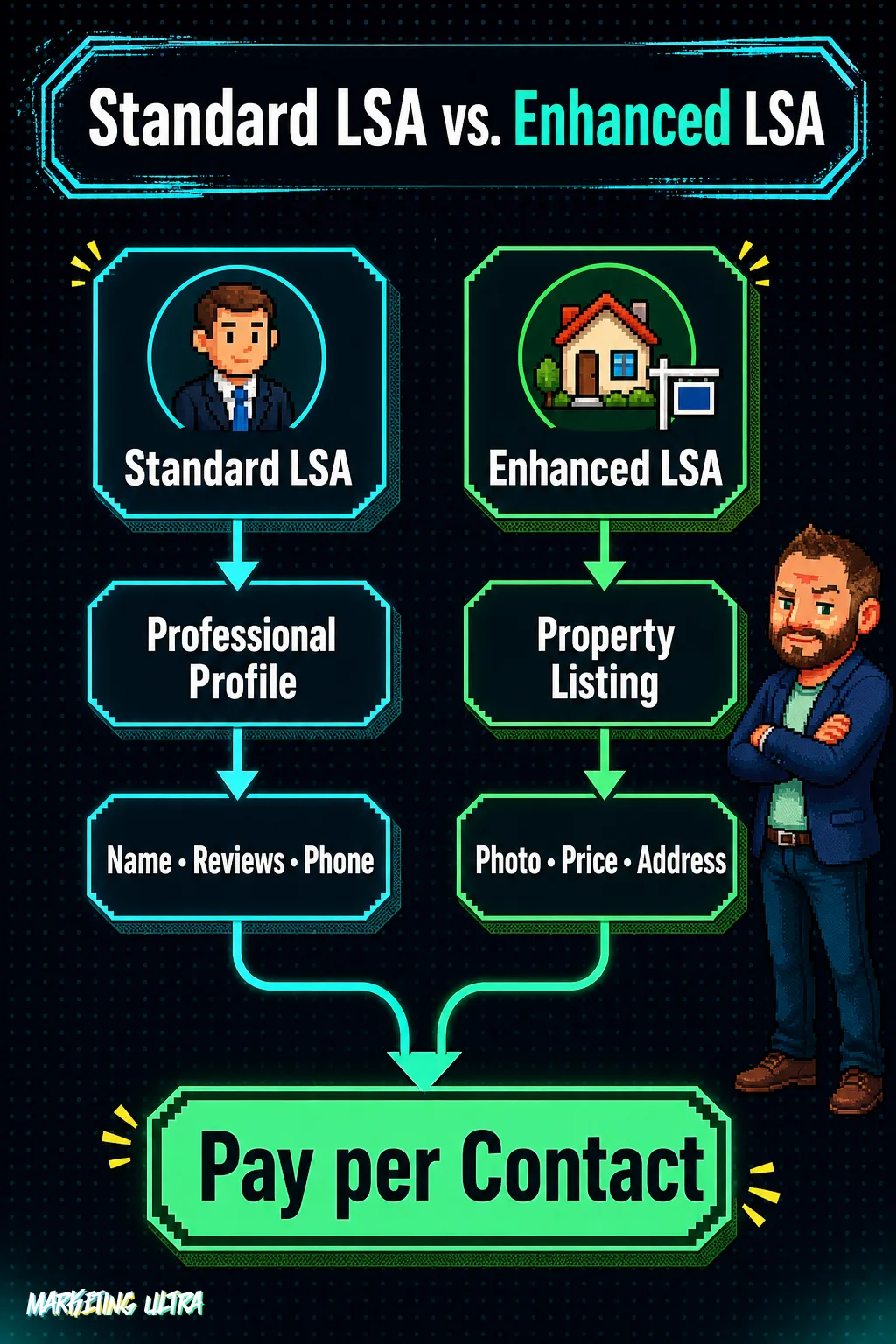
The difference from a standard LSA is substantial. Traditional Local Services Ads sell a service: "this plumber is nearby and has great ratings, give them a call." Enhanced LSA for real estate sell a specific product: "this three-bedroom home in Austin is listed at $450,000, here is the photo." Google has shifted from brokering professionals to brokering inventory.
The format has reached general availability (GA) for real estate advertisers based in the United States, according to the official Google Ads blog announcement.
Geographic Availability (June 2026)
- United States: available (GA) for real estate advertisers.
- Spain / European Economic Area: not available.
Source: official Google Ads blog.
How Enhanced LSA Differ from Standard Local Services Ads
The core difference is what gets advertised: standard LSA surface a professional profile; Enhanced LSA for real estate surface a specific property. That shift changes the entire model.
Standard LSA have been running for years across plumbers, electricians, lawyers, and other local services. Pay per contact: the advertiser pays when they receive a call or message. Priority placement above text ads. Google's verification badge as a trust signal. For professional services, they work.
Enhanced LSA for real estate keep that priority placement but change what gets advertised. Instead of a verified professional, you get a property listing. And that matters:
- Structured catalog: the advertiser needs a property feed, not a business profile. The same logic as Google Shopping, applied to homes.
- The user sees the product before clicking: photo, price, address. The decision to reach out is made right on the SERP.
- Direct transactional intent: Google intercepts the home buyer at the moment of search and serves a result they used to find only on Zillow or Realtor.com.
You know what happens when Google builds a product storefront inside its own results? The portals that used to live off that traffic start sweating. Take note.
For the paid media professional, this opens a new front. If your client is a real estate agency operating in the US, Enhanced LSA are the format that will capture the most valuable purchase intent. If you are operating outside the US, now is the time to watch and get your catalogs ready. Because when Google opens a format to a vertical, it rarely closes it.
Google Verticalizes: Why Real Estate Is Just the Beginning
Google has spent a decade verticalizing search results, and real estate was the missing piece. Google Flights, Google Hotels, Google Shopping. Always the same playbook: build the storefront inside the SERP so the user never has to leave to find what they need.

Why real estate now? Because anyone who manages paid media knows that real estate keywords compete for some of the highest CPCs in the entire Google Ads ecosystem. A single qualified lead in the housing sector can be worth hundreds of dollars. Google sees those numbers and thinks: why settle for selling plain-text clicks when I can build a listings marketplace and charge per direct contact?
My money is on this move not staying limited to the US or to real estate. If the numbers add up, and in a vertical with those margins, they will, we will see Enhanced LSA in automotive, insurance, and financial services. And whatever else gets in the way. The same path Google Shopping took: starts as an experiment, ends up as the standard. For those of us managing accounts in Google Ads expert mode, the writing is on the wall: Google is not just competing with Meta or TikTok for ad spend. It is competing with Zillow, with Idealista, with insurance comparison sites. And it does so from the most advantageous position of all, being the place where every search begins.
In my experience managing campaigns, every time Google launches a vertical format, the effect is the same: advertisers who move early capture cheap inventory, while latecomers pay three times as much. Enhanced LSA are going to work, I am calling it now. Will you be there when the door opens?
Today, Enhanced LSA for real estate do not exist outside the United States. They are not available in Spain or anywhere in the European Economic Area. Google has not announced an expansion timeline. But formats that perform in the US always make their way across the pond, late, with regulatory adjustments, sometimes scaled back. But they arrive. And when they land in Europe, portals like Idealista or Fotocasa will have to decide whether to play within Google's ecosystem or brace for a loss in visibility. Exactly what happened to travel agencies when Google Flights showed up.
Google does not launch formats on a whim. Where there is margin in a vertical, it moves in. For those of us working in paid media outside the US, the plan is straightforward: understand where this is heading and get the catalogs ready. Because when Google decides to move in on a vertical, it does not warn you twice.