Have you ever called a customer support line and felt the urge to hurl your phone out the window? "Press 1 for sales, press 2 for billing, press 47 to speak with someone who actually has a pulse." OpenAI has just moved GPT-Live-1, a full-duplex voice API that listens and speaks simultaneously, just like a real person on the phone, into general availability. And that, at least on paper, should put the phone tree out to pasture for good.

TL;DR: The No-Fluff Summary
- Truly full-duplex: GPT-Live-1 merges listening, reasoning, and speech into a single model. No more chaining three systems with latency baked in between.
- $0.05/minute: voice session cost, billed by the second. The reasoning model is charged separately.
- Developers only: this is not a plugin or a button. You need code, integration, and someone who knows what they are doing.
- EU availability unconfirmed: OpenAI has not confirmed availability in the EU as of today.
In this article
Availability in the EU: Unconfirmed
The source does not confirm availability in the EU. Phase: general availability (GA). Eligibility: API developers.
What Is GPT-Live-1 and What Does True Full-Duplex Actually Mean?
GPT-Live-1 is OpenAI's new real-time voice API, and its defining feature is collapsing three previously separate stages into a single model: speech-to-text transcription, reasoning, and text-to-speech synthesis.
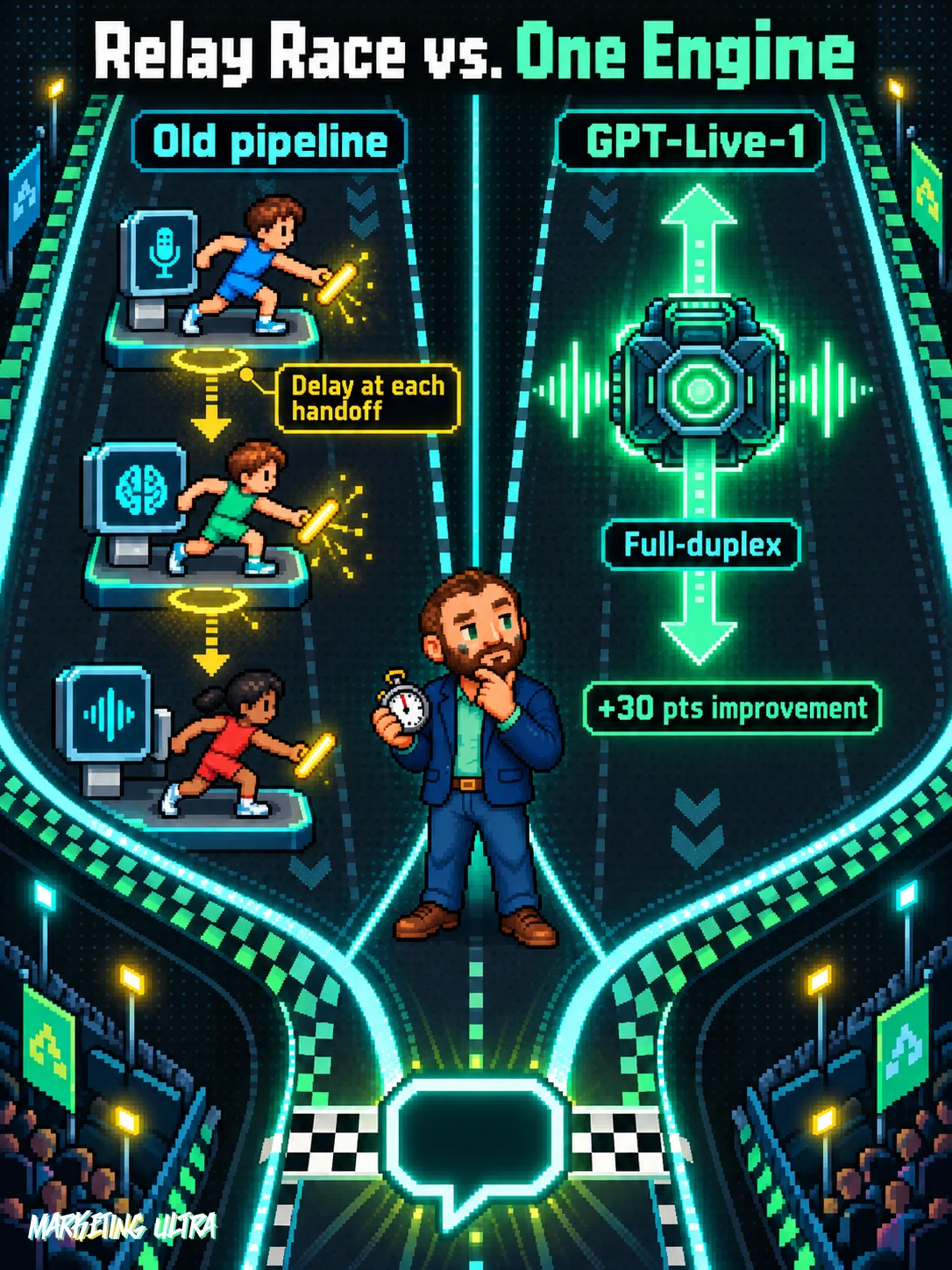
Until now, building a voice AI agent meant running a relay race: one system listens and hands the baton to one that thinks, which hands it to one that speaks.
Every handoff adds latency. And that latency is exactly what makes talking to a bot feel like talking to a bot.
The difference? Full-duplex. The model can listen while it speaks. Interrupt it and it stops, processes, and picks back up without losing the thread. It filters background noise. It handles topic shifts without resetting. This is not a walkie-talkie waiting its turn, it is an actual conversation.
According to data published by OpenAI, GPT-Live-1 improves by 30 points over GPT-Realtime-2.1 when paired with GPT-6 Astra as the reasoning model at medium effort. The voice session cost: $0.05 per minute, billed by the second. The reasoning model and tools are charged separately.
That does not sound expensive. But pay attention: the real cost of a voice agent is NEVER just the API.
What Can Your Brand Do With GPT-Live-1?
The most obvious application is retiring the IVR as we know it. Instead of rigid numbered menus, a real dialogue where you explain what you need and the system actually understands. No more "I did not understand your response." No more starting over. This is the use case that will have the biggest impact on end users, and the one that was most overdue.
But there is more. Automated customer service with agents that look up orders, handle tickets, and respond to interruptions without breaking. Yelp is already testing Yelp Host for managing restaurant reservations. Hatch is scheduling home repair appointments using voice agents built on this same API.
And on the internal side: branded voice assistants for teams. A tool that captures notes, retrieves product information, or manages bookings, all through speech, with a system that does not require you to spell out every word. Developers control tone and style through the system prompt.
Does it sound good? Yes. Can you have it running by tomorrow? Not so fast.
GPT-Live-1 Is Not for Marketers (Yet)
GPT-Live-1 is a developer API. Full stop. It is not a plugin, not a button in your CRM, not a new tab in any dashboard.
You need code, telephony infrastructure integration, and someone who knows how to configure the system prompt so the agent sounds like your brand, not a generic assistant.
Migrating from the previous Realtime API is not straightforward either. Swapping the model name is not enough, it means updating prompts, tools, and removing the manual turn-taking logic you were previously managing yourself. OpenAI has made clear this is an architectural change, not a rename.
And the detail that matters if you are reading this from Europe: EU availability has not been confirmed by OpenAI's official source. The phase is GA (general availability), but there is no explicit mention of Europe. If you are planning anything with this from a European account, verify directly before assuming anything.
The Real Opportunity GPT-Live-1 Creates for Agencies
My bet is that the real impact of GPT-Live-1 will come through the products built on top of it. Agencies will feel it downstream.

Between "API available" and "product a marketing team can integrate without a CTO standing next to them" there is a development gap that, in my experience, does not close in a matter of months. It always works the same way: first the technology, then the products, and finally those of us who use them.
What does change is the conversation. Until now, pitching a voice agent service to a client meant explaining why it sounded off and why it got confused when interrupted. Those objections just got a lot harder to make.
The technology is no longer the excuse. What remains is the real work: designing the experience and integrating client data so the agent actually delivers value.
Those already working with AI agents applied to campaigns and marketing have a head start here. They have spent time designing and testing agents. That is a real advantage.
GPT-Live-1 is a genuine technical leap. Conversational IVRs are about to stop being a concept and start being a product. But the hard part remains what it always has been: making it work for your specific business without an in-house engineering team.
Anyone telling you this can be set up in an afternoon is lying.
Frequently Asked Questions About GPT-Live-1
What does a minute of conversation with GPT-Live-1 actually cost?
The voice session costs $0.05 per minute, billed by the second. The total cost also includes the reasoning model (such as GPT-6 Astra), any tool calls the agent makes during the conversation, and telephony infrastructure. At high call volume, the real per-minute cost can end up noticeably higher than the base API rate.
What does a company need to integrate GPT-Live-1?
A development team with voice API experience, compatible telephony infrastructure, and the ability to design the system prompt that defines the agent's personality and behavior. There is no visual interface or no-code setup: integration is 100% programmatic.