Ask an AI what people are saying RIGHT NOW and you often get a mix of Google results, stale knowledge, and four links with no context. Last 30 Days collects recent conversations from Reddit, X, YouTube, TikTok, Hacker News, GitHub, and other sources, ranks them by engagement, and makes the agent turn them into linked research. It is open source, works in Claude Code, Codex, and other agents, and has one unusually valuable habit: it also tells you when a source failed.

TL;DR: The No-Nonsense Summary
- What it is: a recent-research skill that searches several communities at once and scores evidence by votes, comments, views, and other public signals.
- What it adds: it goes beyond headlines by collecting comments, transcripts, and GitHub activity for the agent to compare.
- What works for free: Reddit, Hacker News, Polymarket, and GitHub start without keys. Everything else depends on optional tools, accounts, or APIs.
- The score: 8.5/10. It is extraordinary when it finds good signal, but the report still needs judgment and external sources still fail.

I use it as an enrichment step for articles because I want the community's real pulse, not just the editorial result. It saves me from opening twenty tabs, but I do not publish its conclusions blindly: you still have to review the signal and separate what matters from the noise.
DaniIn this article
| Field | Details |
|---|---|
| Project | mvanhorn/last30days-skill |
| License | MIT |
| Reviewed state | Version 3.24.0; 61,966 stars; 5,408 forks; reviewed September 13, 2026 |
| Keyless start | Reddit, Hacker News, Polymarket, and GitHub |
| Available sources | 18 documented source types, with several optional and configuration-dependent integrations |
| Hosts | Claude Code, Codex, Cursor, Copilot, Gemini CLI, and other Agent Skills hosts |
This tool is included in these collections: Skills for Claude Code, Codex and Coding Agents by Task · AI Agent Resources for Marketing by Task
The Problem It Solves
Google is good at finding pages. It is less useful when the question is what a community thinks this week, which comment changed a conversation, or which objection keeps appearing under three different videos. The platforms do not help either: each keeps its searches, metrics, and formats behind a different door.
Last 30 Days acts as the bridge. It launches several searches, retrieves posts and comments, extracts transcripts when possible, and gives the agent an evidence block with dates, links, and engagement signals. The agent then judges which patterns deserve to make the summary.
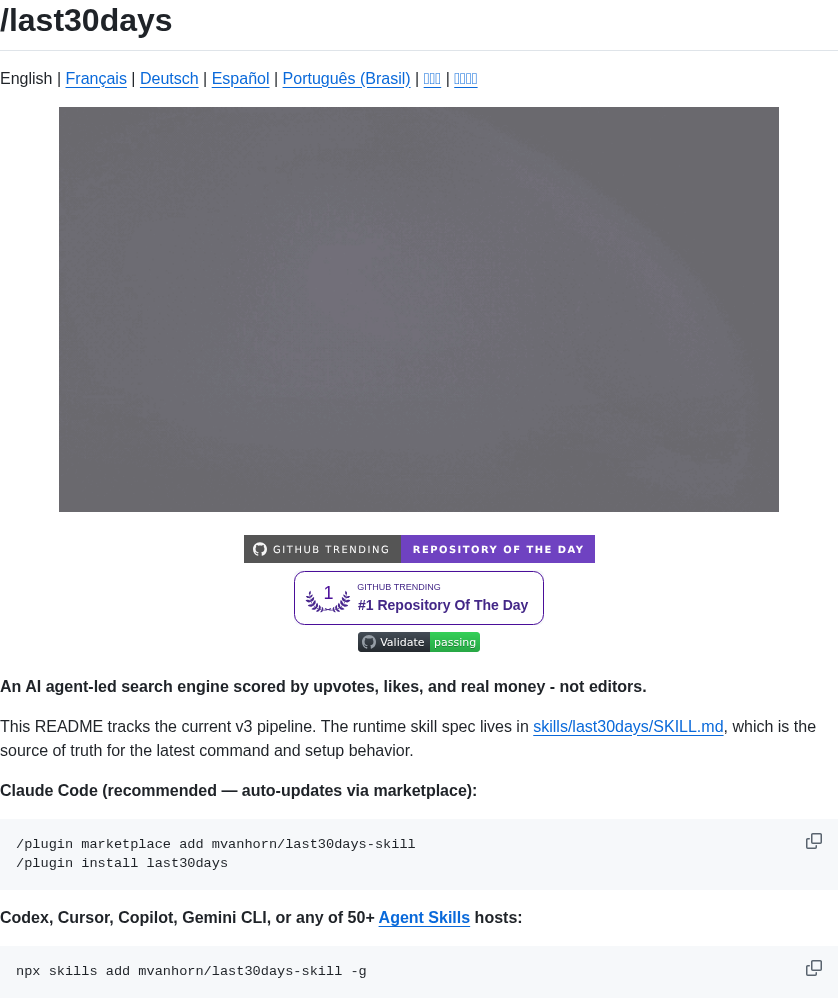
Engagement helps prioritize. It does NOT turn a popular opinion into truth. A comment with 2,000 votes may capture a community's mood and still be wrong. The tool sorts signals; editorial judgment remains outside the code.
Getting Started
For Claude Code, the project recommends installing the marketplace and then the plugin:
/plugin marketplace add mvanhorn/last30days-skill
/plugin install last30days
For Codex, Cursor, Copilot, Gemini CLI, and other compatible hosts, the general route is:
npx skills add mvanhorn/last30days-skill -gThe engine needs Python 3.12 or newer. Reddit, Hacker News, Polymarket, and GitHub can run without keys. YouTube relies on yt-dlp; TikTok and Instagram need ScrapeCreators; X supports several authentication paths; and paid web search or synthesis is optional.
That means “zero configuration” describes the floor, not the complete product.
Paste it into Claude Code, Codex, or whichever agent has the skill installed:
Run /last30days on “what people in my industry are saying about AI agents”. Separate confirmed findings, opinions, and noise. Include links to the original posts and flag any source that fails or returns partial coverage.
For product research, add the exact name, repository, or official account. It prevents a generic word from filling the report with namesakes.
Using It in Real Marketing
The clearest use case is preparing a piece where the conversation matters as much as the documentation. A launch, a comparison, a prospect meeting, or a trend that has not yet reached the usual articles.
It already forms part of Marketing Ultra's editorial enrichment. The point is not to paste twenty quotes into a post. The point is to detect a tension, check whether it appears in more than one community, and follow the link to the original source before writing.
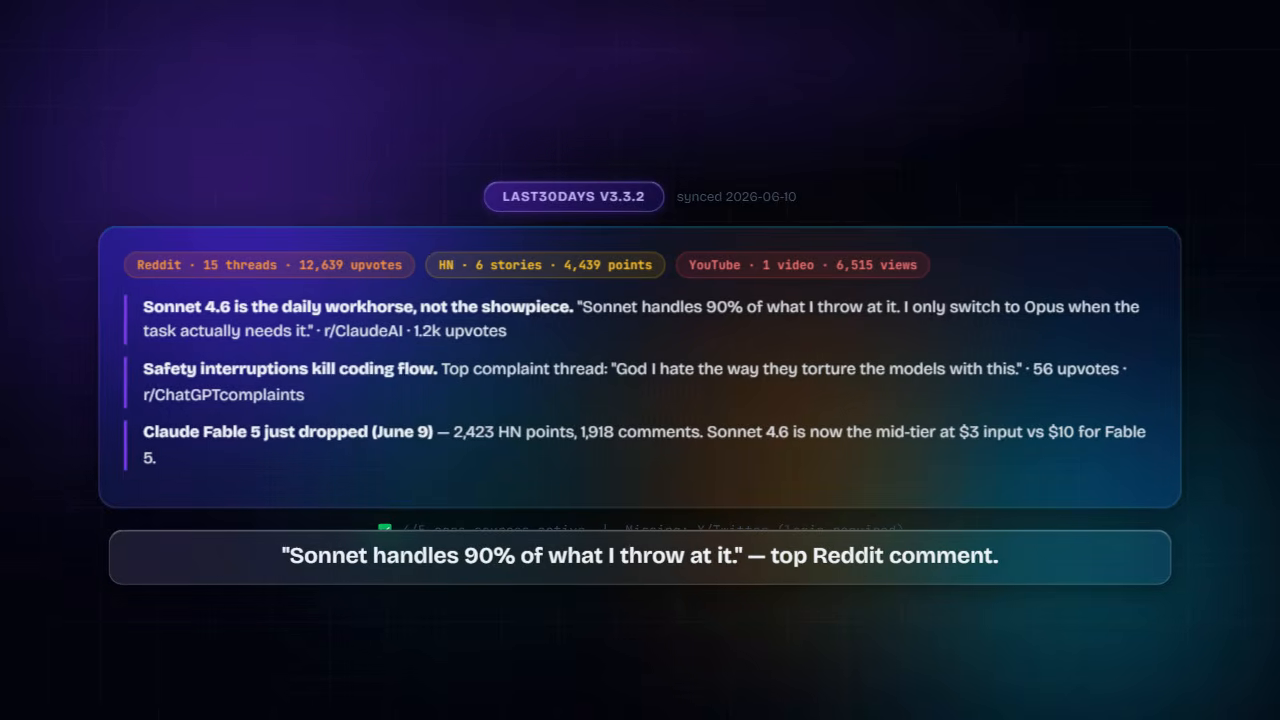
For this review, the skill was run on Last 30 Days itself. It found the current repository, recent uses on X and TikTok, and one Reddit conversation. It also returned an unrelated YouTube video, left Reddit and Instagram with partial coverage, and hit an error on LinkedIn.
That is the most useful proof of all: the system saves a huge amount of searching, but it does not remove review. If you copy the summary without opening the sources, you have only automated blind trust.
Watch “This AI Skill Hit 38,000 Stars: Here's Why”, by Prompt Engineer
What They Don't Tell You
The first drawback is size. Version 3.24.0 documents 18 source types and its operating contract is more than 2,300 lines long. It has comparison and discovery modes, a library, topic queues, optional sources, and several authentication backends. That is power. It is also a large failure surface.
The second is that an “available” source is not guaranteed to respond well today. The repository itself has open issues covering LinkedIn and Instagram. This review's test produced those exact symptoms. The tool reports them in its output, which is the right behavior, but the user must read the warning.
The third is privacy. The project has no built-in analytics or tracking and saves reports locally. Even so, queries travel to whichever services you enable: Reddit, X, ScrapeCreators, search APIs, or an optional remote backend. “Stays on your machine” describes saved files and local mode; it does not mean internet research sends no requests to third parties.
There is a security question too. The engine consumes untrusted social text and hands it to another model. The project includes defenses against malicious instructions, but it still has open issues about untrusted-content escapes and directives embedded in output. That is not a reason to dismiss it. It is a reason to stay updated and never execute whatever a retrieved post says.
What People Say
The recent signal is positive, although advanced-user enthusiasm still outweighs long, independent evaluation.
My grok @bot is a workflow machine. I use @mvanhorn 30 days skill to research, that is where all the day starts.
Cada vez uso más el skill de @slashlast30days de @mvanhorn. Recomendado.
The counterpoint appears in the repository itself. Issue #1086 on LinkedIn and issue #1020 on Instagram describe sources that could end with zero results or 404 responses. The project moves extremely fast, but speed does not remove the fragility of depending on external platforms.
Verdict
Last 30 Days deserves the 8.5/10 score it keeps in the collection. It solves boring, expensive work: finding recent conversations, opening comments, checking metrics, and gathering everything with traceability. For content, sales research, and trend monitoring, it is a serious tool.
It does not score higher because the output still needs editing, some sources require external accounts or services, and a run can mix excellent signal with obvious noise. The tool gives you radar. It does not give you judgment.
If you already work with coding agents, it is worth installing. If you want a button-driven app with no terminal, this is not it.
Frequently Asked Questions About Last 30 Days
Is Last 30 Days really free?
The code is MIT licensed and the base sources can be used without paying. X, TikTok, Instagram, LinkedIn, and some backends depend on credentials, tools, or services that may have limits and costs.
Which sources work without an API key?
The current documentation lists Reddit, Hacker News, Polymarket, and GitHub as the keyless starting set. YouTube can work through yt-dlp, but that tool still has to be installed.
Does it work with Codex?
Yes. Install it as an Agent Skill with npx skills add mvanhorn/last30days-skill -g. It also supports Claude Code, Cursor, Copilot, Gemini CLI, and other compatible hosts.
Does it always research exactly the last 30 days?
That is the default window for recent signal. Some sources may degrade, return no results, or retain useful material outside the window when nothing else exists, and the report should disclose it.
Can I publish the summary as written?
You should not. Open the important sources, verify quotes, separate popularity from truth, and read every coverage warning. The summary is research material, not an automatic editorial signature.