August 2, 2026 was when the EU AI Act's transparency obligations kicked in. Two weeks. You've been operating under new rules for two weeks, and I'd bet you haven't touched a single setting in your Google Ads account. Article 50 of the AI Act affects how PMax generates your ads, how you label creatives in Asset Studio, and what you must disclose to users about the content you serve them. Here's the consultant checklist that should be on your desk right now.

TL;DR: The no-fluff summary
- Article 50 is live: since August 2, all AI-generated advertising content must carry a machine-readable label identifying it as such.
- You are responsible: Google is the AI system provider, but the advertiser ("deployer") is accountable for the content they publish.
- PMax, the problem: the black box generates creatives you don't fully control, but you're legally on the hook for them.
- Penalties: up to €15 million or 3% of global turnover for breaching transparency obligations.
In this article
What Does Article 50 Actually Require from Digital Advertising?
Article 50 of Regulation (EU) 2024/1689 requires that all AI-generated or AI-manipulated content be labeled in a machine-readable format and detectable as artificial. Images, videos, audio, and text. No exemptions for advertising.
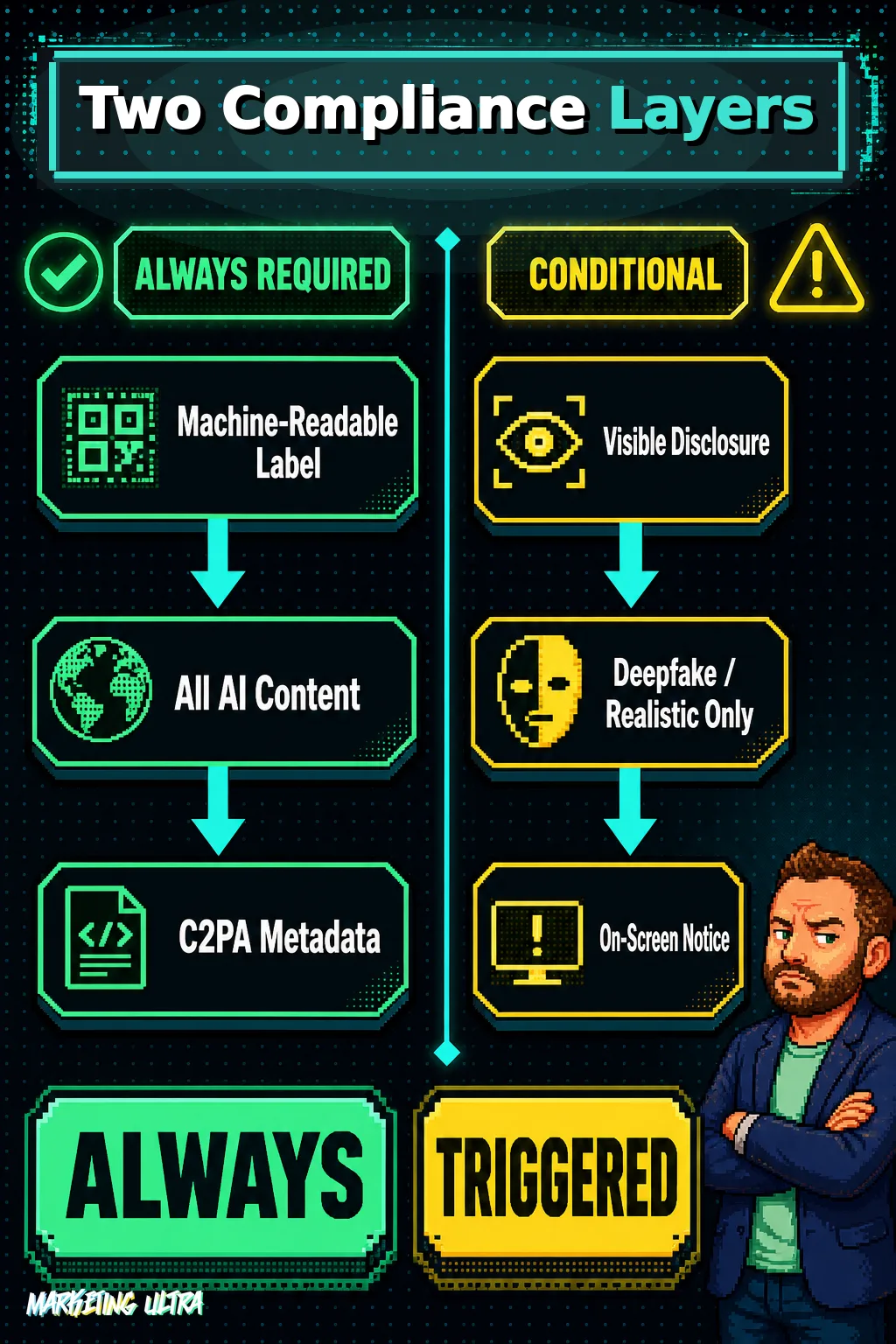
What does this mean for you as an advertiser? If your AI system interacts with people (chatbots on landing pages, shopping assistants), users must know they're talking to a machine. If you generate creatives with AI, they must carry a technical label identifying them, C2PA Content Credentials metadata or equivalent. And if the content simulates real people, places, or events in a way that looks authentic (what the law calls a "deepfake"), disclosure must be visible.
A nuance most people are missing: simple commercial advertising content (taglines, product descriptions) doesn't fall under the "public interest" category and doesn't need a visible label. But it still needs the machine-readable mark. Those are two entirely separate compliance layers. Conflating them is the most common mistake I'm seeing right now.
In a thread on r/DigitalMarketing posted the day after enforcement kicked in, one user summed it up perfectly: "Most teams shelved compliance after the June 'EU delays AI Act' headlines, but only the high-risk tier moved." The June headlines confused half the industry. What was delayed were the high-risk obligations under Annex III. The transparency requirements, the ones that apply to you as an advertiser, have been in force since day one.
PMax and Asset Studio: The Black Box Now Has Legal Obligations
PMax uses generative AI to create headlines, descriptions, and images from your landing pages and assets. Asset Studio goes further: it generates complete visual creatives from scratch.
Who's responsible if that content falls short?
Not Google. Google is the AI system "provider" and has its own obligations (including implementing machine-readable labeling). But you, as the advertiser, are the "deployer." And the deployer is accountable for the content they publish.
If PMax generates a creative that fails to meet transparency requirements, that's your problem to solve.
With PMax, this creates a serious structural issue: the black box. You don't know exactly which combinations are being served, and you don't have full control over which creatives get generated. We've already covered the risks of running PMax on autopilot in our complete Google Ads guide. Now add a regulatory layer on top.
And here's the analysis I'm not seeing anywhere: Google, as a generative AI provider already operating in the market before August, gets longer transition periods under the Regulation to achieve compliance. RIGHT NOW there's an operational gap. You already have deployer obligations, but the platform you're using isn't giving you the tools to meet them. When a platform withholds control while you carry the liability, you're exposed. Regulation aside, that alone should concern you.
What to Review in Your Google Ads Account Today
If you manage accounts with PMax, Demand Gen, or any format that uses generative AI, here's what I'd look at:

- AI creative inventory. Identify which headlines, descriptions, images, and videos in your active campaigns have been generated or modified by AI. PMax, Demand Gen, Display, all of them. If you can't tell which assets are AI-generated and which aren't, that's your first problem.
- Visual asset metadata. Download assets generated via Asset Studio or other tools and check whether they still carry the machine-readable mark (C2PA Content Credentials). If you edited them afterwards in Canva or Photoshop, the metadata has very likely been stripped.
- Chatbots on landing pages. If you have an AI-powered chatbot on your landing pages, users must know they're talking to a machine. No exceptions.
- Content that simulates reality. AI-generated voices in videos? Images of people who don't exist? If it looks real and isn't, you need a visible disclosure. The AI labels Google already implements point in the right direction, but they don't cover every scenario under Article 50.
- Internal documentation. Keep a record of which assets are AI-generated, when they were created, and what steps you took to comply. When someone asks, and they will, you need evidence, not good intentions.
The AI Act isn't going to kill your Google Ads account. But with penalties of up to €15 million or 3% of global turnover for breaching transparency obligations, "I'll get around to it" has an expiration date. And the trend is global: in the US, the FTC already requires "double disclosure" for AI-generated sponsored content, with fines of $53,088 per violation.
If you manage with judgment, review diligently, and document everything, this is just another layer of work. If you're blindly trusting automation and not asking what's happening inside the black box, August 2 was your wake-up call. And it's been ringing for two weeks.
Frequently Asked Questions About the AI Act and Google Ads
What are C2PA Content Credentials?
C2PA Content Credentials is a technical standard that identifies the origin and modifications of a digital file through verifiable metadata embedded directly in the file itself. The AI Act points to solutions like this to satisfy the "machine-readable mark" requirement. Google already uses it in some products, but its implementation within Google Ads is still partial.
What's the difference between a "provider" and a "deployer" under the AI Act?
The provider is the entity that develops or commercializes the AI system, Google, in the case of PMax or Asset Studio. The deployer is whoever uses it in their business: you, as the advertiser. Both have obligations under Article 50, but the deployer is directly accountable for published content and for informing users when that content is AI-generated.