Anthropic has just launched Claude Sonnet 5, an AI model built for agents to do the heavy lifting without blowing up your API bill. The promise: agentic performance close to their premium model, at half the price. Sounds good. The real question is whether you can actually use it from where you are.

TL;DR: The no-nonsense summary
- Claude Sonnet 5: Anthropic's agentic model, built to automate AI-driven workflows at a contained cost.
- Performance close to Opus 4.8: outperforms Sonnet 4.6 in coding, reasoning, and tool use. In some benchmarks it even beats the premium model.
- Aggressive pricing: $2/M input tokens at launch, 60% cheaper than Opus for agentic tasks at scale.
- EU availability: no official confirmation. "Global" doesn't automatically mean GDPR-compliant access.

After the Fable 5 letdown, at least this one lands right. Sonnet was overdue for an upgrade, and for most workflows it's more than enough, content generation especially, where it was already solid and now gets even better. Can't wait to put it through its paces.
DaniIn this article
What is Claude Sonnet 5 and why should you care?
Claude Sonnet 5 is Anthropic's new language model, built for agentic use: an AI agent that plans and executes multi-step sequences using tools, browsers, terminals, APIs, without losing track of the objective.
Forget the souped-up chatbot. Here, the agent gets a goal and figures out how to reach it.
The Claude family has tiers. Opus 4.8 is the flagship: expensive, powerful, built for deep reasoning. Sonnet sits in the middle, optimized for cost per task. And Claude Sonnet 5 is here to close the gap with Opus, without wrecking your budget.
Claude Sonnet 5 performance and pricing
According to TechCrunch and Anthropic itself, Sonnet 5 doesn't just beat its predecessor (Sonnet 4.6), in several benchmarks it goes head to head with Opus 4.8. As Decrypt reports, the gap between mid-range and premium has nearly disappeared in some tests.
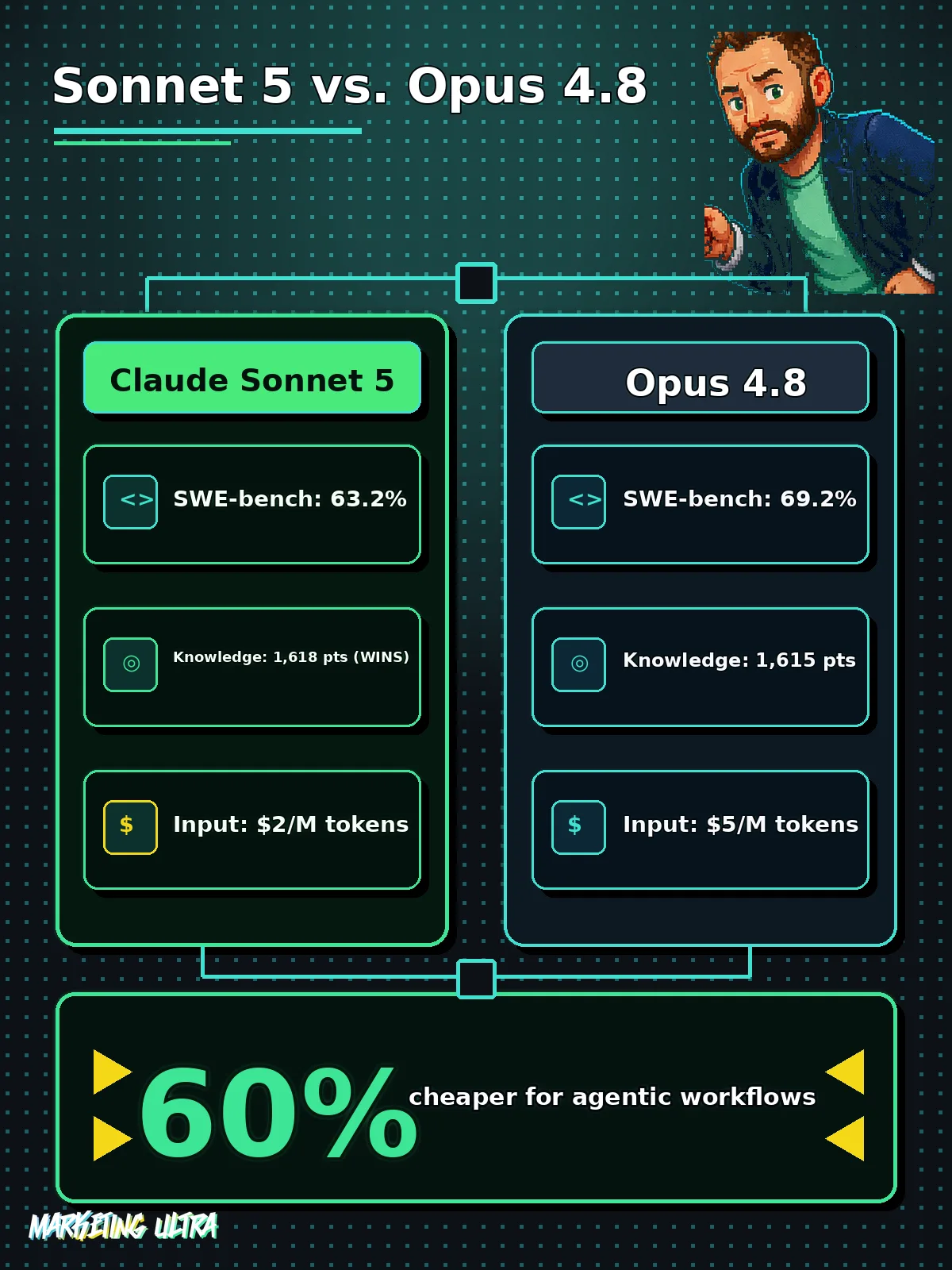
- SWE-bench Pro (coding): Sonnet 5 hits 63.2%. Sonnet 4.6 was at 58.1%. Opus 4.8 sits at 69.2%.
- Knowledge work: according to data cited by Decrypt, Sonnet 5 scores 1,618 points on an evaluation where Opus 4.8 scores 1,615. It beats it. By a hair, but it beats it.
- Context window: 1 million tokens. Accepts text, image, and file inputs.
Launch pricing: $2 per million input tokens and $10 per million output tokens through August 31, 2026. After that, $3 and $15. Opus 4.8 charges $5 and $25. For agentic workflows where the model chains dozens of actions and token usage spikes, Sonnet 5 runs 60% cheaper.
What does that actually mean? Anthropic is playing the volume card: make the mid-range model "good enough" so almost nobody needs the premium tier in their daily operations. It's the same logic Google applied with Gemini Flash or OpenAI is chasing with its Sol lineup. The real margin is in the model everyone uses every day. For an agency managing 20 accounts with automated agents, the difference between $2 and $5 per million tokens isn't a minor detail. It's your bottom line.
What can Claude Sonnet 5 do for marketing and e-commerce?
An agentic model with a 1-million-token context window and contained pricing makes automations viable that until now only made sense for large accounts. Where does it fit?
Automated customer support. Agents that query your knowledge base, pull up customer history, and resolve issues without human intervention. If your support isn't overly complex, this takes a significant chunk of tickets off your team's plate.
For content, the fit is obvious: product descriptions, landing page copy, email marketing drafts. Publish the output as-is? Absolutely not, judgment stays with you. But your team starts from a solid draft instead of a blank page, and that changes everything. If you want to understand how AI is reshaping content creation for search, we've broken down what works and where you're taking a real risk.
Campaign monitoring. If you manage paid media across multiple clients, you know what it's like to spend three hours on a report the client skims in two minutes. Agents that check performance across platforms, flag anomalies, and generate the first draft. You review it in 20 minutes and move on.
E-commerce management. API integrations with platforms like Shopify to optimize listings, adjust pricing, monitor inventory. The integrations already exist. What was missing was a cheap enough model to make them worth running.
None of this replaces the professional making the decisions. It multiplies your capacity, but judgment stays yours. Leave an agent managing your bids unsupervised, and you already know how that ends.
The fine print nobody reads
Let's get into the small print.

EU availability: no official confirmation
Anthropic announces global availability for Claude Sonnet 5, but no official source explicitly confirms access for accounts in the European Union with regulatory compliance guarantees. The model is available via the Claude API, the web platform, and AWS Bedrock. Being able to connect doesn't mean you're legally covered.
Claude Sonnet 5 looks promising. The numbers hold up and the pricing is aggressive.
But "global availability" and "EU regulatory compliance" are two very different conversations. For anyone working with real customer data in Europe, that's the biggest asterisk of this launch. The headache is regulatory.
Don't build for production before you've got that sorted.
Frequently asked questions about Claude Sonnet 5
What does a 1-million-token context window actually mean?
The context window is the amount of information the model can handle at once. One million tokens is roughly 750,000 words: enough to analyze lengthy documents, full knowledge bases, or long conversation histories without dropping anything.
Does Claude Sonnet 5 have safety guardrails for automated tasks?
According to Anthropic, the model includes built-in protections that automatically block high-risk activities. This matters especially when the model has access to tools and APIs with write permissions over real data.