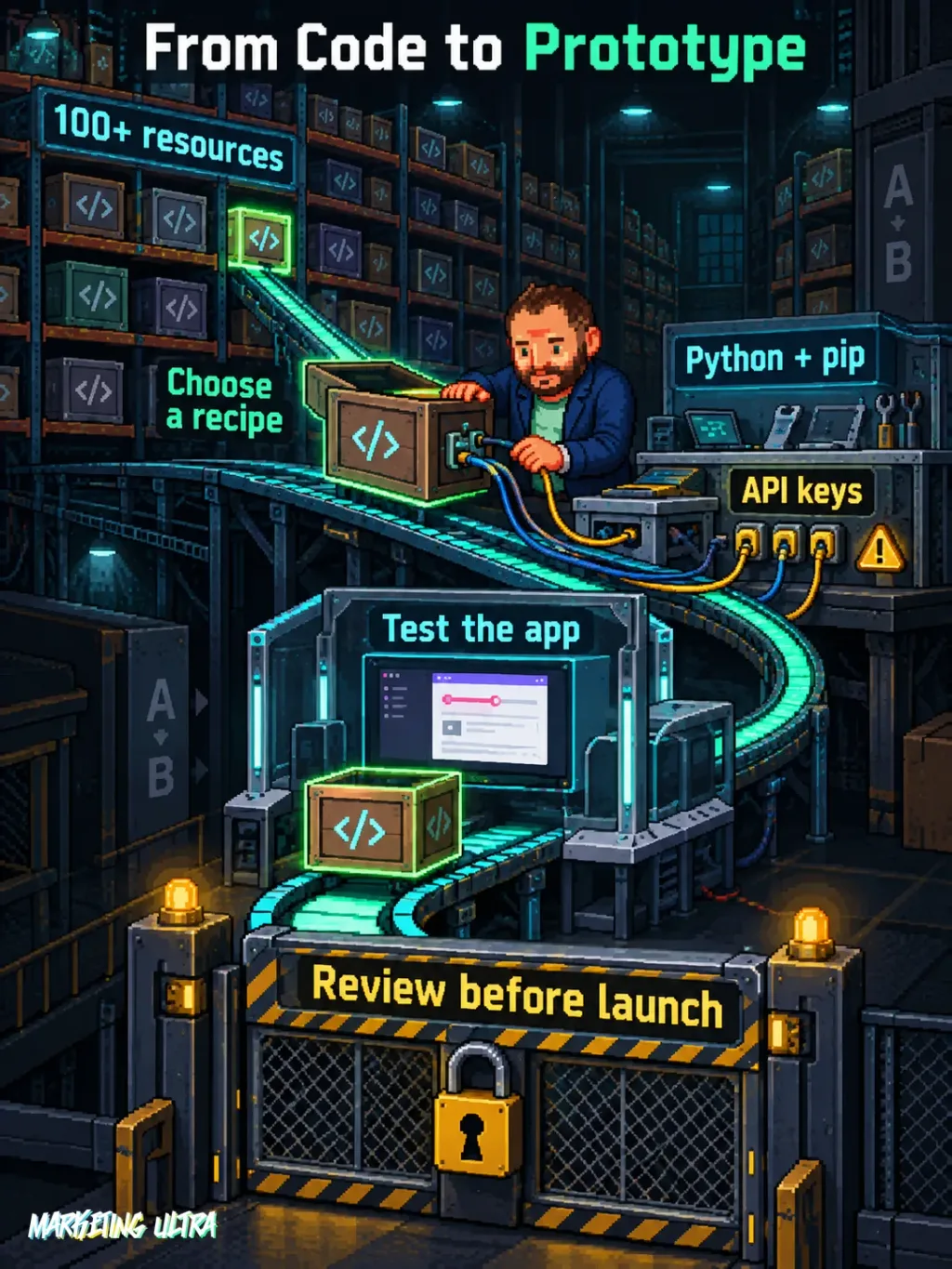
Awesome LLM Apps is like walking into a warehouse packed with over 100 AI resources ready to take apart: agents, skills, RAG systems, multi-agent teams and chatbots for almost any experiment. It is an open-source collection for learning by building. What do you actually get? Code to inspect, run and adapt. Hosting, support and guarantees are still your problem.

TL;DR: The No-Nonsense Summary
- What it is: an Apache-2.0 collection with more than 100 open-source resources spanning agents, skills and RAG applications.
- How to get started: clone the repository, install the requirements for your chosen example, add the required keys and run the app.
- The real cost: the code costs €0, but the models and external services you connect may carry their own costs, which the project does not spell out.
- The key limitation: these are educational and technical starting points; turning them into reliable tools requires reviewing code, data, security and deployment.
In this article
| What it is | A collection of more than 100 open-source AI agents, agent skills and RAG apps. |
|---|---|
| Official website | https://theunwindai.com/ |
| Repository | repo |
| License | Apache-2.0 |
| Price | open source |
| Alternative to | scattered tutorials and custom boilerplate for LLM apps |
| GitHub stars | 139,274 (review dossier) |
| Launch year | 2024 |
| Maintained by | Shubhamsaboo (individual) |
| Platforms | Self-hosted (clone the repo), web (Streamlit), Chrome extension, Docker not mentioned |
| Requirements | LLM API key (Claude, Gemini, GPT, DeepSeek, etc.), Python, pip |
| Integrations | Claude, Gemini, GPT, DeepSeek, Llama, Qwen, Slack, Notion, GitHub, Gmail, OpenAI Agents SDK, LangGraph, CrewAI, MCP |
| Language | English interface; README available in Spanish, German, French, Japanese, Korean, Portuguese, Russian and Chinese |
Reviewed on 2026-09-23
This tool is part of the living roundup Open-source apps that replace paid software →
The Problem It Solves
Building an LLM application from an empty folder forces you to decide on the interface, model, tools and execution flow before you even know whether the idea is worth pursuing. Awesome LLM Apps removes that blank page: you get examples you can open, run and pull apart.
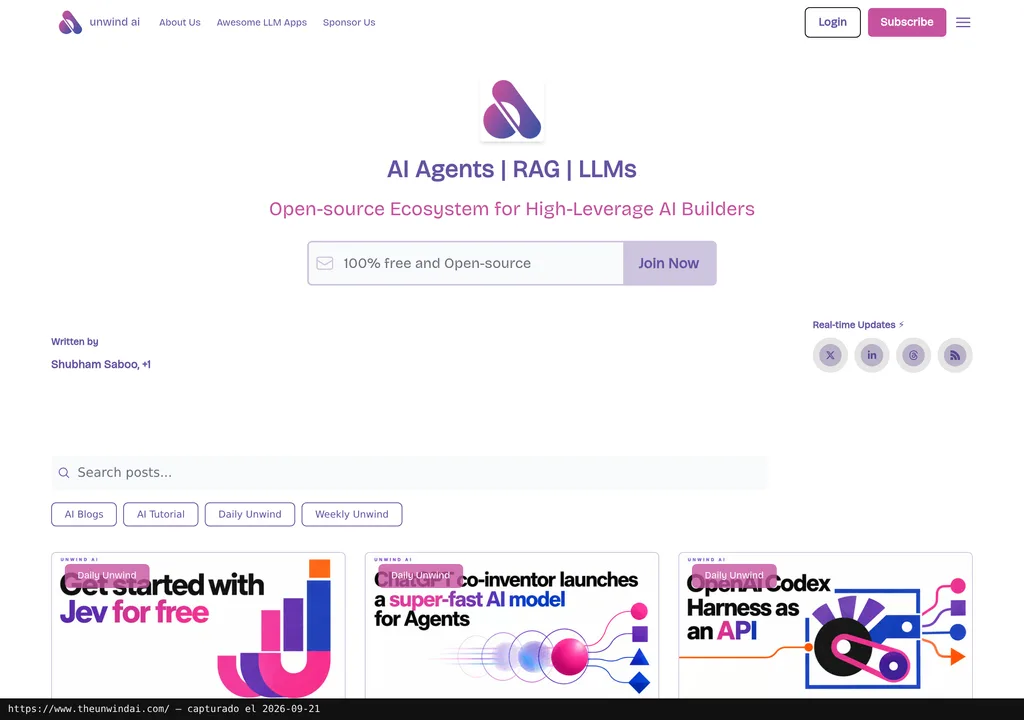
The official Awesome LLM Apps repository brings together more than 100 open-source resources across agents, skills and RAG applications. It ranges from basic agents to examples involving voice, memory, MCP and multi-agent teams. The review dossier records 139,274 stars and repository activity dated September 20, 2026.
Put simply: pick the recipe closest to what you want to build and adapt it after seeing how the pieces connect. You do not have to imagine the whole architecture from scratch. But you are not getting a magic packaged solution with support, hosting and guarantees, either. Do not confuse the two.
Getting Started
The clearest way to get started is on your own machine. You need Python, pip and whichever API keys the selected project requires. The README demonstrates it with a Streamlit travel agent.
git clone https://github.com/Shubhamsaboo/awesome-llm-apps.git
cd awesome-llm-apps/starter_ai_agents/ai_travel_agent
pip install -r requirements.txt
streamlit run travel_agent.py
Note: those commands start the travel agent. They do not prove that every other project works the same way. The catalogue includes integrations with Claude, Gemini, GPT, DeepSeek, Llama and Qwen, plus examples using Slack, Notion, GitHub, Gmail, LangGraph, CrewAI and MCP. The interfaces are in English, although the README has Spanish and other language translations.
There is also an npx skills add installation route for certain skills. If that format interests you, the guide to skills for Claude Code and Codex explains the missing context so you do not install things blindly.
Copy this and paste it into Claude Code, Cursor or your favourite coding assistant:
Clone Awesome LLM Apps from https://github.com/Shubhamsaboo/awesome-llm-apps and set up the travel agent in a virtual environment.
Ask me for the necessary keys without displaying them or storing them in Git, install requirements.txt, and run travel_agent.py.
Check that Streamlit opens and test it with a two-day trip; report any errors without changing other projects.
You do not need to do everything by hand. The assistant can guide you through installation, configuration and testing, but you will need to review any errors that appear.
Using It in Real Marketing
Where does this make sense for a small marketing team? Validating a very narrowly scoped internal tool. For example, adapting a research pattern to gather signals about competitor launches and reviewing the report before taking it into a meeting.
For the record: neither Dani nor Marketing Ultra has tested that workflow. The repository documents agents for research, data analysis, competitive intelligence and product launches, but the sources reviewed here provide no independent evidence of their performance inside an agency.
Collecting a hundred applications is not much use on its own. Value appears when you choose one, understand where it gets its data and decide who will review the result. If the team installs five agents with no owner, criteria or goal, it will have built a graveyard of demos with API keys. Very modern. Just as useless.
What They Do Not Tell You
The Apache-2.0 license allows you to use and modify the code, and the repository presents itself as free. The code costs €0. Then come the models, APIs, hosting and external services required by each example. There are no verified prices for those dependencies, so there is no point inventing a neat-looking bill.
Its variety is also its main drawback. A simple single-file agent and an advanced application with memory, tools or several models do not require the same level of review. Streamlit opens. Great. Before client data goes anywhere near it, you still have security, stability and response quality to check.
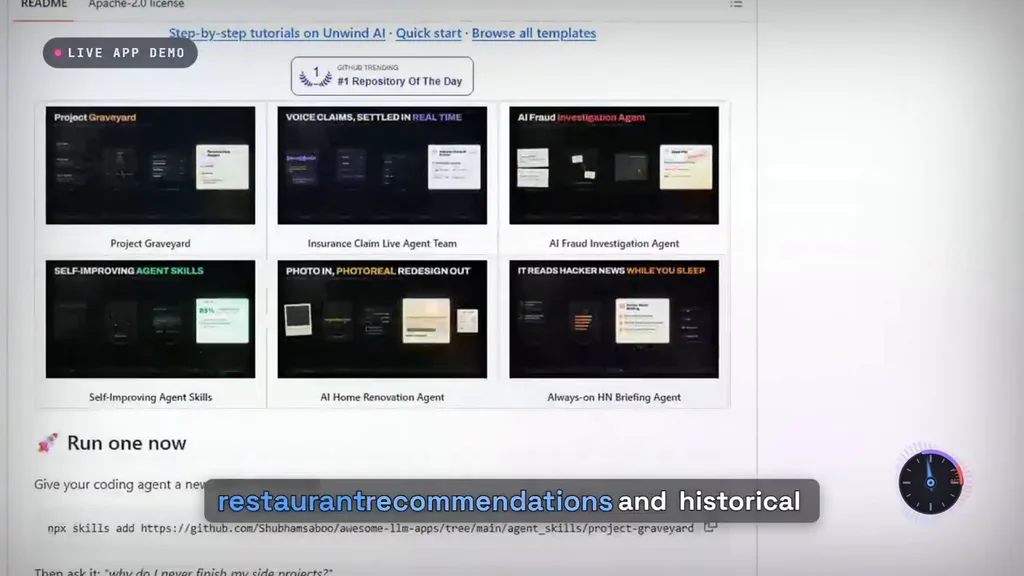
The verified screenshot of the application lets you see its interface in action, but it is not enough to check the results, stability or specific functions across the whole catalogue. Nor is there a sufficiently corroborated video with an author, version, date and useful timestamp. That is why this review does not use the visual material linked from Reddit as evidence. A lack of evidence is not fixed with enthusiasm and epic music.
What People Say
On Hacker News, chris_5f describes it as a very useful resource and recommends its maintainer, while noting that Shubham Saboo acts more as a curator than a creator. The publication date and the user's role are missing. This is an individual opinion. Technical validation: none.
"This is an awesome resource. This guy Shubham posts great stuff on twitter and linkedin too. Check out in case you haven't. I have got a lot of my LLM resources through his page. He is a more of a LLM curator and less of a creator but highly recommend." chris_5f on HN
On Reddit, NecessaryBear98 presents the collection as a catalogue of starting points and links it to their own commercial training offer. That commercial relationship means the praise needs to be read in context. Another post by the same author barely contains a reference to the forum and provides no useful evidence about installation or results.
Alternatives
The real alternative is sticking with scattered tutorials or building your own base structure for every application. Tutorials let you go deeper into a specific technology; a custom structure gives you more control, but takes you back to the blank page that Awesome LLM Apps aims to avoid.
Verdict
Awesome LLM Apps deserves a place in an open-source roundup: it turns abstract concepts into code you can inspect and offers entry points ranging from simple agents to RAG, MCP and multi-agent teams. Use it to learn, take patterns apart and build a specific prototype.
I would not use it as a shortcut to put an application into production without an audit. The catalogue saves you the first slog. The audit, the testing and every decision that matters? Still on you. That is the appeal of Awesome LLM Apps. And also the headache.