Half the industry is selling AI-powered rankings while you sleep. The other half is warning that Google penalizes anything a machine touches.
Both are wrong.
AI SEO isn't pressing a button and watching a tool hand you a top-3 ranking. It's something less glamorous and far more profitable: using artificial intelligence to do better what you should already be doing.

TL;DR: The no-fluff summary
- AI SEO is not GEO: using AI FOR your SEO (tools, workflows) is one thing; optimizing your site TO appear in ChatGPT or Perplexity is something else entirely.
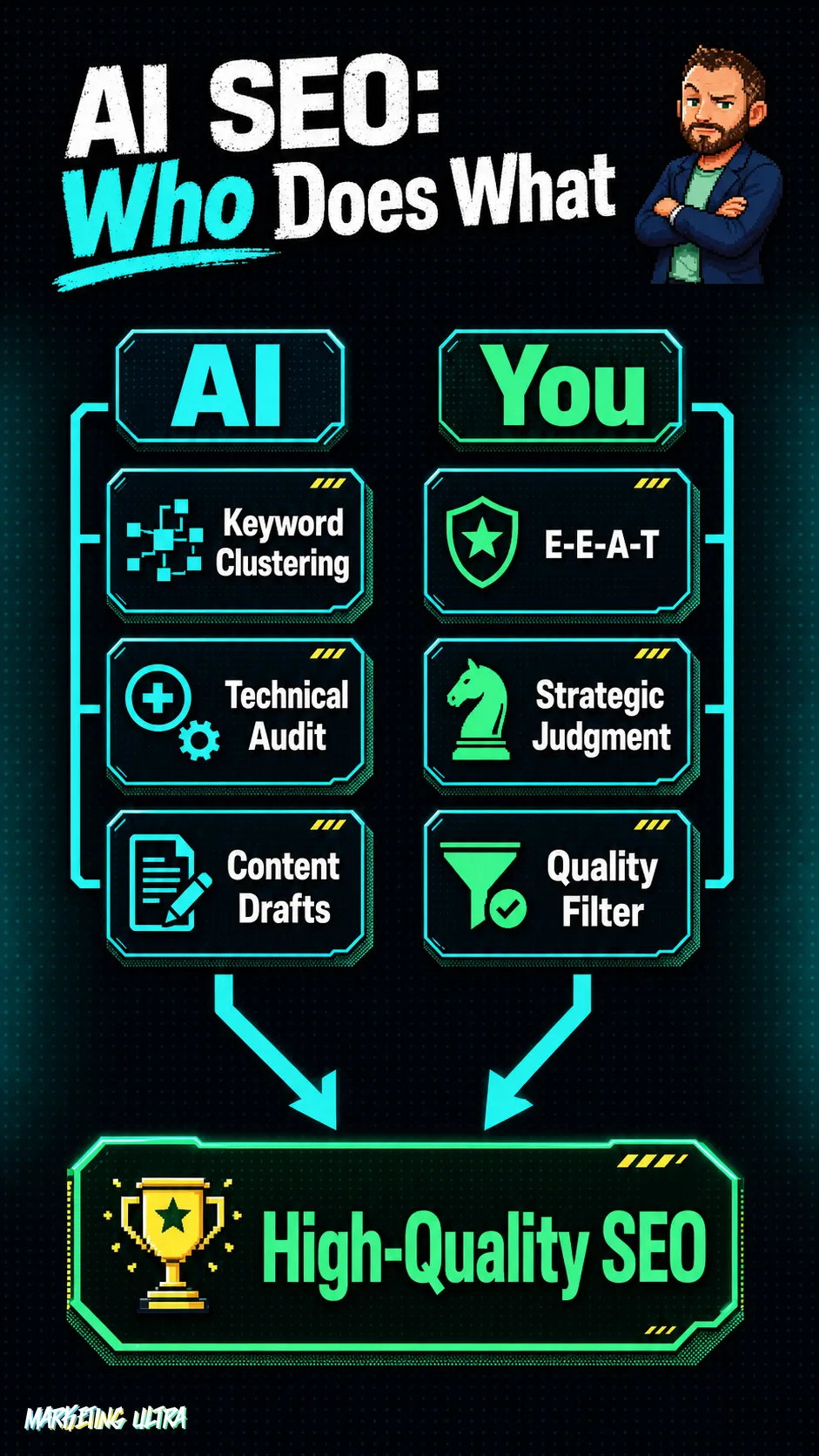
- Where it genuinely helps: keyword clustering, technical audits, content drafts, competitor analysis. The mechanical work that used to eat your hours disappears.
- The real risk: publishing unfiltered AI content. Google doesn't penalize AI, it penalizes low-quality content at scale. The March 2024 core update made that crystal clear.
- E-E-A-T is yours: your experience, your opinion, your professional judgment cannot be delegated to a machine. And that's exactly what Google values.
In this article
What Is AI SEO (and Why It's Not the Same as GEO)?
AI SEO means applying artificial intelligence tools to your search optimization workflow: keyword research, technical analysis, content optimization, opportunity detection. AI works FOR your SEO, not the other way around.
Because the opposite already has a name: GEO (Generative Engine Optimization), which is about optimizing your content to appear in ChatGPT, Perplexity, or Gemini answers. They're related, but they're different disciplines. We've already covered how GEO tactics are becoming the new keyword stuffing.
Here we're focused on the other side: how AI makes you a faster, more accurate SEO professional with fewer manual errors. No magic involved.
Where AI Improves Your SEO (and Where It Bites Back)
AI is exceptional at tasks where volume overwhelms you. These are the ones that deliver the most value day-to-day in an agency setting:
Keyword Clustering
Before: hours spent exporting lists, filtering spreadsheets, and manually grouping by search intent. Today you feed a keyword dump into Claude or ChatGPT, ask it to cluster by intent, flag cannibalization, and propose a content architecture. In 10 minutes you have what used to take a full morning.
Technical Audit
Screaming Frog spits out a report with 47 tabs. An LLM can parse that export, prioritize the errors that actually impact crawlability, and hand you an action plan ranked by impact. But you need to know what to ask. A generic prompt gives you generic answers (we've covered that already).
Content Drafts
The most obvious use case and the most dangerous one. Generating a draft with AI saves time. Publishing that draft without touching a word puts you squarely in the pile of mediocre content Google swept out of the index in its March 2024 core update.
AI writes correctly. You write with judgment and something worth saying.
Competitor Analysis
Ask an LLM to compare the structure of the top 5 URLs for a target keyword and flag the gaps you can fill. It saves you reading 15,000 words of competitor content. You still need your eye to decide whether that gap is actually worth chasing.
Where does it go wrong? Anything requiring JUDGMENT. AI doesn't know whether your business can realistically compete against a domain with a 90 DA. It doesn't know your client runs a two-person team. It doesn't understand your market. Those calls are yours to make.
AI Tools for SEO Worth Your Time
I'm not going to list 47 tools, that's what Google is for. These are the ones that pull their weight in a real SEO agency:
Semrush and its Copilot give you automated account analysis, traffic drop alerts, and content suggestions based on real traffic data. Not perfect, but it replaces the weekly manual review nobody wants to sit through.
Ahrefs and its Content Explorer for identifying content gaps is one of the most underrated features in the industry. If you're not using it to see what your competitors cover that you don't, you're leaving money on the table.
Surfer SEO optimizes on-page content with a real-time score. Useful for briefing writers. But if the tool tells you to "use your keyword 47 times," it's time to apply some common sense.
Then there are the generalist LLMs (Claude, ChatGPT): the Swiss Army knives of AI SEO. For clustering keywords, analyzing SERPs, generating schema markup, extracting entities, or writing meta descriptions at scale. The difference between useful output and garbage is how you ask.
What Does Google Say About AI and Rankings?
Google has held the same position since February 2023: "we don't care how content is produced; we care that it's useful." They published this in the Google Search Central blog and the message hasn't changed.
What DID change was their tolerance for scaled junk. The March 2024 core update removed hundreds of sites generating thousands of AI pages without human oversight from the index. This wasn't "Google vs. AI." It was Google vs. low-quality content produced on an assembly line.
The lesson? Use as much AI as you want in your SEO workflow. But what you publish needs to pass a human filter. E-E-A-T (Experience, Expertise, Authoritativeness, Trustworthiness) isn't something a machine can manufacture. The experience is yours or it belongs to no one.
At Marketing Ultra we're clear on this: AI saves us hours of mechanical work every week. But everything that goes out carries someone behind it who knows what they're talking about. That part can't be delegated.
AI SEO: The Tool Is Not the Advantage
AI SEO is a tool. Nothing more, nothing less.

If you can't do SEO without AI, you won't be able to do it with AI either. If you can, you'll move faster and spot opportunities that used to get buried in Excel tabs.
Without judgment, the best tool in the world only helps you make mistakes faster.
Frequently Asked Questions About AI SEO
Can Google detect AI-written content?
Google has not confirmed it uses AI detectors to rank content in search results. Its system evaluates quality, usefulness, and E-E-A-T, not the production method. An AI-generated article that has been edited with real judgment and first-hand experience ranks just as well as one written entirely by hand.
How much does it cost to build an AI-powered SEO workflow?
It depends on the stack. Semrush and Ahrefs start at around $100-130/month on their entry plans, Surfer SEO from $89/month, and generalist LLMs like Claude or ChatGPT have professional plans from $20/month. The return isn't in the tool, it's in knowing how to use it.