Alibaba just released a 27.8-billion-parameter AI model under an Apache 2.0 license that, in several benchmarks, outperforms Claude Opus 4.6 Max on coding tasks. Qwen 3.8 27B is the first local model that genuinely deserves your attention as an alternative to paid APIs. But before you cancel your subscription, let's look at the numbers up close.

TL;DR: The No-Nonsense Summary
- Qwen 3.8 27B: Alibaba's dense model with 27B parameters, Apache 2.0 license, results that beat Claude Opus 4.6 Max on code.
- Minimum hardware: 17 GB in quantized form (4-bit). In practice, a $4,000, $5,000 laptop or a 24+ GB GPU.
- Sweet spot: code, AI agents, and high-volume workloads where API token costs spiral.
- Weak point: speed (15-30 tokens/s locally, several times slower than cloud) and mandatory manual setup.
What Is Qwen 3.8 27B?
Qwen 3.8 27B is a dense AI model with 27.8 billion parameters, developed by Alibaba and released on August 14, 2026. Its Apache 2.0 license allows commercial use, modification, and redistribution with no restrictions or fees. It is multimodal (text, image, video), with a context window of 262,144 tokens expandable to one million, and optimized for code, reasoning, and agentic workflows.
The benchmarks are what sparked the frenzy. On SWE-bench Pro (software engineering) it scores 61.7, above Claude Opus 4.6 Max's 53.4. On LiveCodeBench v6, 90.3 against 88.8. These are Alibaba's own numbers, so take them with a grain of salt. But the community is validating them: on Hacker News, the launch thread racked up 1,436 points and nearly 800 comments.
On LinkedIn, a post with 109 likes nails it: "100x smaller than frontier models, but performance more or less in line with the frontier models of a few months ago." The fact that a model fitting on a laptop comes close to what models a hundred times its size can do is worth sitting down and taking seriously.
What Hardware You Need to Run Qwen 3.8 27B Locally
The full model in 16-bit precision occupies 56 GB of GPU memory. That rules out any consumer machine. The key is quantization (reducing the numerical precision of the model's weights): at 4 bits it drops to around 17 GB, which a high-end machine can handle.
Simon Willison tested it on a MacBook Pro M5 Max with 128 GB of RAM using LM Studio. Result: between 15 and 30 tokens per second. It works. But with a big asterisk.
Keep in mind: those 17 GB are the model alone. If you use the full context window at 4 bits, the key-value cache can add another 16 GB. The "runs on a laptop" claim requires a $4,000, $5,000 laptop or a dedicated GPU with 24-32 GB of VRAM. On TikTok, a comment with 41 likes puts it in perspective: "No consumer computer can run this. Mac Studio is like $7,000." An exaggeration, but the point stands.
AMD has announced day-zero support for its Ryzen AI Max+ and Radeon AI PRO R9700 with 32 GB. NVIDIA's RTX 4090 with 24 GB works too. The software side is solved. What stings is the price tag.
Where Qwen 3.8 27B Shines, and Where It Stumbles
Code and agents: that's its home turf. The SWE-bench Pro and LiveCodeBench results are those of a much larger model, and it's fine-tuned for multi-step tasks where other models give up halfway. If your daily work involves automating workflows with AI agents, there's real substance here. On GitHub, a user in the club-3090 repo who tested it with a dual RTX 3090 summed up their verdict with a meme: "Mom, can I have a Claude subscription?" / "We have Claude at home."
It also delivers on document and image analysis (integrated vision) and on predictable, high-volume workloads. If you're processing thousands of similar requests a day, the marginal cost per token is ZERO.
Where does it fall short?
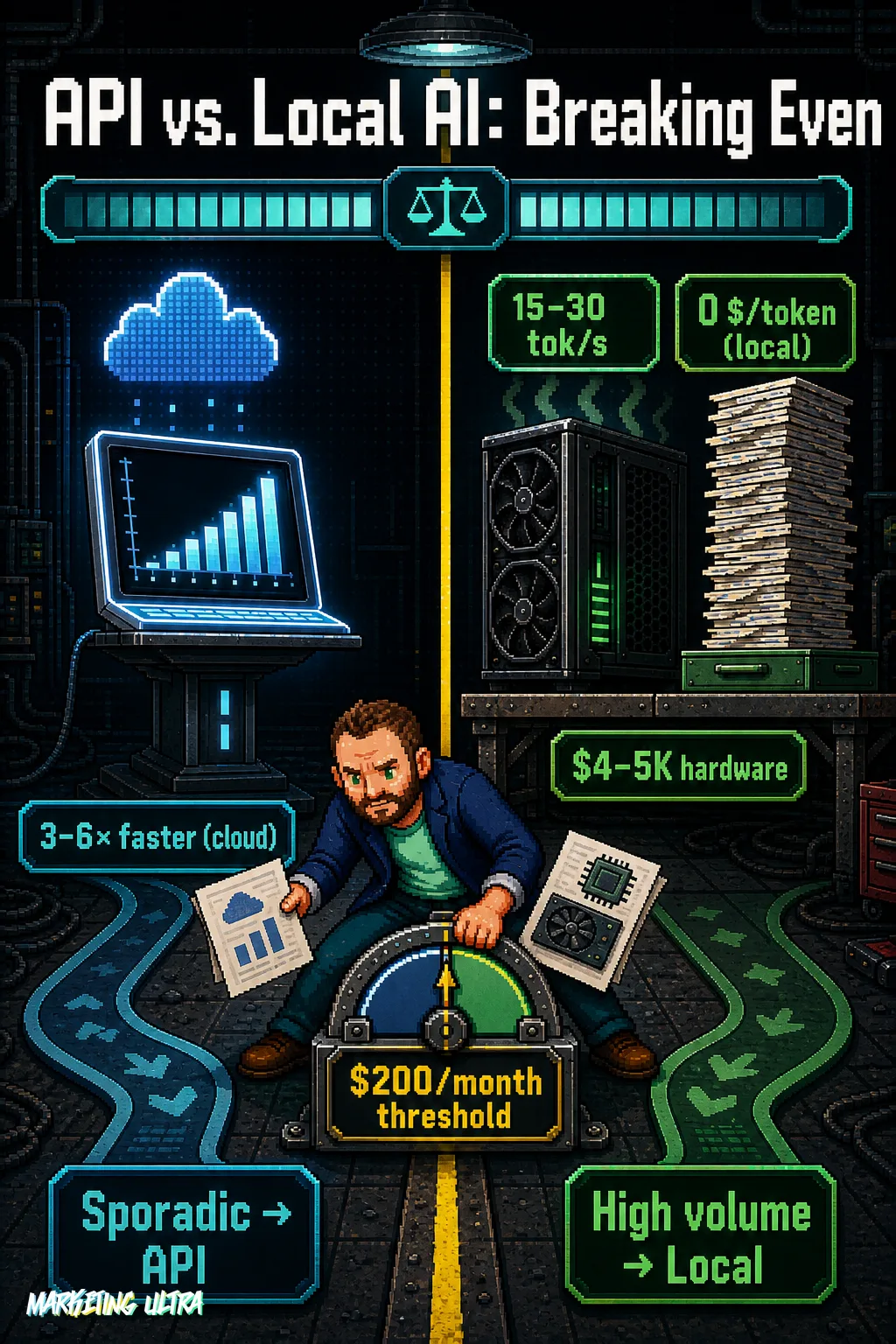
Speed. Willison measured 15-30 tokens per second locally. In the cloud, any frontier model multiplies that by 3 to 6. For real-time responses, the cloud wins hands down.
Default configuration. Willison noted that generating a simple SVG took 21 minutes because the model ships with reasoning cranked to maximum ("xhigh"). Dropping it to "low" fixes the problem. But if nobody tells you, the first stretch is maddening.
And what nobody puts in the headline: this is not plug-and-play. Setup and maintenance are entirely on you. Every hour fighting with parameters is an hour you're not billing.
When Does Switching from API to a Local AI Model Make Sense?
If you're paying $50 a month in API costs and your usage is sporadic, Qwen 3.8 27B is not worth it. Between the hardware cost and the setup time, your subscription is still the better deal. Full stop.

The equation changes when your monthly token bill climbs above $200, $300 and your use case is repetitive. Bulk document processing, code agents running in a loop, sensitive data you don't want going to the cloud. There, the investment in hardware, which you already have, or will amortize in under a year if you're optimistic, starts to pull ahead.
And then there's privacy. Your data never leaves your machine. For anyone working with sensitive client information, that's no longer optional. With Apache 2.0 and local execution, you meet GDPR requirements without depending on a third party's data retention policies. That said, as Wired analyzes regarding the risks of open-weight models, the same license that frees you, frees everyone.
My bet is that the usage pattern set to grow fastest is the hybrid one: local AI for raw volume and predictable tasks, a frontier API for anything demanding top quality or instant response. The skill is in knowing when to use each. And if you're already using local AI for tasks like transcription, Qwen 3.8 27B is the natural next step.
Qwen 3.8 27B doesn't kill APIs. It's the first local alternative that deserves you to sit down and run the numbers. If you already have the hardware and your token bill is hurting, the math speaks for itself. If your usage is occasional, stick with your subscription and move on. What has changed is that, for the first time, "we have Claude at home" is not just a meme.
Frequently Asked Questions About Qwen 3.8 27B
What Is AI Model Quantization?
Quantization reduces the numerical precision of a model's weights (from 16-bit to 4 or 8-bit) so it occupies less memory. A Qwen 3.8 27B model quantized to 4 bits drops from 56 GB to around 17 GB, with minimal quality loss on most tasks.
What's the Difference Between Apache 2.0 and Other AI Model Licenses?
Apache 2.0 allows commercial use, modification, and redistribution with no restrictions. Other "open" models like Llama use licenses with limits on active users or jurisdictional clauses. In practice, Apache 2.0 is the most permissive license in the AI ecosystem: no fine print, no surprises.