You're showing up in the AI Overview for your target keyword. Congratulations. Now open GA4 and look for that organic traffic spike that was supposed to come with the AI visibility. A study tracking more than 51,000 events over nine months confirms what already smelled off: appearing in Google's generative response doesn't equal getting clicks.

TL;DR: The No-Fluff Summary
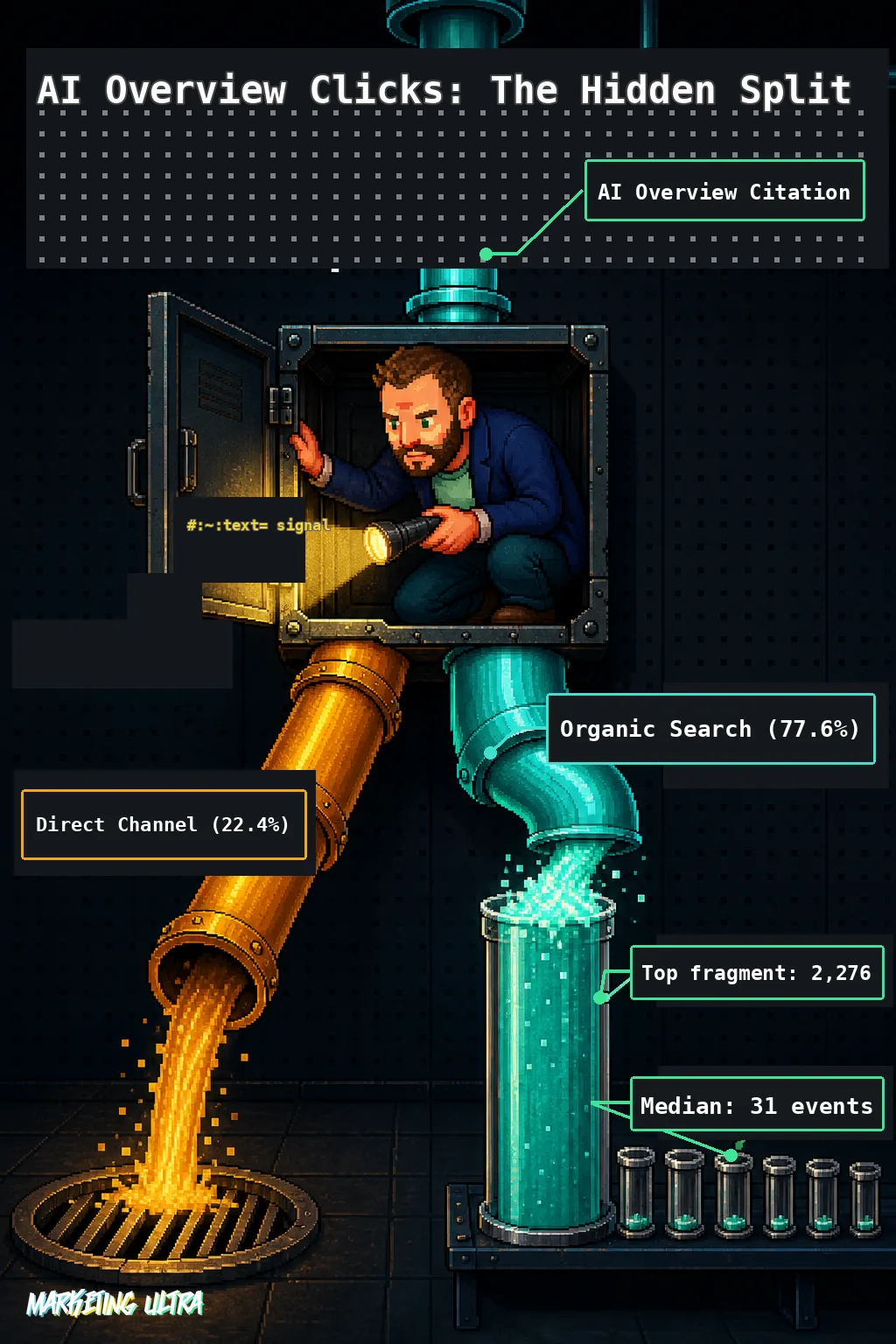
- Broken attribution: 22.4% of AI Overviews traffic ends up in GA4's "Direct" channel, outside your organic reports.
- Extreme volatility: AI traffic share swings between 2% and 17% with no clear pattern. Impossible to plan around.
- Few winners: the top-cited fragment generated 2,276 events; the median is 31. Showing up isn't winning.
- Simple fix: a custom GA4 dimension tracking the
#:~:text=string separates AI traffic from real organic.
Where Are the Clicks? The Gap That 51,000 Events Expose
AI Overviews are the AI-generated summaries Google displays at the top of search results, pulling in snippets from multiple sources. Getting cited there should drive traffic. But a large chunk of that traffic never shows up in your organic search reports.
That's what the most comprehensive analysis published to date by Search Engine Land reveals: nine months of tracking (September 2025 to June 2026), 1,661 cited fragments, and more than 51,000 tracked events.
The number that stings: 22.4% of visits arriving from AI Overviews were attributed to the "Direct" channel in GA4, not "Organic Search." In raw numbers: 11,468 events vanished from organic performance reports. Your team thinks SEO isn't delivering. Paid gets the credit. And you're making decisions on data that lies.
Is this consistent? Not even close. In April 2026, misattribution sat at 16.8%. The following month it jumped to 29.3%. That kind of rollercoaster turns any planning based on this data into an act of faith.
The share of organic sessions attributed to AI Overviews averaged 7.53%, but the real range swings between 2% and 17%. One in six visitors during the February, March peaks. One in fifty by the time the report was published. There's a name for that: noise.
Few Winners, Many Extras
How many events did the top-cited fragment in the study generate? 2,276. And the median across all 1,661 tracked fragments? 31.
Thirty-one.
There's no democratization happening here. A handful of sources takes almost everything, and the rest show up to fill the seats. If your content isn't the one Google selects as its star answer, your citation is worth little more than a handshake.
What kind of content wins? The study is clear: structured content that answers specific questions. Schedules, prices, routes, comparisons. HTML tables formatted as actual tables, not paragraphs dressed up to look like one, achieve a disproportionate presence in citations. Long-form editorial content gets left out in the cold.
This should ring a bell for anyone who's been in SEO long enough: it's the featured snippet playbook all over again. Google gives you a spot in its shop window, the user gets the answer without leaving the SERP, and you're left with the impressions and none of the clicks. At least with featured snippets your URL showed up front and center. Now the AI rewrites your content, mixes it with other sources, and the reader doesn't even know you exist. According to Martech.org's AI visibility index, some brands are simply disappearing from generative responses, making it clear that showing up guarantees absolutely nothing.
How to Separate AI Overviews Traffic From Organic in GA4
If you're not tracking this separately, your channel reports are wrong. It's that simple. And the fix is easier than it sounds.

When a user clicks a cited fragment inside an AI Overview, Google appends a string to the destination URL in the format #:~:text=. It's the same mechanism used to highlight text in results. The fix: create a custom dimension in GA4 that fires every time a session arrives with that string. No complex code, no third-party tools.
With that setup in place, you can see two things: how much traffic is actually coming from AI Overviews, and how much was leaking into the "Direct" channel without you knowing. If you've spent months defending SEO investments using data that doesn't separate these two sources, what you find after implementing this will change the conversation, whether that's with a client or your boss.
Optimize for AI Overviews? Yes, But Drop the Hype
Don't read this as "do nothing." AI visibility matters, and as I cover in the guide on how agentic search is reshaping SEO, this channel isn't going away. But there's a real difference between adapting your content (clear structure, tabulated data) and going all-in chasing citations in a system that puts you at the top today and ignores you tomorrow without warning.
The underlying problem is expectations. Google has spent years selling the idea that AI in the SERPs "complements" organic traffic. Longitudinal data says otherwise: it fragments it and misattributes it. If you've noticed that your blog is losing organic traffic, part of the explanation may be right here. And if you want to quantify it, you need dedicated tools to measure your AI engine visibility, not just GA4.
The frustrating reality is that you can't ignore AI Overviews, but you can't plan around them either. Building a strategy on a metric that swings between 2% and 17% with no clear pattern is, charitably, optimism.
Next time someone tells you that "ranking in Google's AI is the NEW SEO," ask them for the click data. Not impressions. Not visibility scores. Real clicks, with the custom dimension configured in GA4. And if they don't have it, you already know what that opinion is worth.