Your brand might have the best content in the world, the best ads, an SEO strategy that's been delivering results for years. But if someone asks ChatGPT about your industry and your name doesn't come up, a growing slice of your audience simply doesn't know you exist. And that slice gets bigger every week.
It's called AI Share of Voice. The KPI that decides whether AI recommends you, or leaves you out.

TL;DR: The No-BS Summary
- AI Share of Voice: measures how often ChatGPT, Perplexity, or Gemini cite you versus your competitors. This isn't your traditional SOV: it measures trust, not impressions.
- The volume is staggering: more than 18 billion AI responses per day, with Google's AI Overviews already appearing in 48% of searches.
- Real conversions: AI-referred visitors convert 4.4x more than standard organic traffic. This isn't vanity data.
- Measurement isn't trivial: each engine responds differently and the same query can produce different results day to day. You need to segment by engine, query, position, and time period.
What Is AI Share of Voice?
AI Share of Voice measures how often a brand is cited or recommended in responses from ChatGPT, Perplexity, Google AI Overviews, Gemini, or Copilot, compared to its direct competitors. Think of it as a trust thermometer: does AI consider you a reliable source, or does it walk right past you?
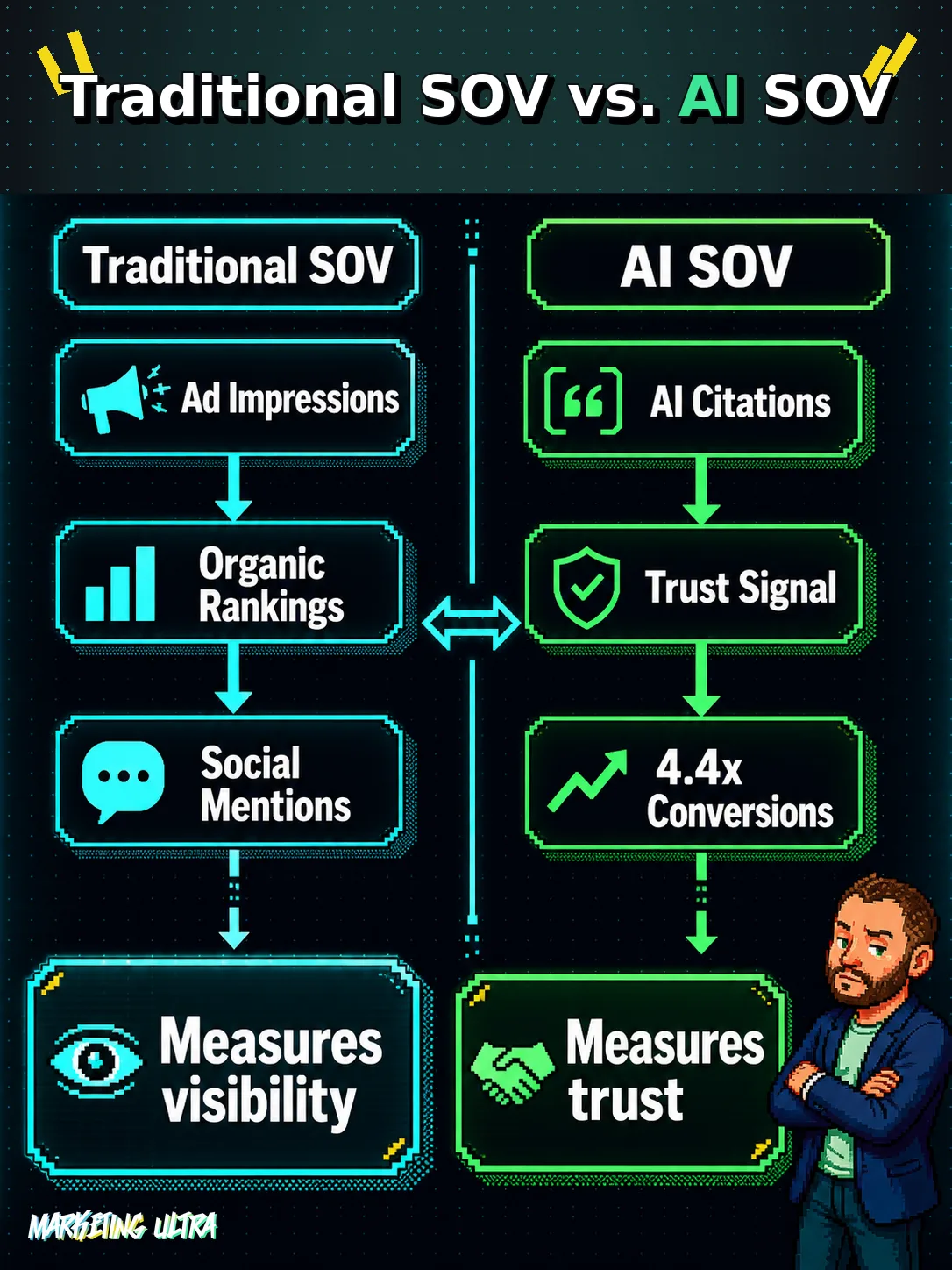
Don't confuse it with traditional Share of Voice. The old SOV tracked ad impressions, organic rankings, social mentions, familiar territory. AI Share of Voice measures something different: whether a language model considers you a credible source when someone asks about your industry. The difference between appearing on a list and being the one a trusted friend recommends out loud.
Why should you care? Because AI-powered search engines already generate more than 18 billion responses per day. A channel that's been eating into classic search's market share while most brands are still staring at their Google Analytics dashboard.
The Numbers That Justify Measuring Your AI Share of Voice
Let's put some figures on the table, because when a CMO asks for justification, opinion doesn't cut it.
ChatGPT surpasses 800 million weekly active users and processes more than one billion queries per day. Perplexity hit 780 million queries in May 2025. Google's AI Overviews now appear in 48% of searches, up from 31% the previous year.
And Bing? A 15.8% increase in visits since launching AI-powered search. Copilot keeps growing and more Bing results now include AI-generated answers.
But here's the stat that should stop you in your tracks: AI-referred visitors convert 4.4x more than standard organic traffic. We're talking real revenue. Revenue that's either coming in, or NOT.
If your brand isn't showing up in those answers, you're not losing positions, you're not even in the game. The user asks, the AI answers, your competitor gets the recommendation. You never even know it happened. It won't show up in your traffic report. It's the 2026 version of that "direct traffic" black hole in Analytics: just because you're not measuring it doesn't mean it isn't happening, as we covered when we looked at how to measure visibility in AI engines.
How to Calculate AI Share of Voice
The base formula is straightforward: AI Share of Voice (%) = queries where your brand is mentioned / total tracked queries x 100.

Simple to write down. Not so simple to execute.
Important caveat: each model responds differently to the same question. The same query can produce different results on different days. And where your brand appears within a response, first mention versus fifth, changes the real weight of that citation. That's why AI Share of Voice is a multidimensional metric that needs to be segmented by engine, query, position, and time period.
According to the "State of AI Search 2026" report by AthenaHQ, cited by Semrush, the average brand mention rate in AI responses is 17.2%. Companies that actively work on their semantic authority reach 15-30% for high purchase-intent queries. That's where the real game is played.
Tools? The ones gaining the most traction: Semrush AI Visibility Toolkit, HubSpot AI Search Grader, and Conductor. They let you monitor brand mentions across multiple AI platforms and benchmark against competitors. Monthly evaluations at a minimum, this space moves fast.
From 0 to 283 Queries on Bing: What We Measured Without a Sitemap
Here's our own data. At Marketing Ultra, we've been tracking AI search engine visibility window by window from day one. In 18 weeks, we went from 0 to 283 attributed queries from Bing, with no sitemap submitted and no specific action taken for that search engine.
What does that tell us? That Bing (and by extension Copilot) was indexing and serving our content in its AI responses without us doing anything explicit to be there. Well-structured content with a genuine point of view and real data found its way in on its own. While others chase the magic optimization formula, the foundation remains the same: create content that an AI considers worth citing.
My bet is that most brands are in the opposite situation: they're publishing content but have no idea whether Copilot, Perplexity, or Gemini is citing them. They're not measuring their AI Share of Voice. And when classic organic traffic takes a hit, which it will, they won't see it coming.
Here's the angle nobody talks about. AI Share of Voice is being owned by technical SEO teams, when it should be sitting on the CMO's dashboard alongside cost of acquisition and ad ROI. If AI-referred visitors convert 4.4x more and you don't know how many you're getting, you have a measurement gap. Simple as that.
AI Share of Voice is no longer optional. It connects your brand's visibility in answer engines to real revenue.
What most companies are missing is simply the decision to measure it. And while they wait, whoever is measuring it is already occupying the space you leave empty every time someone asks ChatGPT, Perplexity, or Copilot something about your industry.
In the new era of agentic search, brands that aren't tracking their AI Share of Voice are already behind. And every week that passes, they fall further back.