Most SMB marketing is a car with an engine, a full tank, and GPS, but no driver. It turns, it burns money, and it goes nowhere. And no, I'm not talking about budget or tools. I'm talking about the fact that nobody with real strategic judgment is at the wheel. A fractional CMO fixes exactly that: senior marketing leadership without the fixed cost or the inertia of a full-time executive on the payroll.

TL;DR: The No-Fluff Summary
- Fractional CMO = real leadership: a senior marketing director who sets strategy, prioritizes, and executes, without being on the full-time payroll.
- Measurable savings: can cost between 30% and 60% less than an in-house CMO, once you factor in salary, benefits, and overhead.
- Real growth: in my experience, companies with a fractional CMO grow significantly faster in revenue than those operating without strategic direction.
- Built for SMBs: if your revenue is under €3 million, it almost always makes more sense than a full-time executive hire.
What Is a Fractional CMO?
A fractional CMO is a senior marketing director who takes ownership of your company's strategy without being on the full-time payroll. They set priorities, coordinate teams, choose channels, and measure results. This is not the consultant who hands you a PDF and disappears. They execute. And they think in terms of business outcomes, not isolated deliverables like a freelancer would.
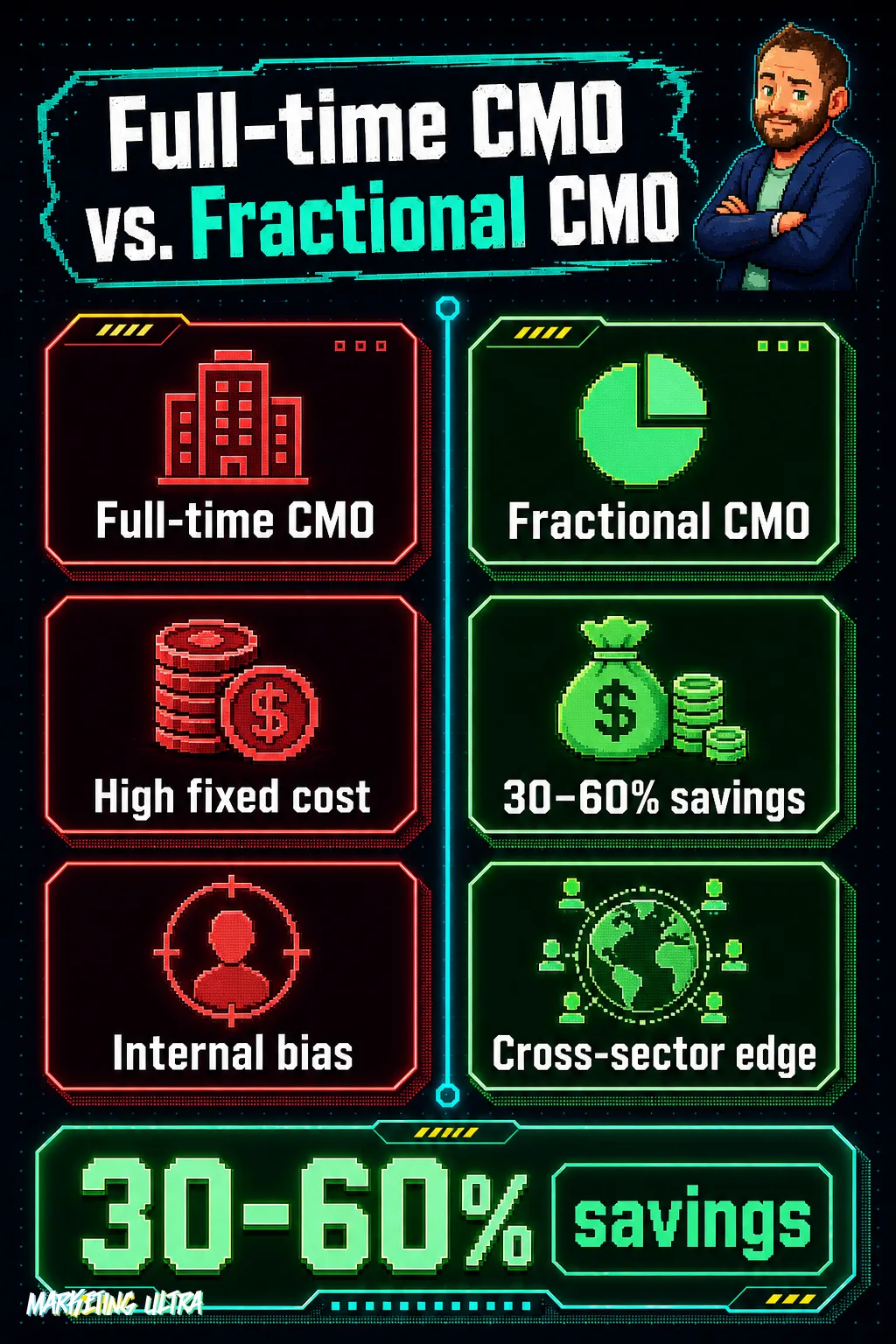
This model has grown by more than 60% over the last five years. Why? Because companies need strategic direction, but not all of them can absorb the cost of a full-time CMO. A fractional CMO can cost between 30% and 60% less than a full-time hire, once you account for salary, benefits, and organizational overhead.
And here's the thing: cheaper does not mean worse. A fractional CMO typically brings cross-sector experience that an executive who's been inside the same company for years simply doesn't have.
The Mistake: Hiring One Just to Cut Costs
Most companies looking for a fractional CMO have one thing in mind: the invoice. "I'm avoiding a big salary. Done."
Wrong. The real value isn't what it costs. It's what they see.
Perspective.
An in-house executive gets absorbed into office politics, inherited decisions, and the "this is how we've always done it" mindset. They've been sailing the same waters for years and stop questioning things that need to be blown up entirely. The fractional CMO arrives without political baggage, without prior commitments, and with exactly enough distance to tell you what your own team doesn't dare say.
This isn't theory. In my experience managing client accounts, companies that bring in a fractional CMO grow substantially faster than those that continue without strategic direction. Not a little faster, I'm talking double-digit revenue differences.
Here's my read: in most SMBs, marketing doesn't fail because of budget. It fails because nobody with real judgment is calling the shots. There's execution, campaigns, posts, ads, but zero direction. A fractional CMO doesn't give you more hands. They give you a brain that thinks in business terms.
And often the problem isn't even that there's no marketing lead. It's that whoever's in the role got there without the preparation to actually lead: the accidental manager who runs campaigns but never sets direction. A fractional CMO breaks that pattern.
When Does a Fractional CMO Actually Make Sense?
Not always. There are business profiles where this model fits perfectly and others where it's simply a waste of money.
It makes sense if your revenue is under €3 million. At that scale, the cost of a full-time CMO is rarely justified. A fractional CMO gives you the strategic direction you need without straining your cash flow.
It also makes sense if you're growing but your marketing isn't scaling. You have product, you have demand, but your campaigns are running on manual. Or if your team is working without direction: you have the headcount and the budget, but nobody is saying "yes to this, no to that, this comes first."
And a scenario I'm seeing more and more: companies mid-way through a digital transformation where technology, business, and marketing are speaking entirely different languages. A fractional CMO bridges all three because they've already done it elsewhere.
It does not make sense if you're looking for someone to execute. A fractional CMO thinks and decides. If what you need is someone to run campaigns or manage social media, that's a different role at a different price point. Confusing the two is the most expensive mistake you can make. If you want to dig into real costs and when to pull the trigger, we break it all down in detail here.
Fractional CMO and AI: The Combination Nobody's Talking About
Here's something most people aren't saying out loud. Marketing in 2026 looks nothing like it did three years ago. Generative AI has changed everything, from how people search to how we measure results.

A full-time marketing director who's been inside the same company for five years has rarely kept pace. A fractional CMO who works with multiple clients, by definition, stays current. They've seen what works and what doesn't across different industries, different budgets, and different moments in a company's lifecycle.
Worth being clear: AI doesn't replace the marketing director. AI is the tool; the fractional CMO is the judgment that decides how to use it. Without that judgment, AI scales your mistakes just as fast as it scales your wins. And from running AI-driven operations inside an agency, I see this play out every single week.
This isn't a trend. It's not a patch. A fractional CMO is real marketing leadership without committing to a six-figure salary for someone who might take a year just to understand your business.
If you think you can't afford one, calculate what you've already burned with nobody at the wheel. That number hurts more.