Shopify has just added something to its admin panel that brick-and-mortar retailers have been asking for: a centralized view to see and manage all POS devices from the admin, without touching each terminal individually. Sounds like the bare minimum you'd expect from a retail platform in 2026. And it probably is. But it gets interesting when you flip it over and look at what Shopify actually says about availability in Europe.
Spoiler: nothing.

TL;DR: The no-fluff summary
- Centralized management: new section in the Shopify admin to monitor all POS devices from a single panel, without accessing each terminal individually.
- Technical requirement: Shopify POS app version 11.9 or higher. No update, no access.
- Who it's for: merchants with multiple locations or several in-store terminals. If you only sell online, this doesn't apply to you.
- Spain and EU: Shopify says "global," but doesn't explicitly confirm inclusion of the European market. Worth watching closely.

About time. This was one of the biggest headaches for e-commerce managers, and having it centralized like this is genuinely a blessing.
DaniWhat Shopify's new POS device management actually does
The new section in the Shopify admin lets you view, monitor, and assign all POS devices connected to your account from a single dashboard. No more jumping from terminal to terminal or opening the app on every iPad sitting at the counter.
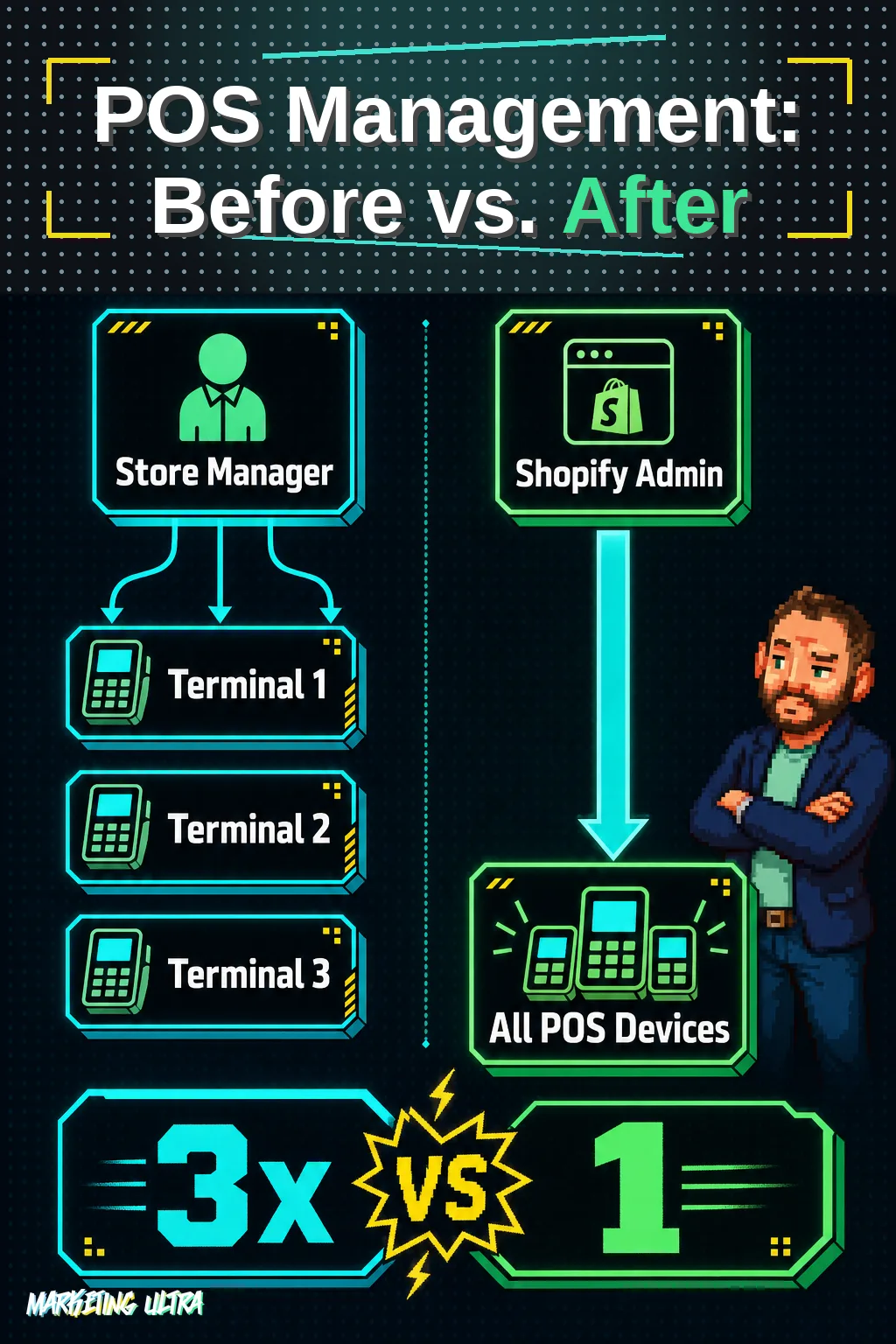
According to Shopify's official changelog, the feature is in general availability (GA) for accounts running the Shopify POS app version 11.9 or higher. In practice, that means:
- See the status of each device: active, disconnected, pending setup.
- Assign devices to specific locations within your store network.
- Monitor hardware directly from the admin, without physical access to the point of sale.
Until now, managing this meant logging into each device individually or heading to the app on-site. For a store with a single register, that's no big deal. For a chain with five locations and fifteen terminals spread across them, every minute spent babysitting hardware manually is a minute you're not spending on selling.
Who actually benefits from the Shopify admin POS view
If you sell exclusively online and have no physical retail presence, move on. This isn't for you.
The real impact lands on omnichannel merchants running Shopify POS across multiple locations. The classic scenario: three stores, each with two or three terminals, and until now checking whether a device was active or misconfigured meant logging into each one separately. Or texting the store manager. Or just hoping for the best.
Centralizing that in the admin isn't exactly groundbreaking, but it's the kind of feature that saves real time day-to-day. Fewer assignment errors, and the retail manager can see what's happening at every location without leaving their desk.
Got just one store with one terminal? This update is largely irrelevant to you. And that's perfectly fine.
Availability in Europe: what Shopify isn't saying
Shopify is announcing this feature as "globally available." Sounds great. But the official source doesn't explicitly state that Spain or the European Economic Area are included in that rollout.
That doesn't mean it won't work there. It means there's no explicit confirmation. And in the B2B software world, "global" sometimes translates to "United States, Canada, the UK, and we'll figure out the rest later", especially for features tied to retail hardware, where local fiscal regulations around POS systems can shape how and when a rollout actually happens.
If you're running Shopify POS in Europe, check that you're on app version 11.9 and see whether the section appears in your admin. If it doesn't, don't assume it's rolling out next week. Shopify typically deploys in phases and rarely publishes a market-by-market timeline.
Convenience for merchants, dependency for Shopify
Shopify has been doubling down on physical retail for months. The Spring Edition 2026 updates already pointed in that direction, and this centralized device management is another piece of the same puzzle.

The pattern is clear: Shopify wants merchants with physical stores to run EVERYTHING through its ecosystem. Inventory, sales, staff, devices. The question nobody's asking is whether that centralization benefits the merchant more, or the platform.
My read? Both, but for very different reasons. Merchants gain operational convenience. Shopify gains lock-in. The more pieces of your operation live inside their admin, the harder it becomes to migrate to another system when prices rise or terms change. It's the same playbook we see with Google Ads and its "helpful" features that, conveniently, always push you to do more inside their walled garden.
That's not inherently bad. But it's worth keeping in mind before applauding every new feature without thinking through what it means twelve months down the road. Convenience has a price, even when it doesn't show up on the invoice.
Shopify's centralized POS device management is a practical upgrade for multi-terminal retailers. Full stop. It doesn't change the game, but it removes a genuine operational headache for anyone running retail across multiple points of sale.
What deserves more scrutiny is the ambiguity around Europe. If you're running Shopify POS outside the US, don't take anything for granted until you see it in your own panel. And if someone tells you the integration is "ready for the European market," ask for the screenshot.
Availability (July 2026): Shopify indicates global availability, but the official source does not explicitly confirm whether Spain and the European Economic Area are included. It cannot be stated with certainty that this feature is active for European merchants.