Everyone is talking about knowing how to write prompts. Weekend courses, LinkedIn threads, PDFs with "the 50 best prompts for your digital strategy." Most of it is recycled noise that ignores both how a language model actually thinks and what a real marketer actually needs. The skill that will separate professionals from tourists is not writing effective marketing prompts, it is designing the system behind them.

TL;DR: The straight version
- Effective prompt ≠ pretty prompt: it is a structured instruction with a role, brand context, measurable objective, and clear constraints.
- Copying does not scale: without your brand data, your audience, and your campaign details, any generic prompt produces generic output.
- The real leap is the flow: designing connected prompt sequences (agents) that solve a business problem from start to finish.
- Watch out for platform agents: Google and Meta design their agents to maximize their metric, not yours.

Whoever makes this leap and builds this skill into their regular toolkit is the marketing professional who will survive the generational shake-up this technology is bringing with it.
DaniWhat is an effective marketing prompt?
An effective marketing prompt is a structured instruction that translates a business objective into a concrete output from an AI model. Forget "write me a post about my product." We are talking about a professional brief with context, constraints, and a success criterion.
The difference is the same as between telling an intern "do some content stuff" and handing them a full brief with audience, brand tone, campaign objective, and success metric. The LLM is only as good as the instruction it receives. According to Skai's guide, prompt structure has more impact on output quality than the model you use.
Here is the first mistake I see constantly: treating the model like a search engine on steroids. Vague question, generic answer, then complaining on LinkedIn that "AI does not work for marketing."
Wrong. The problem is not the AI, it is your instruction.
Why copying prompts does not work
Copying prompts from a list works the same way as copying someone else's diet: it ignores your context, your data, and your goal.
A prompt copied from a thread does not know your brand, your audience, or your pricing strategy. It is missing half the information the model needs to give you something useful. Result: generic text you could have found on any blog from 2019.
Prompt engineering is the fastest-growing AI skill: 32.9% annual growth according to Precedence Research. LinkedIn lists it as the most in-demand AI competency globally. The market is real. But the training on offer keeps selling lists as if they were magic recipes.
Here is the real insight: a prompt is not a finished product. It is a component of a system.
How to write marketing prompts that actually work
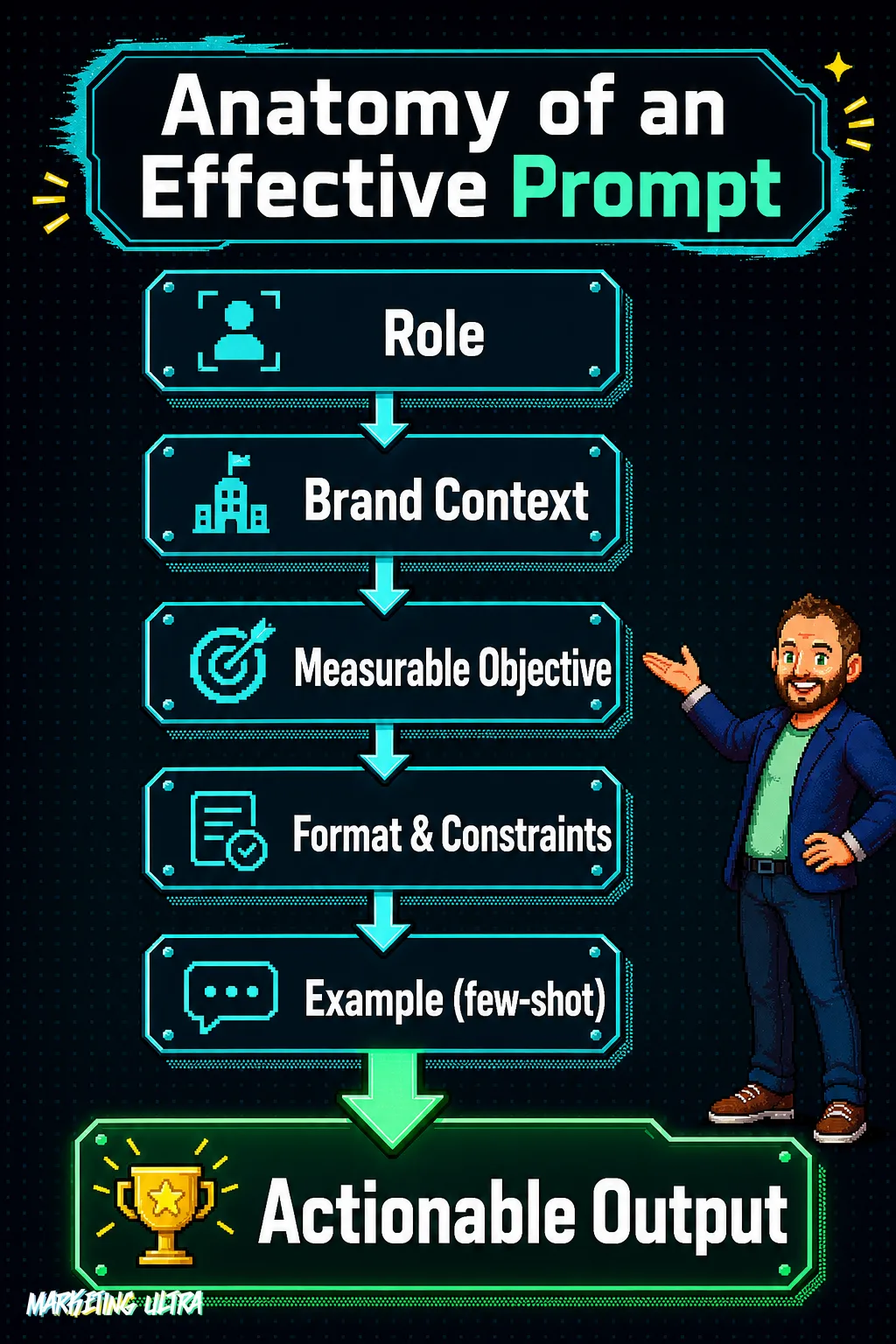
An effective marketing prompt has five parts. None are optional.
- Role. Tell the model who it is. "You are a B2B paid media specialist with SaaS experience" is not decoration, it radically changes the direction of the response.
- Brand context. Name, sector, target audience, tone, competitive differentiator. Without this, the model improvises. And when an LLM improvises about your brand, it fabricates.
- Measurable objective. Not "write me some content." Instead: "Generate 3 ad copy variations for Meta targeting marketing directors at companies with 50 to 200 employees, with a CTA pointing to the demo landing page."
- Format and constraints. Length, structure, prohibited words, tone. Everything you define is ground the model does not have to guess.
- Example. Providing 1 to 2 samples of the expected output dramatically improves precision. It is the difference between explaining what you want and showing what you want. This is called few-shot prompting, and it is probably the most underrated technique in the field.
Note: this is not a rigid template. Sometimes you can drop the example; sometimes you need to add performance data from past campaigns. The point is that every prompt should carry enough information so the model has nothing left to invent.
From prompt to flow: the skill that actually matters
Knowing how to write a good prompt is necessary. But it is not enough.

I would wager that the real competitive advantage over the coming years will not come from the individual prompt, but from designing flows: connected sequences of instructions that solve a business problem from start to finish.
What does that look like in practice? Instead of asking "analyze my competitive landscape," you design a flow where a first prompt pulls competitors from a data source, a second analyzes their ad copy, a third compares it against yours, and a fourth generates actionable recommendations.
That has another name: designing an agent.
And here is what I consider the most important skill a marketer can develop right now: knowing how to define the objective an agent is working toward, how it will get there, where it operates, and how far its reach extends.
Google is already playing this game with tools like Ask Advisor, which puts an AI agent in charge of managing your campaigns. Meta is doing the same with Advantage+. Agentic marketing strategy is not the future, it is the present.
And here is what happens: the agents the major platforms launch are designed to maximize their metric, not yours. Google wants you to spend more. Meta wants you to expand your audience. If you are not the one defining the objectives, the constraints, and the success criteria, the agent will optimize for whoever programmed it.
Not for you.
The marketer who designs their own flows will have a level of control that someone dependent on platform automation will never have. And if they also optimize their content so AI cites it as a source, they close the loop: using AI to create and positioning themselves to be recommended by AI.
The prompt is the brick. The flow is the building. And anyone still collecting individual bricks in 2026 is going to end up with a very well-written pile of rubble.
Frequently asked questions about marketing prompts
Do I need to know how to code to design prompt flows?
No. A prompt flow is a logical sequence of instructions, not code. Tools like Claude, ChatGPT, or Make let you chain steps without writing a single line. What you need is strategic thinking: define what goes in, what comes out, and what criterion validates each step.
How quickly will a marketer see results with structured prompts?
From the first session. Teams that move from generic to structured prompts notice the difference from day one: fewer revisions, more usable outputs, and far less time throwing away what the model generates.