One hundred blogs that in 2022 were boasting six-figure annual revenues. Four years later, the median blog has lost 85% of its organic traffic. Daniel Stanica published the numbers last week and Rand Fishkin called them "damn depressing." I read them differently: they're a natural filter that has separated those who built something real from those who were renting space on Google's land.

TL;DR: The No-Nonsense Summary
- 85% median drop: 100 "six-figure" blogs from 2022 have lost most of their organic traffic in just 4 years.
- Survivors with a moat: the few that held on share something that can't be built fast or cloned with AI. The pattern: they built on land they owned, not Google's.
- Semrush isn't the whole story: the study measures organic traffic, not business health; some "dead" sites by traffic may be more alive than ever through other channels.
- Zero-Click as the next filter: even survivors face a Google that increasingly answers queries without sending a single click.

If blogging is dead... what are you doing here? 😛
Dani100 Six-Figure Blogs, Four Years Later
Daniel Stanica selected 100 blogs that appeared on "six-figure blogger" lists in 2022 and tracked them through 2026. The results, published in his study The Great Blogging Collapse, don't exactly inspire optimism.
The median blog in the sample lost 85% of its monthly organic traffic, as measured by Semrush. More than half suffered drops that the study itself describes as "catastrophic." According to Fishkin, five of the nine categories analyzed lost more than 90% of their traffic, though I haven't been able to verify this figure directly against the original study.
The timing is no coincidence. 2022-2026: the mass rollout of generative AI, AI Overviews, algorithm updates that reshuffled the entire board. All at once.
Why They Died: The Moat That Never Existed
Most of those blogs were publishing content that any AI can generate in three seconds today: "top 10 X" listicles, generic how-to guides, affiliate roundups without a single firsthand experience. Technically correct, optimized, ranked. And completely replaceable.
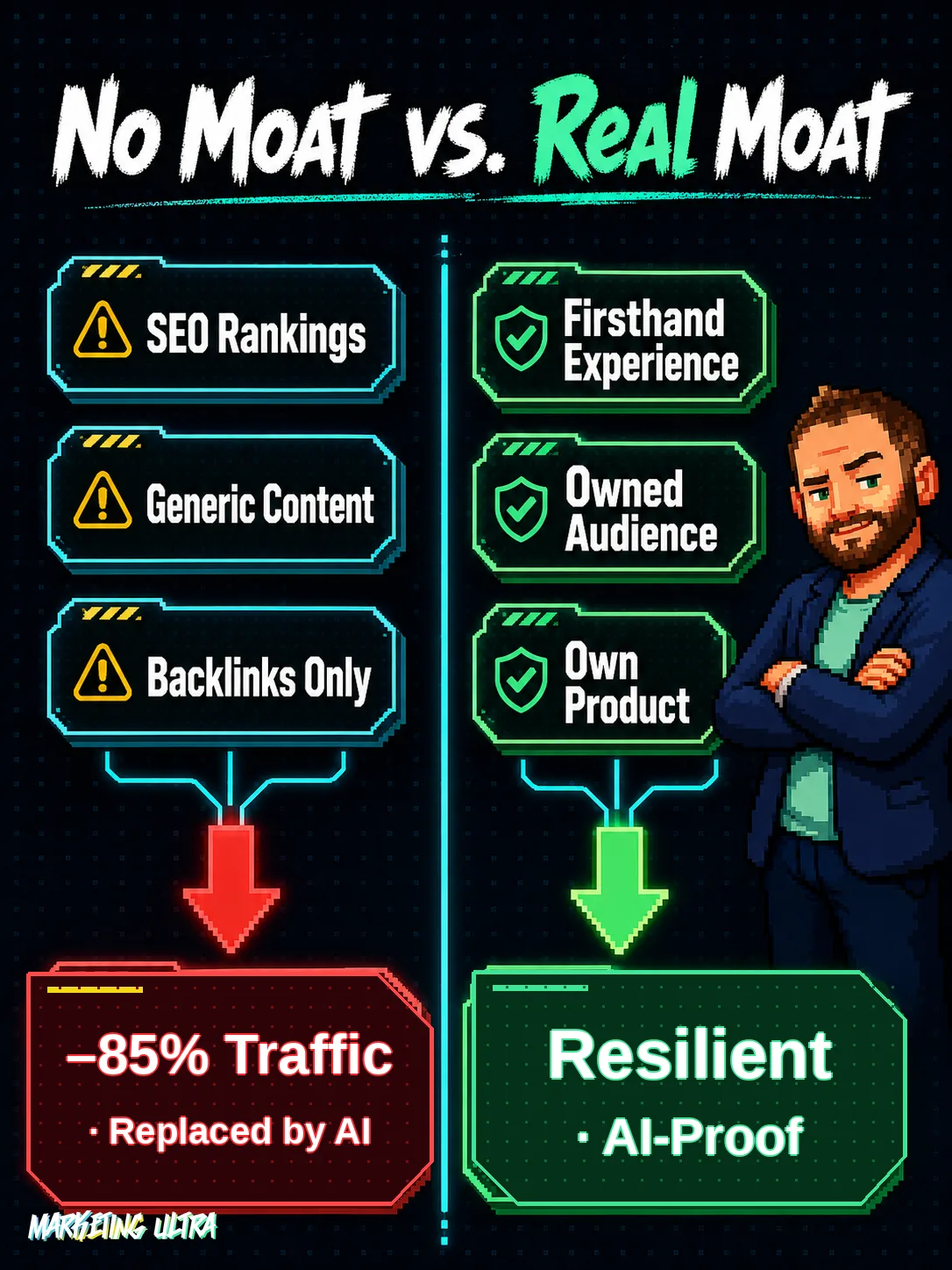
They had no moat. None at all. Their competitive edge was getting to a keyword first and accumulating backlinks. In 2022, that was enough. By 2026, Google has an AI summary that does exactly what those articles did, without the user ever needing to click.
Stanica puts it plainly: "the experience that cannot be summarized by AI has become the greatest competitive advantage". Recipes actually cooked, DIY projects with dirty hands, trips lived in the first person. A large language model can't replicate that. Generic listicles? It can, faster and cheaper than any human.
My bet is that a good chunk of those "six-figure blogs" already had a broken model in 2022, Google's faucet was just still running. Massive organic traffic was masking a brutal dependence on a single channel. When that channel changes the rules (and it always does), the castle collapses. We see the exact same pattern in paid advertising when someone builds their entire acquisition strategy around a single campaign type and Google moves the goalposts without warning. Diversification isn't a feel-good business-book tip: it's basic survival.
What the Blogs That Survived the Collapse Have in Common
The survivors in Stanica's study share three traits. None can be built overnight. That's precisely why they work.
Experience-based content. No recycled takes, no desktop research. Actually cooking the recipe and burning your fingers, traveling to the place and taking your own photos (yours, not Shutterstock's), testing the product before writing a single line. Google has been preaching E-E-A-T (Experience, Expertise, Authoritativeness, Trustworthiness) for years. Here, finally, are the numbers to prove it.
The second is having an owned audience: email lists, communities, a direct line to the reader. The study itself acknowledges that some sites with catastrophic Semrush drops made up for it with newsletters, branded direct traffic, or YouTube. Here's the thing: if your audience depends entirely on Google surfacing you, you don't have an audience. You have a variable-rate mortgage.
And the third: a real product. Not just affiliate links, not just AdSense. A product or service of your own that the content fuels, not the other way around.
It's what we've been saying at Marketing Ultra about AI search optimization (AEO): if you want LLMs to cite your content, you need to bring something to the table that doesn't already exist in their training corpus. Experience and data that can't be reduced to two AI-generated lines, with your name on them.
The Zero-Click Era: Survive to What End?
Fishkin closes with a warning worth sitting with: "even these few survivors may not hold on for long in Google's Zero-Click era." I agree with the diagnosis. The prognosis, not entirely.

Google is increasingly answering queries directly in its results without sending a single click to publishers. AI Overviews is the steroid-boosted version of what featured snippets were already doing. "Free" organic traffic is becoming less free and less abundant.
But the blogs that survived Stanica's collapse no longer depend on that faucet. If your business has its own foundations, not borrowed ones, organic traffic becomes just one channel among many. It can drop 30%, 50%, and you're still standing because oxygen is coming in through multiple windows. SEO still makes sense, but as one piece of the strategy, not the whole strategy.
The ones in real trouble are those who went all-in on organic + affiliate + AdSense. That model, in the Zero-Click era, has nowhere left to go.
This Isn't an Obituary
Stanica has put the numbers on the table, and what they certify is the death of one specific model: content that AI can replicate in three seconds, sitting on top of total Google dependency with no plan B. Those blogs never had a moat.
The survivors have been doing what should always have been the standard. The fact that it took a collapse for the data to vindicate them says more about the industry than about them.
If your content can be summarized in an AI-generated paragraph, the clock is already ticking.