Open ChatGPT. Ask it something about your industry, something you should know better than anyone. Now look at the sources it cites. If your website isn't there, you have a problem that more backlinks and another 3,000-word guide won't fix. AEO (Answer Engine Optimization) is the discipline that optimizes your content so AI assistants cite you as a source, Perplexity, ChatGPT, Gemini, Copilot. If it's not on your radar yet, you're already behind.

TL;DR: The no-fluff summary
- AEO (Answer Engine Optimization): optimizing your content so AI assistants cite you as a source in their responses. Not SEO. Not GEO.
- What LLMs actually cite: real-world experience, proprietary data, clear-cut opinions. Generic articles get paraphrased, not cited.
- You can measure it today: GA4 shows referral traffic from chat.openai.com and perplexity.ai. No excuses for not checking.
- HubSpot has tripled down on AEO: three posts in a single week. When a giant moves like that, the niche window starts closing.
What Is AEO and How Does It Differ from SEO and GEO?
AEO (Answer Engine Optimization) is the practice of optimizing web content to appear as a cited source in AI assistant responses, ChatGPT, Perplexity, and Gemini. We're not talking about ranking in a list of blue links (that's classic SEO) or showing up inside Google's generative summaries like AI Overviews (that's GEO, which we've already covered in depth). AEO is the third layer: getting the AI assistant to name you as an authority source when it answers a question.
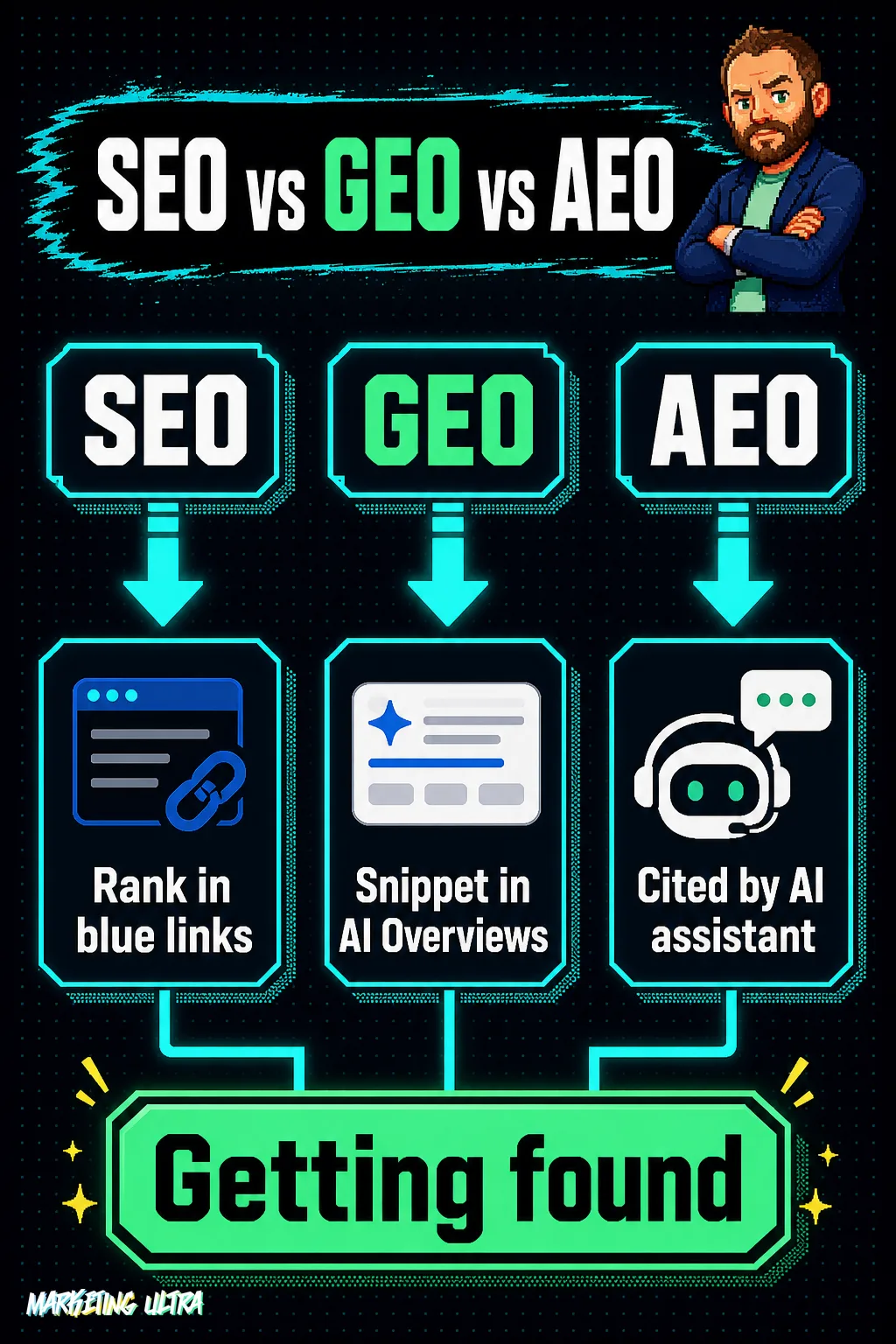
Three layers, one underlying problem: getting found. In SEO you compete for a click in a list. In GEO, for a snippet inside Google's generated summary. AEO goes a step further: getting the assistant to put your name and link alongside its answer. Perplexity does it explicitly, visible, numbered citations. ChatGPT does it when a source provides data or a perspective the model doesn't have by default.
Why does this matter now? Because traffic from AI assistants is no longer a rounding error. According to SparkToro research, nearly 60% of Google searches end without a single click to any website. A growing share of those queries is moving directly to AI chats.
And in those chats, you're either cited or you don't exist.
What Does an LLM Cite, and What Does It Ignore?
An LLM doesn't cite based on structure. It cites based on usefulness. You can have the most beautifully formatted article on the internet, schema markup by the book, flawless heading hierarchy, and no AI assistant will ever mention you. Why? Because what they cite is content that contributes something the model can't generate on its own: proprietary data and first-hand experience.
The patterns that work:
- Direct answer first: the opening sentence after each heading answers the question plainly and stands on its own. That's the fragment the LLM extracts and cites.
- Data in standalone sentences: "The average cost of X is Y according to Z." Don't bury the figure in a three-line subordinate clause.
- Citable definitions: a self-contained sentence that names and defines the concept, with no pronouns that depend on the previous paragraph.
- Real-world experience: formed opinions, detailed case studies, first-person conclusions with a name attached.
What doesn't work: the 5,000-word "ultimate guide" that paraphrases other ultimate guides. If your article says nothing that ChatGPT can't generate on its own, why would it cite you? Generic content gets paraphrased. It doesn't get cited.
Real AEO is about having something to say. LLMs were trained on the entire internet. They already have every "complete guide" and "10 tips to improve your X", yes, including yours. What they don't have is your real-world experience and your formed opinion on why something does or doesn't work in your industry. E-E-A-T isn't just Google's metric: it's what makes an LLM decide to cite you instead of your competitor. Experience earned, not declared.
How to Measure Whether AI Is Citing Your Content
Measuring AEO impact is possible, though the tools are still primitive compared to what we have in SEO. There's no "AI Search Console" or anything close. But there are three concrete ways to do it today, at zero cost.

1. Referral traffic in GA4. Check your acquisition reports and filter by source. Look for chat.openai.com, perplexity.ai, gemini.google.com, and copilot.microsoft.com. If you see traffic from those sources, you're already being cited. One caveat: many GA4 setups dump this traffic into "direct" by default when referral data doesn't come through cleanly. Configure the right filters and create a dedicated segment for AI traffic.
2. Manual testing, once a month. Open ChatGPT, Perplexity, and Gemini. Ask about the topics you cover using the keywords you already rank for. See whether you appear as a cited source. Hands-on? Yes. But it works, and it gives you a real snapshot of where you actually stand.
3. Perplexity as your benchmark. Of all the AI assistants, Perplexity is the most transparent: it shows sources with visible, numbered links. If you write about a topic and Perplexity doesn't include you in its sources when queried on that exact topic, you have concrete, actionable evidence of where to improve.
Is this a perfect methodology? Not remotely. But we're in the "installing Analytics for the first time" phase. Whoever measures first, adjusts first. And when the volume of chat queries scales up, they'll be the ones capturing the citations.
And it will scale.
HubSpot has tripled its AEO output this week with three consecutive posts on its blog. When a player that size starts covering a topic with that kind of intensity, the window to establish yourself as a niche source narrows fast. One thing to keep in mind: LLMs value real-world experience over publication volume. Your site, backed by proprietary data, can beat the 200-writer corporate blog in the citation race.
Next time you ask ChatGPT something about your industry, I want to see your name in the sources.