In 2002, an army of consultants was selling white-text-on-white-background keyword stuffing as the definitive strategy to dominate Google. In 2026, another army, with better branding, admittedly, is selling schema markup checklists and "LLM-optimized phrases" as the definitive strategy to dominate ChatGPT. Know what they have in common? They're both attacking the wrong vector.

TL;DR: The No-Fluff Summary
- GEO is repeating early SEO history: superficial tactics going mainstream, and they'll stop working the moment models evolve.
- 80% of AI citations about your brand come from third parties: not from your own optimized pages, according to Neil Patel's AI audit.
- The real strategy hasn't changed: get authoritative external sources to mention you. That doesn't happen through schema, it happens through genuinely useful content and real editorial relationships.
- Concrete action: audit which third-party sources are generating AI visibility for your brand and strengthen those relationships.
What Is GEO and Why Is Everyone Talking About It?
Generative Engine Optimization (GEO) is the set of practices aimed at getting generative AI models, ChatGPT, Perplexity, Gemini, Copilot, to cite or recommend your content when a user asks a question. The premise makes sense: if more and more people are turning to AI assistants instead of Google for answers, you need visibility there too.
So far, so reasonable. The problem starts when you look at WHAT is actually being sold as GEO.
Schema markup checklists. "Conversational phrases" force-fed into your copy. Restructuring your entire content library with Q&As so "the LLM understands it better." Building dedicated pages specifically "to get cited by AI." MarTech just published an analysis that says exactly what many of us have been thinking: this is year-2000 SEO with a new coat of paint.
Same superficial tactics. Same race to the bottom. And I'd wager the outcome will be identical: when models evolve, and they do, every few months, not every few years like Google, these tactics will stop working or get actively penalized.
The Data Point That Blows Up the Technical GEO Narrative
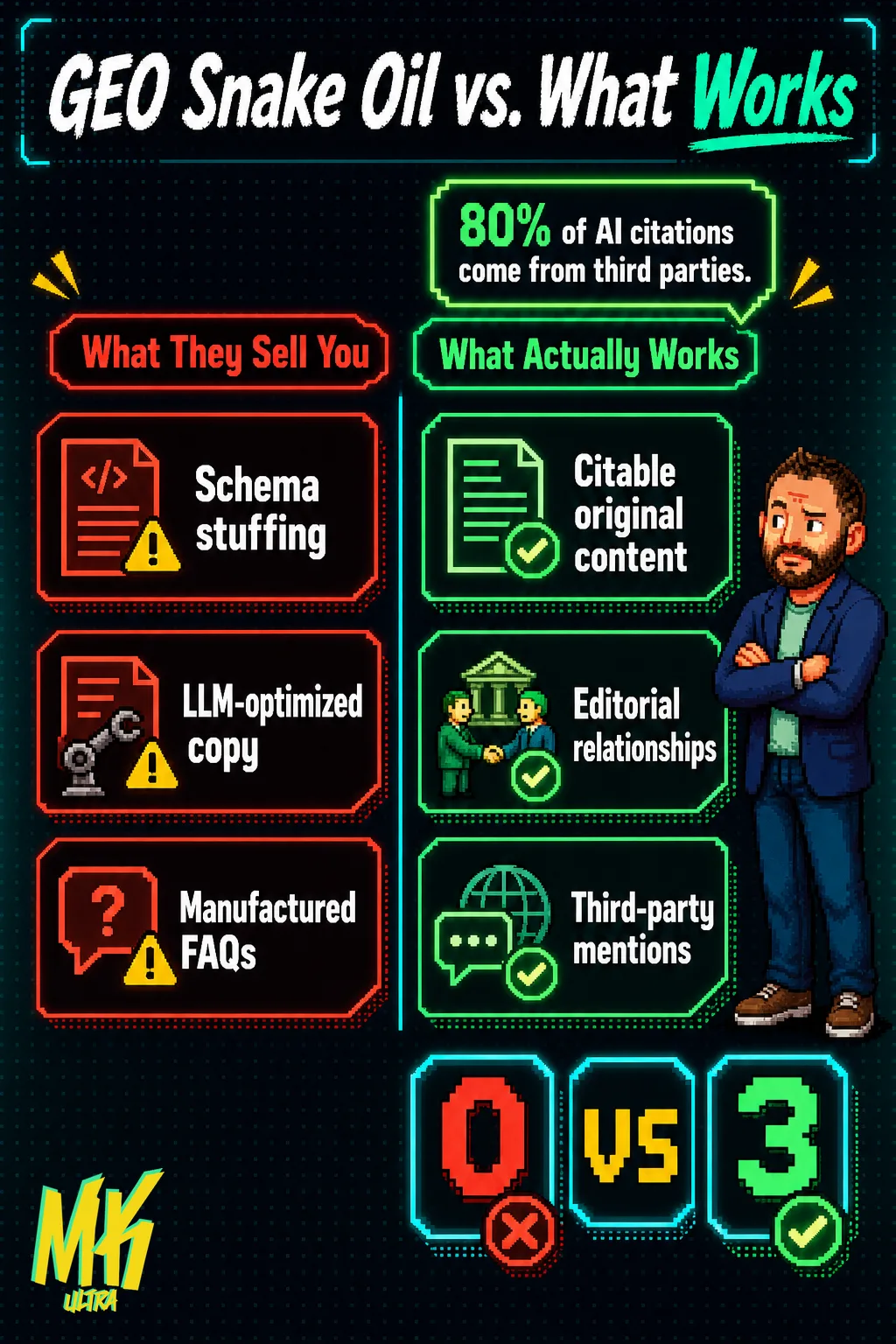
80% of the citations AI models make about a brand or website come from third-party publications, not from the brand's own optimized pages. This figure comes from Neil Patel's AI audit, and it's devastating for anyone investing hours into optimizing THEIR pages so an LLM will cite them.
Think about that for a second. You can restructure your entire site, pack it with schema all the way down to the favicon, and rewrite every H2 as a question. But if 80% of what an AI knows about you comes from what OTHERS say about you, you're optimizing 20% of the pie. And probably the 20% you control least.
If you've spent any time in marketing, this shouldn't come as a shock. LLMs are trained on the internet. And on the internet, your brand's reputation is built by external mentions: press coverage, independent reviews, forums, industry publications. Translation: what people say about you behind your back still matters more than your elevator pitch.
Same Movie, Different Format
Those of us who've been around long enough have seen this film three times. Four, if you count ASO (App Store Optimization) in 2014, which had its moment and then didn't.
And it always plays out the same way:
- A new channel emerges with an opaque algorithm.
- Early movers score easy wins with superficial tactics.
- The tactics go mainstream. Gurus appear selling frameworks and playbooks.
- The channel matures, penalizes the superficial stuff, and rewards what always worked: genuine relevance.
In early SEO, the tactics were keyword stuffing, link farms, doorway pages. In GEO, the tactics are schema stuffing, content reformatting for LLMs, and manufactured FAQ pages. The names change. The logic is identical.
And you know what survived every Google update from Panda to today? Genuinely useful content and backlinks from real authority sources. Google doesn't reward it because it's "good." It rewards it because it's the only signal an algorithm can't manufacture.
The exact same dynamic is playing out with LLMs.
So What GEO Strategy Actually Works?

The real strategy for AI visibility isn't new: get authoritative external sources to talk about you. That can't be optimized with schema markup or magic prompts.
It's built the same way it always was:
1. Content others want to cite. Not "AI-optimized" content. Content that an industry journalist, a technical blogger, or a content creator finds useful enough to reference. Original data, first-hand analysis, genuine expertise. What SEO always called link-worthy content, now it's mention-worthy content.
2. Real editorial relationships. Who covers your industry? Who publishes the reviews that LLMs are actually citing? Which trade publications could you contribute an opinion piece or a case study to? This is plain old PR. It's not glamorous and it doesn't fit on a checklist. But it's what works.
3. Audit your current AI mentions. Before you optimize anything, find out what AI assistants are actually saying about you right now. Ask ChatGPT, Perplexity, and Gemini the questions your potential customers would ask about your product or sector. Identify which third-party sources are generating those mentions. Strengthen your relationships with those sources. It's the most actionable thing you can do TODAY, and it doesn't require touching a single line of your website.
If you work with an AI-assisted content pipeline, this is doubly important: the content you produce with AI needs to pass an editorial filter that ensures it genuinely adds something new. Publishing more generic content won't get you cited more. It'll get you cited less.
The Real Cost of Chasing Superficial GEO Tactics
The brutal part about superficial tactics isn't that they don't work, some do, temporarily. The brutal part is the opportunity cost.
Every hour your team spends reformatting content to "optimize it for LLMs" is an hour not spent creating something worth citing. And the budget you pour into technical GEO tools is budget that doesn't go toward relationships with publications in your space.
And when models change, which they will, because they iterate at a pace Google never managed, all that technical optimization evaporates. Mentions in authority sources don't. Those stay in the training corpus.
It's like the difference between buying followers and building a real audience. Guess which one lasts.
What to Do Monday Morning
Open ChatGPT, Perplexity, and Gemini. Ask the questions your potential customers would ask about your product or sector. Note which sources they cite. How many are yours (spoiler: not many). How many are third-party. And which of those third parties already know you, or could.
That's your AI visibility audit. No tool required, no consultant, no framework. Just a browser and an hour of your time.
Then, with that map in hand, decide where it's worth investing: stuffing more schema into your footer, or publishing a case study in your industry's leading trade publication?
In my experience, the answer is always the second one.