An open-source skill that cuts your Claude Code spend by 75%. Gets the model to write 90% less code. Makes it run 3 to 6 times faster. If you've caught Chase AI's reel that put Ponytail on the map as the most-talked-about skill for Claude Code, you're probably already thinking about installing it. And honestly, the underlying idea isn't bad. But those numbers smell like infomercial copy.

TL;DR: The no-nonsense summary
- The repo corrected its own numbers: the README now publishes an honest agentic benchmark (~54% less code, ~20% cheaper, ~27% faster, 100% safe) and officially labels the viral 80-94% figure a measurement artifact. Exactly what we flagged in June.
- We re-tested v4.8.4 ourselves in August 2026: on an over-build trap Ponytail cut code by 85%, cost by 44%, and time by 59%. On a trivial task: no measurable difference. The savings live where agents over-build, not everywhere.
- Doesn't replace discipline: Precise prompts, the right model per task, and context reuse remain the foundation. Ponytail cuts model over-building, not user laziness.
Update (August 7, 2026): Re-tested version 4.8.4 first-hand with fresh numbers, and updated everything that changed since June: corrected official benchmarks, almost 98,000 stars, npm install, MCP server, and support for 20 agent hosts.
What Ponytail Is and How It Works in Claude Code
Ponytail is an open-source repository that has grown from 15,000 GitHub stars when we first covered it to almost 98,000 today. The mechanism is simple: a skill you install in Claude Code that enforces a deliberately "lazy" approach. Before writing code, the agent climbs a seven-rung ladder: does this need to exist, is it already in the codebase, does the stdlib do it, is there a native platform feature, an installed dependency, a one-liner. Only then does it write the minimum that works.
It stopped being a Claude Code trick months ago. Version 4.8 added an npm package, an MCP server, injection into subagents, and intensity modes (lite, full, ultra). It now ships adapters for 20 agent hosts: Codex, Gemini CLI, GitHub Copilot, Cursor, Windsurf, and the rest of the usual suspects.
Most of the buzz came from a viral Chase AI reel on Instagram, delivered with the unmistakable tone of "the one trick that changes everything." The figures in circulation: code reduction of 80-94%, cost savings of 47-77%, speed multiplied 3x to 6x. Numbers that sound like magic. And that's exactly where it pays to look more closely.
Solid Premise, Infomercial Numbers: The Real Problem with Ponytail
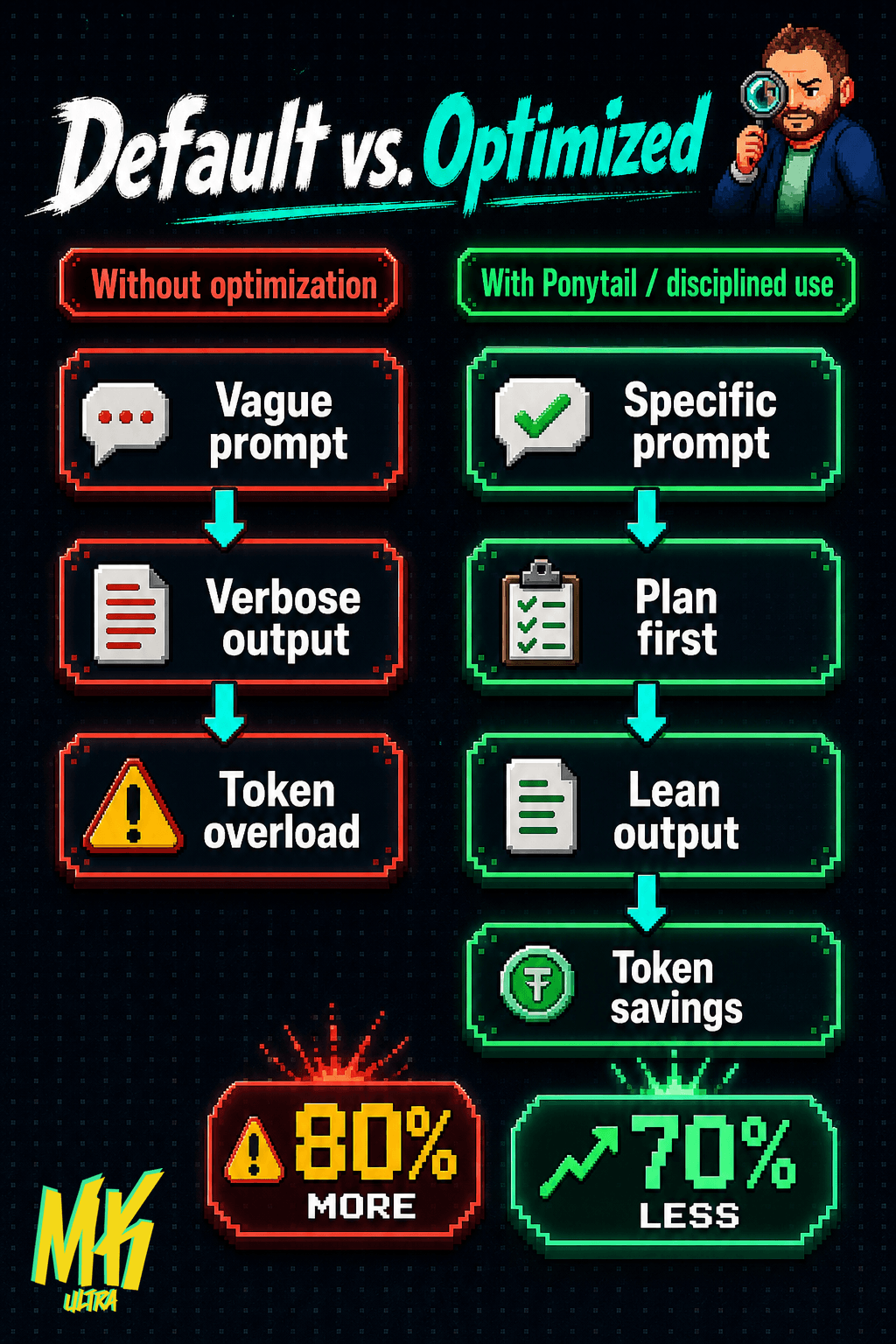
Before debunking anything, let's be fair: the core idea is correct. Language models are verbose by nature. Ask them to fix a bug and they'll rewrite half the file. Ask for a function and you get the function, the tests, the inline comments, a refactor of a neighboring module, and an apology for any inconvenience caused.
That verbosity has a real cost. With Opus, every output token is expensive. With Claude Fable 5 now in the lineup, it only gets worse. If your sessions run long and touch a lot of files, the bill climbs fast.
But 75% savings on tokens, 90% less code, 3-6x faster: compared to what, exactly? When we first published this review, there was no controlled benchmark behind those figures. Marketing numbers. Great for a reel, useless for a technical decision.
Here is the part that ages well: the project itself ended up agreeing with us. After issue #126 pointed out that the viral 80-94% came from comparing against a bare model that pads its answers with prose, the maintainer re-ran everything against a fair agentic baseline and rewrote the README. The official numbers today: around 54% less code (up to 94% on over-build traps), about 20% cheaper, roughly 27% faster, with a separate safety tier where Ponytail scores 100%. The old figures are explicitly labeled as the per-task CEILING, not the average.
A hype repo that publishes its own correction, with a reproducible benchmark harness in the same repository, is rare. It moved Ponytail from "viral trick" to "tool you can actually evaluate".
How to Spend Less on Claude Code Without Installing Anything

Most of the savings Ponytail promises are achievable through disciplined use. No new repositories, no extra skills:
- Concise, specific prompts. Instead of "fix this component," tell it exactly what to fix, in which file, and under what constraints. The more precise the input, the less noise in the output.
- Explicitly ask for less code. Adding "only modify the necessary lines, do not rewrite the file" to your prompt significantly changes what the model produces.
- Pick the right model for the task. Don't run Opus to format a JSON file. Sonnet or Haiku handle mechanical tasks at a fraction of the cost, as reflected in Anthropic's official model documentation. Save Opus for work that genuinely requires complex reasoning.
- Reuse context. If Claude Code re-reads your entire repository every session, you're burning tokens on repeated context. Skills like graphify generate a code map the model can reference without re-scanning every file.
- Cut output verbosity. Skills like caveman enforce short, direct responses. Ponytail's own FAQ now recommends pairing them: caveman shrinks what the agent SAYS, Ponytail shrinks what it BUILDS. In the official benchmark, caveman alone cut code by 20% but actually increased tokens and cost. Different halves of the problem.
None of these practices require installing a new repo. And if session costs concern you, it's worth staying on top of Anthropic's recent moves around Claude Code plans, which can shift what you pay overnight.
The Independent Benchmarks That Were Missing
When we first published this article, a key criticism was the lack of independent benchmarks. Chase AI has since run the same tests from the repository on both Haiku 4.5 (Ponytail's original model) and Opus 4.8:
| Metric | Ponytail (published) | Haiku 4.5 | Opus 4.8 |
|---|---|---|---|
| Code reduction | ~54% | 56% | 71% |
| Cost savings | ~20% | 25% | 53% |
| Speed improvement | ~27% | 30% | 71% |
Ponytail works better than advertised, but only with powerful models. With Haiku, the independent results confirm the published figures. With Opus, the jump is massive: 71% less code and 71% faster.
The explanation makes sense: more capable models are also more verbose. Opus tends to recreate from scratch functionality that already exists in libraries or within the project. Ponytail stops exactly that: "if it already exists, use it." The more verbose the model, the more room there is to cut.
Ponytail's figures weren't inflated. They were undersold, measured against a model that wasn't the one benefiting most. If you run Opus, the real savings exceed what the README promises. That said: these are benchmarks from a single evaluator with limited methodology. Since then the field has filled up: even JetBrains ran its own test in late July. When the vendor blogs start benchmarking a free skill, the hype phase is over and the tool phase has started.
We Re-Tested Ponytail v4.8.4 Ourselves (August 2026)
Independent numbers are good. First-hand numbers are better. So we re-ran the comparison on the current version, 4.8.4, with two headless Claude Code sessions on Haiku 4.5 (the same model the official benchmark uses): identical twin projects, one with Ponytail's ruleset active, one without, scored on the git diff each one leaves behind.
Task one was deliberately boring: add a date field to a signup form. Both arms produced the same solution, a native date input with min and max. Four lines against three. The Ponytail arm used 20% fewer output tokens and fewer turns, but the injected ruleset costs input tokens, so the bill came out level.
The models have learned the easy half. In June, an agent would happily install a date picker library for that task. In August, Haiku 4.5 reaches for the native input on its own. No skill needed.
Task two had a real over-build trap: a searchable, keyboard-accessible country selector with around 200 entries. This is where agents traditionally hand-roll a filterable combobox. Ours did exactly that:
| Metric | Without Ponytail | With Ponytail v4.8.4 | Delta |
|---|---|---|---|
| Lines of code added | 217 | 32 | -85% |
| Output tokens | 6,631 | 2,970 | -55% |
| Cost | $0.141 | $0.078 | -44% |
| Time | 95s | 39s | -59% |
The baseline built a 155-line custom combobox in JavaScript plus 46 lines of CSS. The Ponytail arm used the browser's native datalist element and spent most of its 32 lines on the country names themselves. Both solutions work. One of them you have to maintain.
One run per arm, so treat this as directional evidence, not a lab result. But the direction matches the corrected official benchmark exactly: near zero gain where the code is already minimal, massive gain where there is a trap to fall into. That is precisely the claim the README makes today, and our test backs it.
One warning from the maintainer worth repeating: on terse reasoning models the effect can invert, because the model burns thinking tokens deliberating the ladder. The README names GPT-5.5 as a case where it does. If you run Claude models, this doesn't affect you.
Is Ponytail Worth Installing in Claude Code?
Yes. Two months, one corrected README, several independent tests, and our own re-run later, the answer holds. The numbers back the tool, and the savings concentrate exactly where your bill hurts: the tasks where the agent would otherwise build a small framework nobody asked for.
Install it from inside Claude Code with two prompts: /plugin marketplace add DietrichGebert/ponytail, then /plugin install ponytail@ponytail. You also get a set of commands the June version didn't have: /ponytail-review hands you a delete-list for your current diff, and /ponytail-audit does the same for the whole repo. Those two alone justify the install on a legacy codebase.
That said, no skill replaces discipline. Ponytail cuts model over-building, but the real savings come from internalizing that every token costs money: precise prompts, the right model for each task, reused context. Combine that with Ponytail, and you will see it in your bill.
One last thing to watch: the repo now carries a waitlist banner at ponytail.dev. Something commercial is coming. Enjoy the free, MIT-licensed version while that lasts, and remember that in this industry, every "game-changer" has the shelf life of the next viral reel. This one, unusually, has survived two news cycles and an audit of its own numbers.
Copy this and paste it into Claude Code, Cursor, or your favorite coding assistant:
Help me install the Ponytail plugin in Claude Code: I will type /plugin marketplace add DietrichGebert/ponytail and then /plugin install ponytail@ponytail as two separate prompts (source: https://github.com/DietrichGebert/ponytail). After that, run /ponytail-review on my current diff and explain every item in the delete-list it produces.
No coding knowledge required. The assistant handles installation, configuration, and testing.