Some decisions reek of trouble straight from the headline. Valencia’s City Council has handed management of its two largest municipal shelters, Benimàmet and Natzaret, roughly 400 dogs and cats, to a joint venture between Athisa Medio Ambiente and Adda Ops S.A., for 5.2 million euros over three years. And just like that, what looked like a local story stopped being one.
Left out in the cold is Modepran, the nonprofit that has run those shelters for fifteen years. No-kill policy. Two hundred volunteers. When I read it, my first thought was the usual one: something stinks here.
But «it stinks» isn’t an argument. So instead of mouthing off like a guy at the end of the bar, I did something odd: I set the two most powerful AI models of the moment against each other and let them decide whether this is good or bad for the animals.
Why I Ran a Peer Review Between Two AI Models
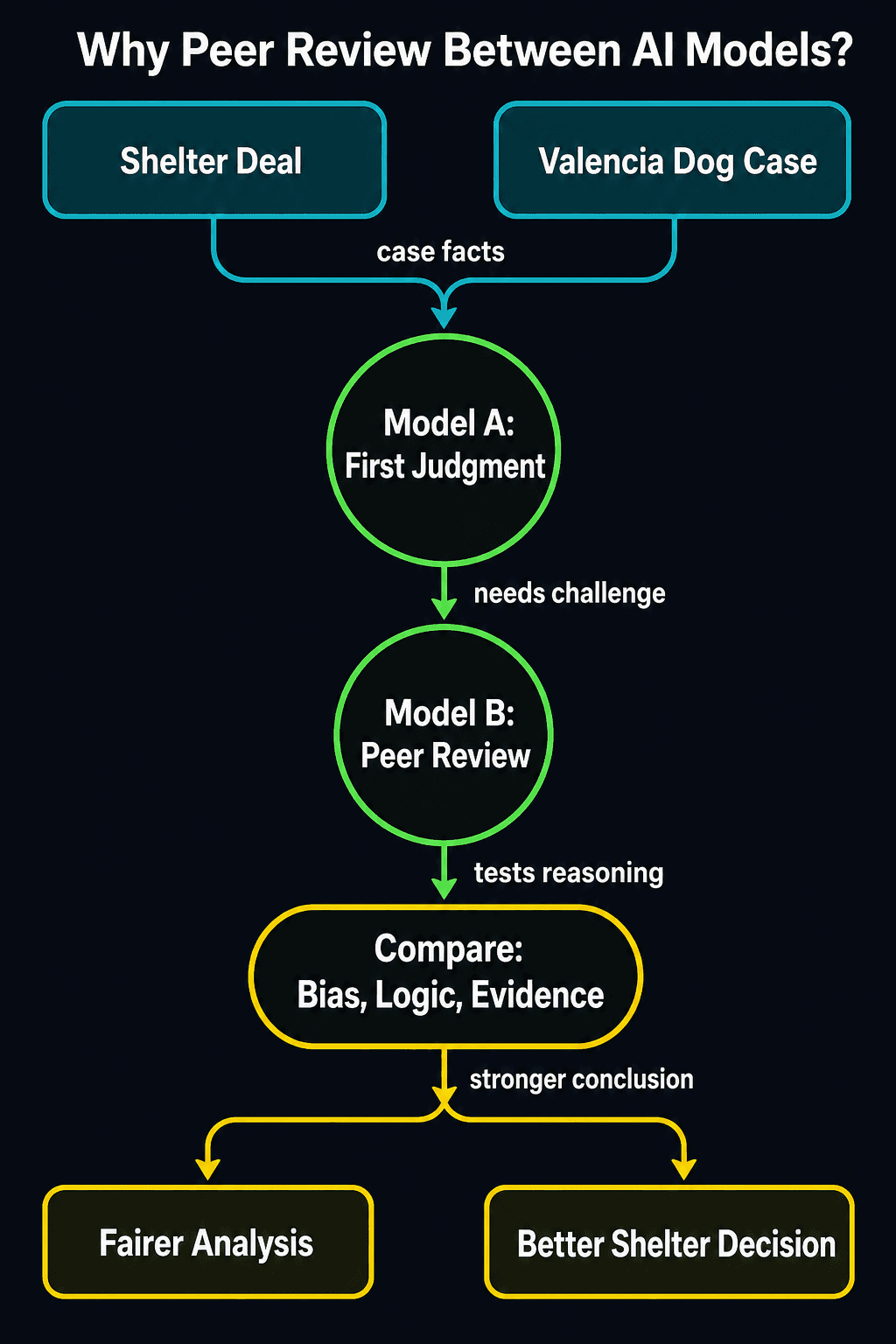
The idea is simple. If AI is so devastatingly good at scaling businesses and projects, then surely it can hold its own talking about dogs and cats.
I asked Claude Opus 4.7 for an exhaustive study of the track record of the two incoming companies and of Modepran itself, every bit of it measured against animal welfare. One question only: will the animals’ lives get better or worse after the change?
And here’s what turns this into more than a clever prompt. I didn’t settle for the first answer. I brought in Codex (OpenAI) as an adversarial reviewer: its job was to push back on Claude, hunt for bias, flag unsupported claims and double standards. A peer review between machines, the same logic behind why a system needs a human in the loop before anything gets the green light.
Codex surfaced 15 material findings in the first round. Animal-rights bias, unsourced data, uneven leniency. Claude fixed every one of them. Second round, Codex’s verdict: APPROVED, a reasonably balanced risk analysis. Only then did I trust it.
What the Track Record of Athisa and Adda Ops Reveals
This is where it gets serious. And it’s not me saying it, it’s the public record. The history of Athisa that the investigation pieced together includes municipal disciplinary files in Logroño in 2024 over understaffing, a contract cancellation in Motril in 2023 over overcrowding, four towns walking away from the Mancomunidad de Cádiz with complaints confirmed by Spain’s environmental police (SEPRONA), and further complaints in Granada. Much of it is documented by specialist outlets such as srperro.com.
This isn’t an activist campaign. It’s a pattern.
The partner, Adda Ops, has no documented experience running shelters for domestic animals. Its real business is wildlife control. Translation: it culls rabbits for Spain’s rail operator along the high-speed train lines. For these two companies, animal welfare isn’t the mission, it’s a growth vertical. A business line. And that alone says plenty about intent.
On the other side, Modepran: fifteen years, an explicit no-kill policy, and results you can actually check, like its 300-plus adoptions in the first year in Paterna. Is it flawless? No. The investigation also flagged sources with bad practices and a technical proposal that was thin on the veterinary side. No organization is spotless, and that has to be said. You can see its work at modepran.org.
But the question isn’t whether Modepran is perfect. It’s what happens when you swap it out for this.
The Verdict on the Valencia Contract: Qualified, but No
Both AI models answered the two questions that matter.
Is the joint venture qualified? On paper, yes. By the letter of the law and the tender, it checks the boxes. In substance, no. And mind you, I’m not talking about morality or hurt feelings. In substance: there are serious, unresolved risks.
The forecast was damning on four fronts:
- Volunteers: a for-profit company doesn’t replace 200 free volunteers with paid staff without that translating into more hours behind bars for the animals. The joint venture hasn’t addressed this.
- No-kill policy: a reasonable risk that it stops being an explicit guarantee.
- Transparency and community: fifteen years of a neighborhood network can’t be copied with a contract.
- Potential upside: it amounts to technical standardization. Slim pickings, set against everything that’s lost.
One detail left me cold. Without my prompting anything of the sort, Claude noted that the formal grounds for excluding Modepran smell like a tailor-made tender: the kind of outcome that only shows up when the specs are written to favor whoever knows how to write the specs. Let me translate: a stitch-up.
And a note on honesty, because this is about rigor: Codex reminded Claude that it hadn’t been able to access the full tender document. Even so, with all the public legal and administrative jargon on the table, the arguments held up. The process has been covered by outlets such as eldiario.es, Valencia Plaza, Cadena SER, and Valencia’s own College of Veterinarians (ICOVV).
Don’t Take My Word: Download the Full Report

This is what matters most to me. I don’t want you to believe me because I write with an edge. I want you to judge it yourself.
The complete study with every fact, source, and both rounds of adversarial debate between Claude and Codex. Unedited. Unfiltered. Judge for yourself.
The conclusion Claude added, when explicitly asked and with no idea where I stood, was blunt: a structural net worsening, with high probability. A political decision dressed up as a technical one. Convenient for the council. The animal foots the bill.
Will more dogs die or live worse lives? The reasoned bet is yes. And if I were Modepran, I’d take the legal challenge all the way to the end.
We’ve spent years being told to listen to AI to empower professionals, create jobs, and grow companies. If we believe AI can also make us better, let’s listen to it when 400 animals’ lives are on the line. Don’t take it from me. Take it from the AI.
For the animals, I’ll spend my tokens.