MiroFish generates thousands of AI agents with their own personalities and memory, lets them interact with each other, and predicts how the market will react to your launch, your price, or your campaign. Massive AI simulation to rehearse market response before spending a dime. Over 73,000 GitHub stars, AGPL-3.0 license, and a live demo: the question isn't whether it exists, it's whether it actually works.

TL;DR: The No-Nonsense Summary
- What it is: An open-source swarm intelligence engine that simulates thousands of AI agents to predict market reactions to a launch, a price, or a campaign.
- Traction: 73,593 GitHub stars, backed by Shanda Group, engine built on CAMEL-AI's OASIS.
- Real cost: The tool is free (AGPL-3.0), but every simulation burns tokens from whatever LLM API you configure.
- The big catch: Agents are LLM prompts with no evidence verification. They can generate convincing answers with no real basis.
In this article
| What it is | Open-source swarm intelligence engine that simulates thousands of AI agents to predict the outcome of social, market, or political scenarios. |
|---|---|
| Official website | https://mirofish.ai/ |
| Repository | repo |
| License | AGPL-3.0 |
| Pricing | freemium |
| Alternative to | manual forecasting with spreadsheets and focus groups |
| GitHub Stars | 73,593 |
| Launch year | 2025 |
| Maintainer | 666ghj (individual) |
Reviewed on 2026-09-15
This tool is part of the living roundup Skills for Claude Code, Codex and other code agents →
The Problem It Solves
MiroFish targets a gap every marketing team knows well: there's no cheap dress rehearsal for the market. Testing a campaign or a launch with real people means a focus group that costs thousands and takes weeks, a survey riddled with self-selection bias, or, let's be honest, launching and hoping for the best.

The pitch is straightforward: give it your material (a launch post, a new price point, an ad), tell it what you want to know, and MiroFish generates hundreds of AI personas with diverse profiles. It lets them react to each other and hands you back a prediction report. A synthetic focus group, running twenty-four hours a day, with no moderator and no catering bill.
Under the hood, its simulation engine runs on OASIS (Open Agent Social Interaction Simulations), a research project from CAMEL-AI. This isn't a side project with a pretty README: it has an academic foundation and corporate backing from Shanda Group.
Getting It Up and Running
MiroFish is deployed from source (Node.js + Python) or via Docker, and needs two external API keys to work.
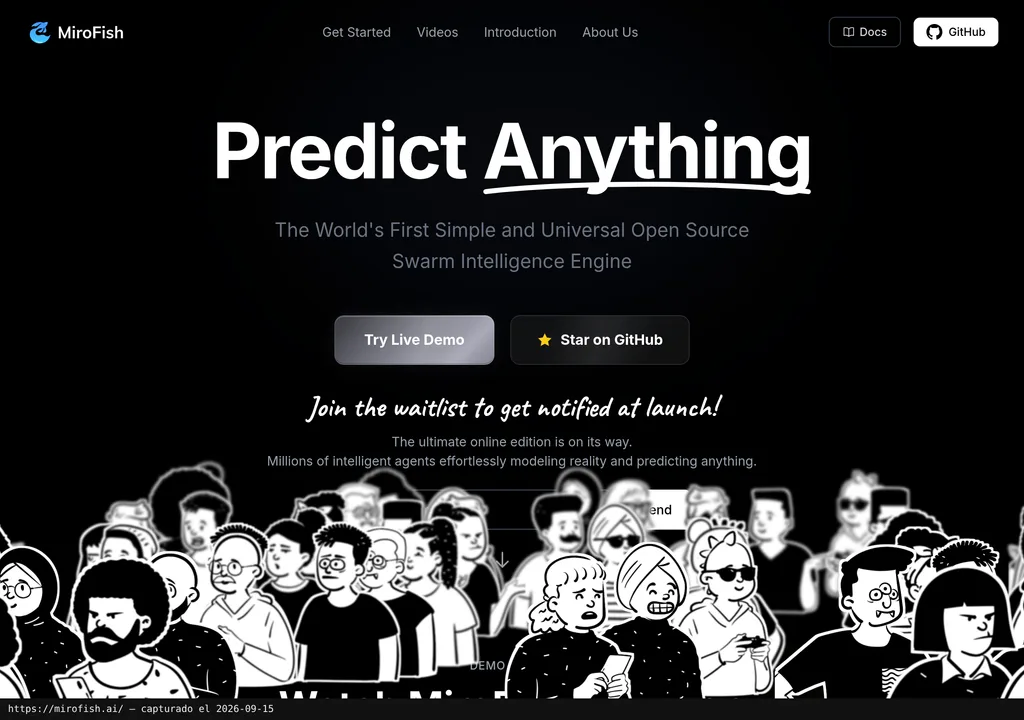
For the source route: clone the repository, copy .env.example to .env, and fill in two required keys. The first is an LLM API compatible with the OpenAI SDK format (the project recommends Alibaba's Qwen-plus via Bailian). The second is a Zep Cloud account for agent memory, which offers a free monthly quota for basic use. Requirements: Node.js 18+, Python between 3.11 and 3.12, and the uv package manager.
Then: npm run setup:all installs everything and npm run dev starts the services. Frontend at localhost:3000, API at localhost:5001. With Docker it comes down to copying the .env and running docker compose up -d. If you'd rather not install anything yet, there's an interactive demo to experiment with a pre-designed scenario.
Copy this and paste it into Claude Code, Cursor, or your favorite coding assistant:
Clone https://github.com/666ghj/mirofish, configure the .env with my LLM API key and a free Zep Cloud account, install dependencies with npm run setup:all, and run a test simulation with 20 agents reacting to this launch text: [paste your text here].
No coding knowledge required. The assistant handles installation, configuration, and testing.
Using It in Real Marketing Work
So what does this actually get you if you work at an agency or as a freelancer? The typical scenario: a client wants to "validate the message before investing in paid media." Translation: three weeks of surveys, an external market study, or your gut feeling dressed up as strategy.
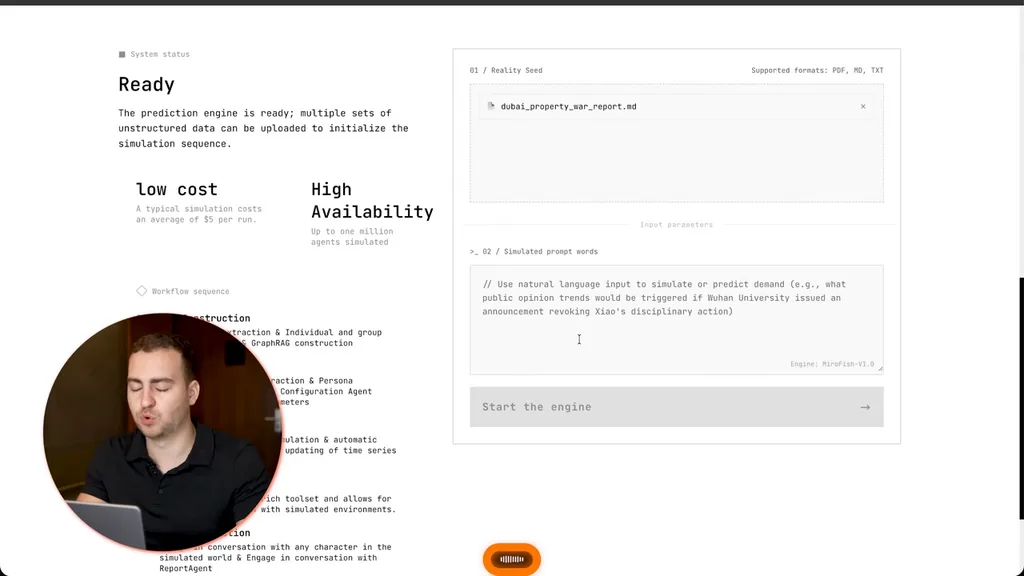
With MiroFish you could feed the simulation your landing page draft, the proposed price, and the ad copy. Generate 500 agents with varied profiles and see what comes out. We've already covered AI agents applied to marketing: MiroFish goes a step further, because it simulates a complete social behavior pattern.
My take: the useful part isn't taking the simulation at face value. It's the angles you hadn't seen. If 300 of your 500 agents react badly to the price but not the product, that's a signal. Not a truth, a signal. Anyone who confuses the two has a bigger problem than tool selection.
What They Don't Tell You
MiroFish agents are LLM prompts, not simulated people with real cognition. Each persona's "opinion" is what a language model predicts someone with that profile would say. Those profiles haven't lived through anything. What they return is a language model predicting which words follow other words. ONLY that. And that has a ceiling. Know it before making decisions based on what it returns.
The cost: MiroFish is free, but every simulation consumes tokens from whatever API you've configured. A long simulation with hundreds of agents can send the bill soaring. The README itself recommends starting with fewer than 40 rounds.
The setup isn't trivial. Two API keys, a specific Python environment (3.11-3.12, no other version works), Node.js, and uv. For a marketing professional without a technical team, this barrier is not a minor hurdle.
And the license. AGPL-3.0 requires you to release any modifications you distribute under the same license. If an agency wants to embed MiroFish in its own product, check the legal implications before building anything.
What People Are Saying
On r/MiroFish, a user opens the debate by asking what the real barrier to using the tool is, putting the usual suspects on the table: setup complexity, documentation gaps, prompt design, and not knowing whether the output has any real quality. The path from "I'll install it" to "it gives me something useful" is longer than the README suggests.
"For most people I assume it is one of these: setup complexity cost unclear use cases documentation gaps prompt design not knowing how to evaluate output quality What is the real blocker for you right now? Would be useful to see whether the biggest problem is technical, conceptual" srch4aheartofgold on Reddit
"TL;DR: MiroFish spawns AI agents to predict things. Cool idea, but the agents hallucinate and they make up plausible justifications with zero evidence checking. I built Brain in the Fish , a Rust MCP server that fixes this with a Spiking Neural Network verification layer that mak" Successful-Farm5339 on Reddit
"TL;DR: MiroFish spawns AI agents to predict things. Cool idea, but the agents hallucinate and they make up plausible justifications with zero evidence checking. I built Brain in the Fish , a Rust MCP server that fixes this with a Spiking Neural Network verification layer that mak" Successful-Farm5339 on Reddit
On r/SideProject, a developer built an entire project ("Brain in the Fish") to solve what he sees as MiroFish's core problem: that the agents "fabricate plausible justifications with no evidence verification." When someone builds a whole tool to patch another tool's central hole, that tells you everything about how serious that limitation is.
Alternatives
MiroFish competes with the classics: in-person focus groups, quantitative surveys, and spreadsheet forecasting models. AI simulation wins on speed and cost. The alternatives win on something that can't be manufactured: real people with real opinions.
As of today, there's nothing open-source with comparable traction. If you're after genuine validation, online surveys remain the most reliable and accessible option. MiroFish doesn't replace them, it precedes them as a cheap first filter.
Verdict
MiroFish's idea makes sense. The execution still has rough edges. The promise of simulating thousands of customers before launch sounds great, but what you're actually simulating is what an LLM thinks those customers would think. That's not the same thing.
Is it worth trying? If you have the technical chops to set it up and the discipline not to confuse a simulation with a validation, yes. It makes complete sense as a cheap first filter before you commit serious budget. But nobody should mistake this for talking to real people, because it doesn't come close.