Google wants you to appear on camera without actually appearing on camera. Upload a selfie, record a short voice clip, and its AI builds a digital double that delivers any script you put in front of it. Google Vids has just launched AI avatars powered by Gemini Omni: video production at scale with no camera, no studio, and no excuses.
It sounds revolutionary. And like most things that sound too good to be true in the Google ecosystem, there's fine print.

TL;DR: The No-Fluff Summary
- AI avatars in Google Vids: digital clones that speak, gesture, and deliver scripts on video without anyone stepping in front of a camera. Powered by Gemini Omni.
- 24 languages and scalability: a single avatar can localize videos for multiple markets without re-shooting. A game-changer for international e-commerce.
- GDPR and biometric data: building an avatar from your face and voice means processing biometric data. In Europe, that is not a trivial matter.
- Availability in the EU: Google declared a global GA launch, but there is no explicit confirmation for EU or EEA countries.
In this article
What Are Google Vids AI Avatars?
Google Vids AI avatars are digital doubles capable of speaking, gesturing, and delivering a script on video without anyone needing to step in front of a camera. They run on Gemini Omni and Gemini Audio, which gives them an expressiveness well above the robotic talking-head avatars we have all suffered through in corporate slide decks for years.
There are two ways to create them. First: pick a preset avatar from the gallery, with options for gender, age, outfit, and visual style (photorealistic, 3D, or graphic novel). Second, and more interesting: upload your own photo and a short voice recording, and Vids builds a digital version of you that delivers the script as if you had recorded it yourself.
You can also start from text descriptions or reference images to customize actions, outfits, or even incorporate your brand logo. Every generated video carries a digital watermark identifying it as AI-generated content. At least Google had the decency not to hide it.
How Can Marketers Use Google Vids AI Avatars?
This is where things get genuinely interesting for those of us doing this work day in, day out.
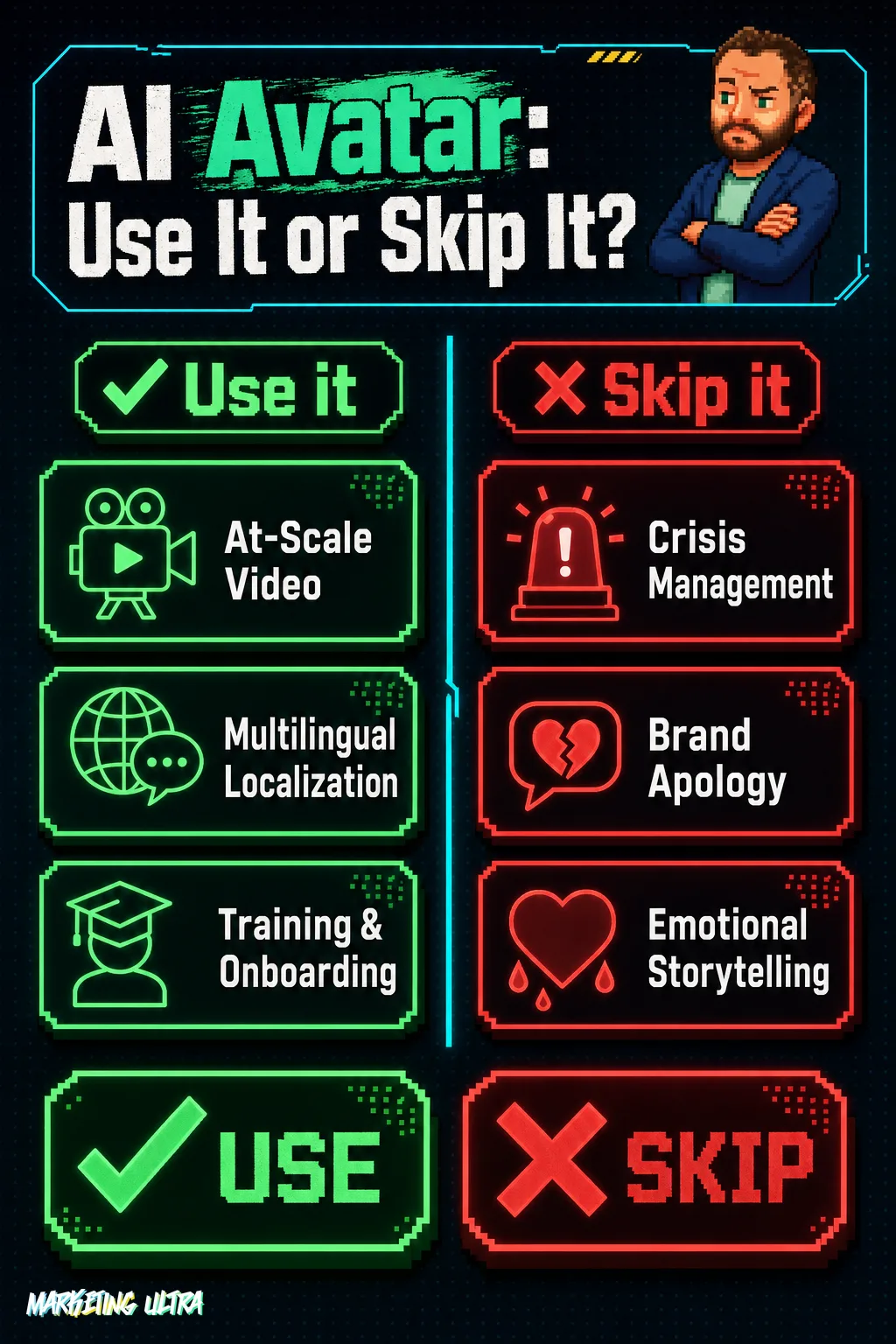
Video at scale, no production bottleneck. If your team needs product demos, tutorials, or social content and the constant hold-up is that nobody wants to get in front of a camera, this solves it. An avatar records in minutes what takes a human team a half-day once you factor in prep, takes, retakes, and editing. For e-commerce operations with large catalogs, the difference is enormous. It is one more piece of the puzzle of automating content production with AI, a path we are already walking at the agency.
Localization without re-shooting. Google Vids already supports avatars in 24 languages, including Spanish, Portuguese, French, German, and Italian. One video, one avatar, multiple markets. You keep visual brand consistency while adapting the language without repeating production. For brands with international reach, this removes one of the most expensive friction points in video.
Training and internal communications. Employee onboarding, compliance protocols, company-wide updates. The avatar never has an off day, never takes vacation, and delivers the message exactly as written. (The dream employee, basically.) For distributed teams, it scales without friction.
And what is it NOT good for? Anything that requires real human connection. Crisis management, emotional storytelling, content where authenticity is the actual value. If your brand needs to apologize, have a real person look into the camera and say it. An avatar saying "we are truly sorry" is about as warm as an automated reply.
Ethics, GDPR, and the Risk Nobody Wants to Talk About
Before you rush off to clone yourself, pump the brakes. There is more legal and ethical weight here than it first appears.
The authenticity trap. A well-made avatar fools the eye. Which cuts both ways. If your audience discovers that convincing "spokesperson" is AI and you had not disclosed it, trust evaporates. Google's watermark is a good start, but the responsibility for transparency with your audience remains yours. Hide the fact it's AI and it will blow up in your face. That is just how it works.
The legal ground is shifting fast. In the United States, laws like Tennessee's ELVIS Act already protect voice and likeness against unauthorized digital replication. In Europe? GDPR has quite a bit to say about collecting biometric data, your face and voice, to build an avatar. The fact that Google offers the feature does not mean your specific use case is legal in your jurisdiction. If you are creating avatars using employees' likenesses, make sure you have explicit, documented consent.
The uncomfortable question. Are we looking at a tool that makes corporate video cheaper, or another Google move to make you more dependent on Workspace? You already rely on them to acquire customers, track behavior, and manage your email. Now they want to be your video production house too. This is not the first time Google has pushed AI-powered creativity inside its own ecosystem, and every new piece locks you in a little more.
My read: the real play here is not selling you avatars, it is making Workspace so sticky that switching becomes unthinkable. The avatar is the candy. Lock-in is the business model. Those of us who have spent years watching Google roll out changes quietly know that today's convenience always comes with a price tag. It always does.
Availability in the EU: The Open Question
Google Vids has declared a global GA launch, but TechCrunch's coverage from July 16, 2026 does not explicitly confirm availability in any EU or EEA country. As of today, there is no confirmed rollout for EU markets. Before communicating this to clients or teams, verify directly in your Google Workspace console.
Is It Worth Testing Google Vids AI Avatars?
If you produce video at scale for training, demos, or localization and you are already inside Google Workspace, testing it makes sense. It is a powerful tool for eliminating the production bottlenecks that have held back marketing and e-commerce teams for years.

But it does not replace video featuring real people when connection is what matters. Use it for operational content, not strategic content. The avatar that reads your onboarding script? Perfect. The face of your brand going out on a limb with a genuine opinion in front of a camera? That is still irreplaceable.
Because if there is one thing I am certain of in this industry, it is that people buy from people, not from pixels. And no matter how much Gemini you feed it, an avatar will never go out on a limb.
Frequently Asked Questions About AI Avatars in Google Vids
What is Gemini Omni and what role does it play in the avatars?
Gemini Omni is Google's multimodal model that processes text, audio, image, and video in an integrated way. In Google Vids, it is the engine that allows avatars to speak with natural intonation, gesture, and adapt facial expressions to the script's content. Without Gemini Omni, the avatars would be robotic talking heads with mechanical movement.
Do Google Vids avatars cost extra on top of Workspace?
Google Vids is part of Google Workspace and avatar features are included in the GA release, but Google has not publicly detailed whether there will be usage limits or additional costs per generated avatar. Check your Workspace plan's terms and conditions before planning production at scale.