Facebook has become a hotel that charges you to open a window. You've spent years posting links to your website, your store, your newsletter, standard practice, the defining function of the internet itself. Meta has started limiting external link posts to two per month on certain Pages and charging for each additional one through Meta One, its new subscription service. Charging to link. For the most basic function on the web.

TL;DR: The No-Nonsense Summary
- 2 links per month cap: Meta restricts organic posts with external links on Pages and professional profiles. Selective rollout since September 2026, not universal yet.
- Eye-watering pricing: In a documented case in Australia, Facebook offered 8 extra links for AUD 61.99/month and unlimited links for AUD 599/month (around €360). Rates vary by country and account.
- You're paying for what was already free: Meta hasn't created anything new, it removed a basic feature and is now selling it back. First it killed organic reach for link posts; now it's monetizing them.
- The pattern is bigger than one feature: With Meta One and Meta Muse, every new product closes the exit ramp toward the open web a little further.
In this article
From Silent Test to Paid Feature
In December 2025, Meta confirmed to TechCrunch a limited test: certain Facebook Pages and profiles in professional mode without a subscription could only publish two organic posts with external links per month. Editorial pages were excluded, they said. It was just a test, they said.
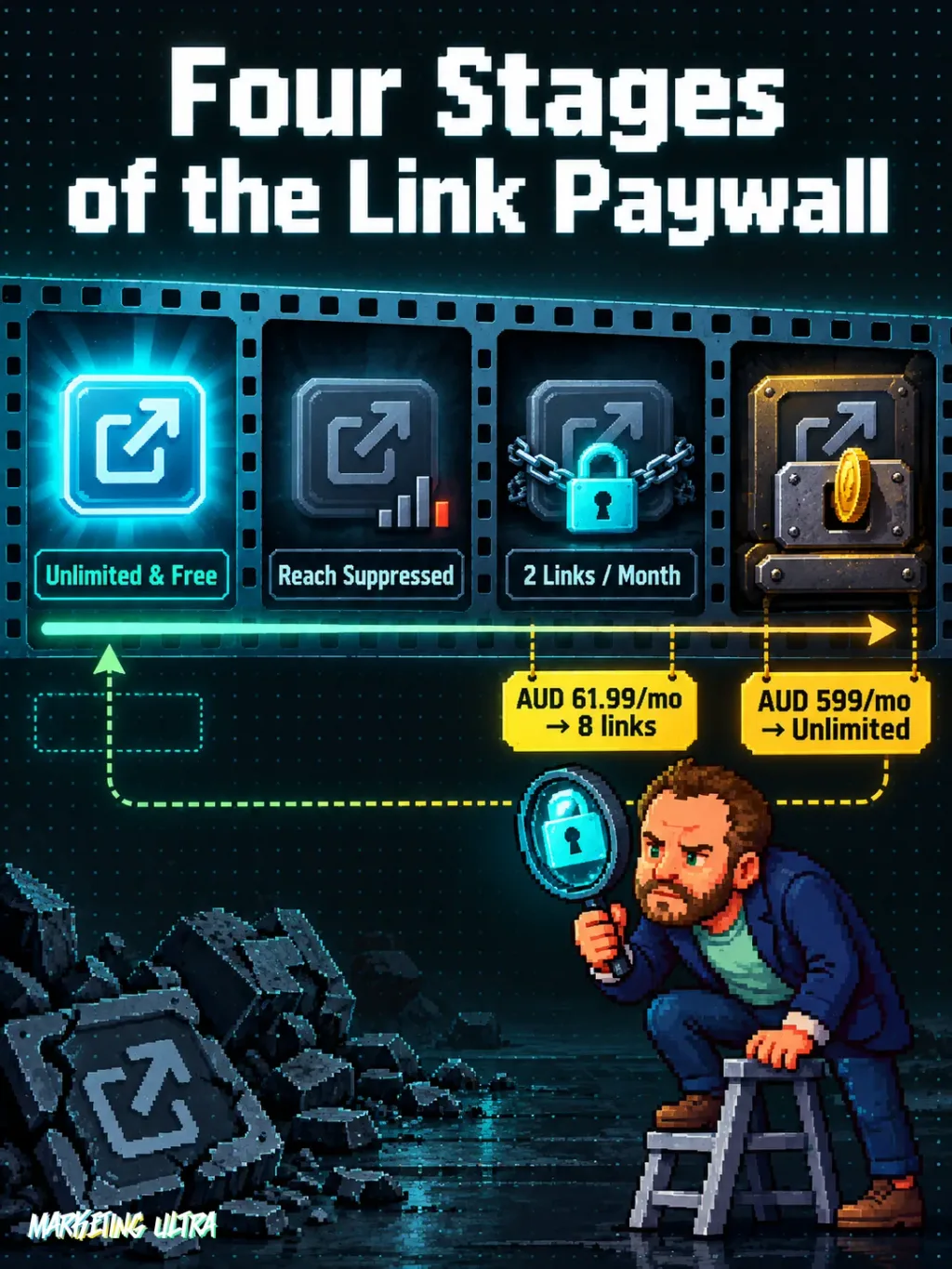
Nine months later, in September 2026, Meta launched Meta One: a subscription service bundling tools across Instagram, Facebook, WhatsApp, and Meta AI. The Advanced plan explicitly includes the ability to add links in organic posts and Reels. What was free is now behind a paywall.
Social Media Today documented that since the launch, more Pages are hitting the two-link monthly cap. The "experiment" framing no longer holds: there's a business model here. And the stated goal of the original test says it all, they wanted to measure whether posting more links "added value" for subscribers. Translation: they wanted to know how many people would pay for something that used to be free.
What Does Linking Actually Cost? A Real Case from Australia
Meta hasn't published global pricing. Meta One rates vary by region, account type, and account history. But one documented case makes your stomach drop.
On September 17, 2026, Vetanswers published real screenshots of what Facebook offered them in Australia after they burned through their two free links: AUD 61.99/month for 8 additional links (Advanced plan), AUD 179/month for 20 links (Expert plan), and AUD 599/month for unlimited links (Max plan).
To put that in perspective: AUD 599 is roughly €360. Per month. To link to your own website from your own Page. Not for advertising, not for extra reach, not for any new tool. Just to LINK.
Worth noting: these are Australian dollars from one specific case, don't treat them as universal pricing. But the mechanic repeats in every market where this is rolling out: strip the feature, then sell you a subscription to get it back.
They Strip It Out, Then Sell It Back
Charging for a new tool is fair. Generative AI, advanced analytics, whatever, you create value, you set a price. No problem.
What Meta is doing is something else entirely. It took a feature that has existed since day one of Facebook, a feature that defines what a page on the internet even is (the ability to link to things), and pulled it. Now it's selling it back. It's like your mobile carrier announcing tomorrow: "You can only make two calls a month. Want more? Subscribe." You're not getting anything new. They took something away and are charging you to get it back.
Mari Smith has spent years documenting how link posts have always had the worst organic reach on Facebook. The platform was already penalizing them in the algorithm long before it started charging for them. First you degrade the product. Then you charge to restore it. It's an old playbook, and it works.
And the contradiction is hard to miss: Meta pours billions into AI to generate content inside its own walls, pushes creators to produce Reels and native text, and simultaneously penalizes anyone trying to drive their audience toward an asset they actually own, a blog, a YouTube channel, a store. The message is unambiguous: create here and stay here. If you want to take your audience off our platform, pay up.
This isn't an isolated move. Meta already launched Meta Muse, an AI agent that lets users buy directly inside the platform without ever visiting your website. Every new product tightens the fence a little more.
Your Site, Your List, Your RSS: What Nobody Can Take From You
Rented audience vs. owned assets. It has always been this way. But every move like this turns it from a best practice into an emergency.

Your Facebook Page and your Instagram account are not yours. Your followers on any platform belong to the platform, and the platform changes the rules when it suits them. Today it's links. Tomorrow it could be video reach. Or access to your own direct messages.
What is yours: your website, your email list, your RSS feed, your community built on infrastructure you control. Nobody can charge you for linking from your own domain. Nobody can cap how many emails you send to your list (except your provider, and you can switch that in an afternoon).
At Marketing Ultra, we see it every week: businesses that depend on a single platform panic the moment that platform changes the rules. My bet is that this move will accelerate something already underway, serious creators and businesses will stop treating Facebook as an organic distribution channel and use it exclusively as a paid advertising platform. Ironic. Meta set out to monetize organic links and is going to end up killing them off entirely.
If your marketing strategy depends on Zuckerberg not raising prices tomorrow, you don't have a strategy. You have a lease with an unpredictable landlord. And the landlord just raised the rent for opening a window.
Frequently Asked Questions About Facebook's Link Post Limit
Does the two-link cap already apply to all Facebook Pages?
No. As of September 22, 2026, the restriction is a selective rollout tied to the Meta One launch, not a universal cap for all accounts. Meta began the test in December 2025 with certain Pages and professional profiles, and explicitly excluded editorial pages. More Pages are receiving it, but it is not yet widespread.
Is Meta One pricing for links the same in every country?
No. The documented rates (AUD 61.99, AUD 179, and AUD 599/month) come from a specific case in Australia, in Australian dollars. Meta One pricing varies by region, account type, and account history. Meta has not published an official country-by-country price list, so the Australian figures should not be used as a global benchmark.