Your website has two types of visitors: humans and AI agents. You're only optimizing for one of them, and it's not the one that's growing fastest. Cloudflare, one of the largest internet infrastructure networks in the world, has been making it clear for months: the agent-native web is already here. Infrastructure deployed, running in production.

TL;DR: The straight talk
- Agent-native web: a site designed so AI agents operate as full-fledged visitors, not intruders crashing into a CAPTCHA wall.
- More machines than people: over 50% of web requests in July 2026 already came from bots and automated agents, according to Cloudflare itself.
- Cloudflare builds the layer: Markdown for Agents, Browser Rendering, Pay per Crawl, and Turnstile. A complete infrastructure stack to tell humans and machines apart.
- The silent risk: depending on whoever controls that layer is the new "depending on Google." The rules can change without warning.
In this article
What an agent-native web actually is
An agent-native web is a site designed from the ground up so that AI agents are first-class operators, not accidental visitors who hit a CAPTCHA wall. The human supervises; the agent executes: it browses, extracts data, compares prices, and even completes purchases.
Sounds like science fiction? The numbers say otherwise. Over 50% of web requests in July 2026 already came from automated agents and bots, according to the Cloudflare agentic internet bot report. And 52% of crawler requests are now destined for AI model training, compared to 22% in spring 2025.
In just one year, machine traffic has overtaken human traffic.
What Cloudflare is building for AI agents
The viral reel that kicked off this conversation referenced two buttons on the Cloudflare website: one for "human," one for "machine." Reality isn't quite that literal, but it's considerably bigger.
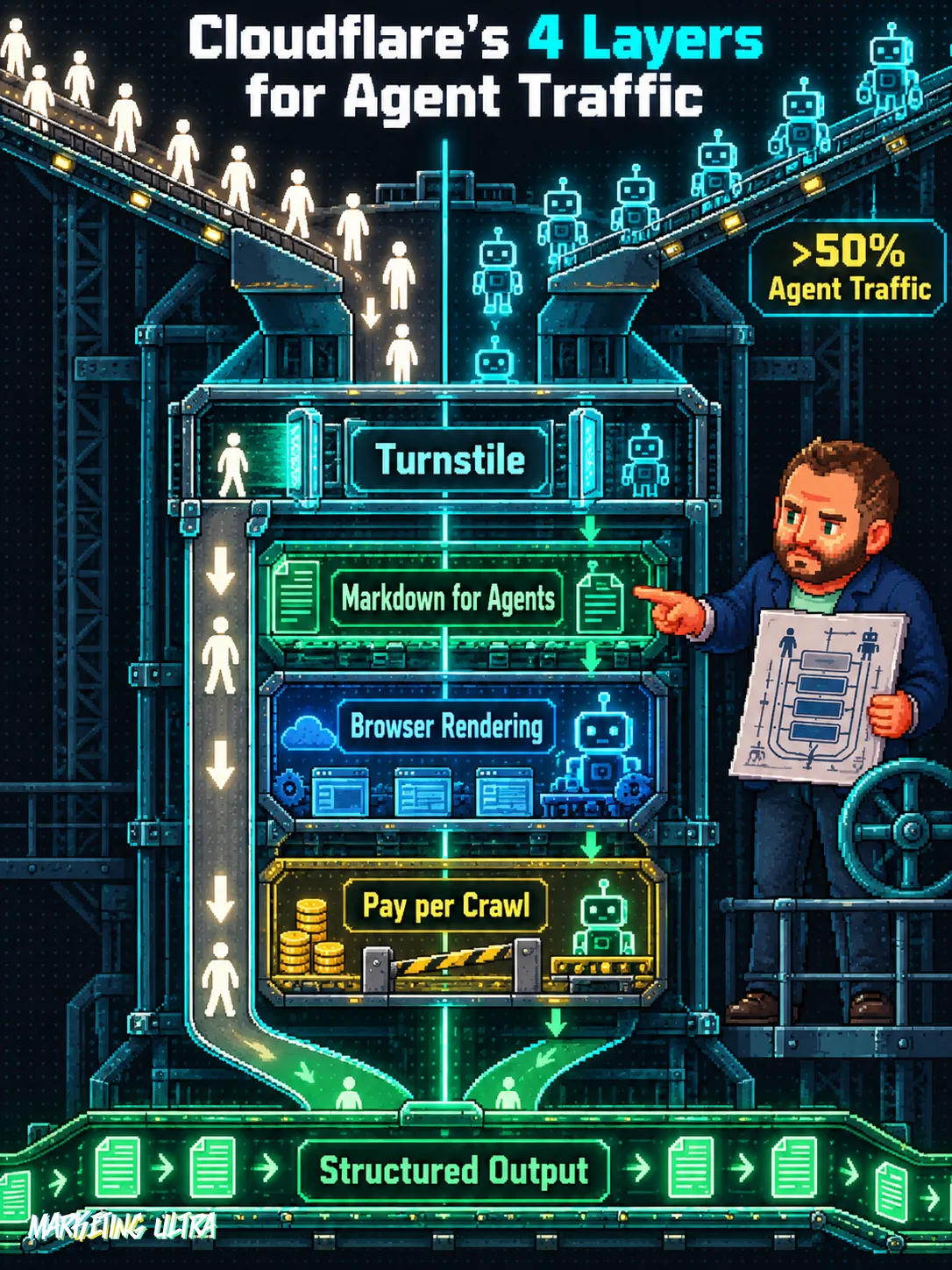
Cloudflare is building the complete infrastructure for an agentic internet. Four pillars:
- Markdown for Agents: a format that lets agents read your site without loading all the HTML, reducing bandwidth and token consumption. Think of it as RSS for the agentic era.
- Browser Rendering: headless browsers in the cloud, built so agents can automate tasks and extract data without spinning up a full Chrome instance.
- Pay per Crawl: a marketplace where AI bots pay to crawl your content. Your content, your rules, your price.
- Turnstile: human verification without CAPTCHA, while quietly classifying and managing bot traffic behind the scenes.
The human/machine separation already exists, it just lives in the infrastructure layer, not in a visible button.
The stated goal: an agentic internet that is "readable, discoverable, invocable, and monetizable." Four adjectives. None of them means "free."
What changes when agents visit your site
If more than half your traffic is already machine-generated, optimizing only for humans is like running a store with the back door bricked up. And it's through that door that agents are walking in, or trying to, the ones comparing prices and recommending brands inside ChatGPT, Perplexity, Gemini, or whatever comes next.

We've spent time talking about AEO and how to optimize so AI cites your site: if your content isn't extractable by an LLM, you don't exist for a growing chunk of your audience. The agent-native web is the infrastructure layer that makes that citability possible. Without it, it doesn't matter how well you write.
But a word of warning: Pay per Crawl sounds great on paper, but I'd bet it's going to create a new divide. Large sites with high-value content will be able to monetize their corpus. Smaller ones will sit at the back of the line, hoping some agent crawls them for free. Same story we lived through with publishers and Google News. Only worse.
And the deeper risk: the more you optimize for agents, the more you depend on whoever controls that layer. Sound familiar? It's exactly what Google has been doing with Ads accounts for years, build the infrastructure, make it indispensable, then move the goalposts without making a sound. If you want to understand how AI agents are already reshaping marketing campaigns, the pattern is the same: whoever controls the channel controls the rules.
Where to start without losing your mind
You don't need to rewrite your entire website tomorrow. But you do need to understand that the visitor has changed, and that infrastructure is adapting far faster than most businesses.
Getting practical:
- Assess whether your site is agent-ready. Check how much of your content is readable and extractable by AI agents. If you've never thought about it, that's already your answer.
- Review how you serve content to bots. If your robots.txt blocks everything except Googlebot, you're shutting the door on agents that could be recommending your product. Tools like Firecrawl let you see your site through an agent's eyes.
- Structure your data for extraction. It's not just schema markup: it means standalone answers, quotable paragraphs, clean definitions. Everything an agent can take away without having to parse a JavaScript carousel.
Cloudflare already has this in place. And every day your website only speaks human, agents skip right past it.