There's a game I've been watching play out for too many months. A manager who hasn't been able to make a tough call in three years suddenly discovers AI, reorganizes half the department in two weeks, and sells it as digital transformation.
Raise your hand if you haven't seen this at your company, or the one next door.

TL;DR: The no-nonsense summary
- The perfect alibi: AI has handed the mediocre manager the ideal argument to justify decisions they should have made, or avoided, years ago.
- Hiring while automating: it makes complete sense when you know your real problem is culture and leadership, not tools.
- Credibility burned: the team left standing after the restructure doesn't see transformation. They see someone who couldn't step up when it mattered.
- Team instinct: in an agency, the difference between "optimizing with AI" and "cutting headcount" is known before the internal memo goes out.
Why AI Is the Perfect Cover for Poor Leadership
AI has handed the mediocre manager the best alibi of the last decade: an argument that sounds inevitable and that nobody dares to question. You see it in any company with more than twenty employees, using automation as cover for team decisions that should have been made, or avoided, years ago.
Direct question: how many of those "roles that AI has made redundant" had spent eighteen months delivering nothing you couldn't have flagged in an honest quarterly review?
We all know the answer. And it's uncomfortable.
The World Economic Forum estimates that AI will transform millions of jobs in the coming years. Transform. Not eliminate by decree while someone covers their tracks with a slide deck labeled "automation roadmap."
Here, AI hasn't replaced anyone. It's given the person who couldn't manage a way to sound like progress. "AI does that now." Right. AI does a LOT of things. But making the team calls that required honesty and a backbone two years ago isn't one of them.
The CEO Who Actually Got the Difference
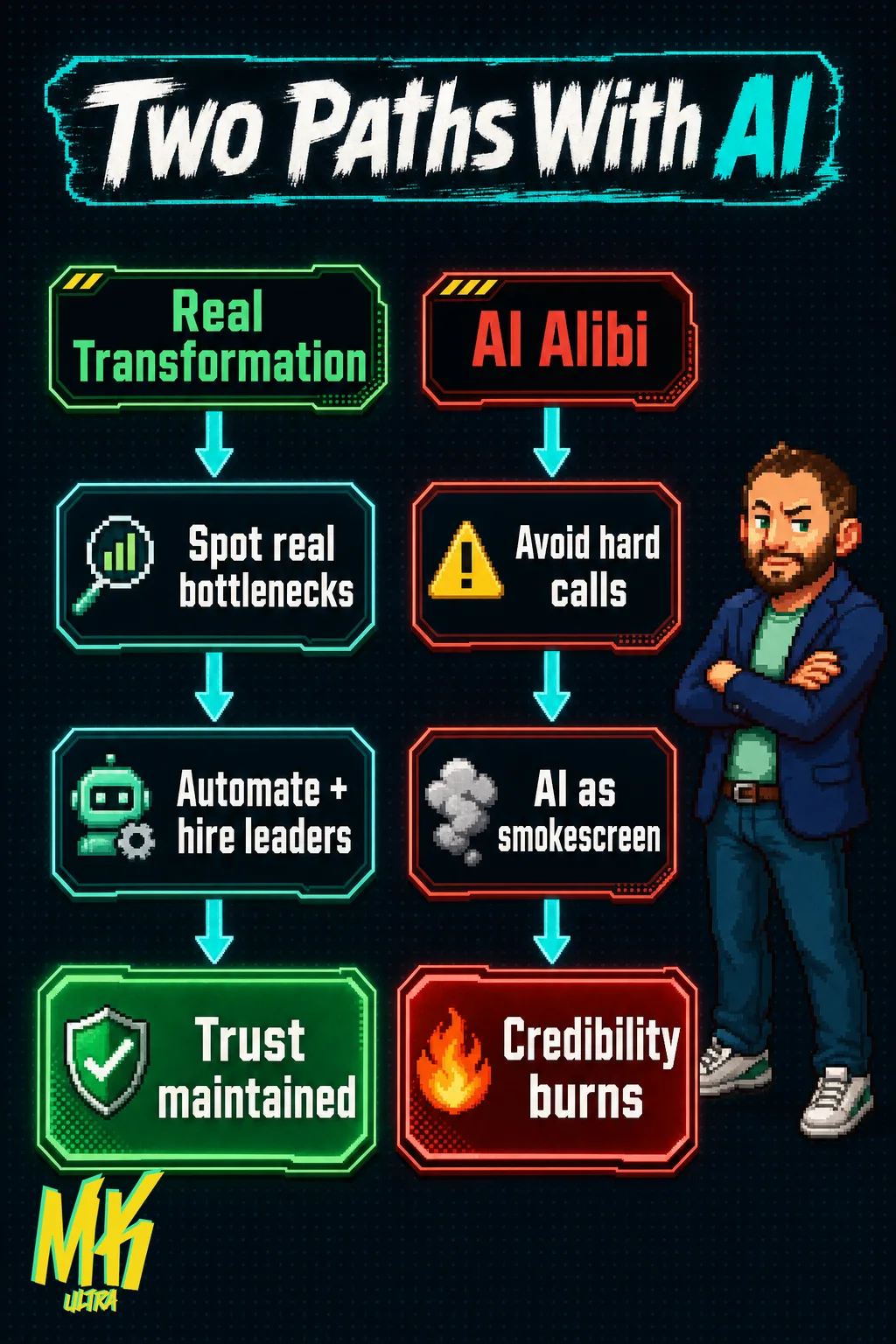
Automating processes and hiring people at the same time looks like a contradiction. Until you actually stop and think about it, it's exactly what someone does when they know where their real bottlenecks are. There's a case that illustrates this perfectly. A CEO automating internal processes at full speed while simultaneously hiring a Head of People.
When asked whether that's a contradiction, the answer is the kind you read twice: the bottlenecks are in leadership and culture, not in tools.
That's knowing exactly what you're dealing with.
If he'd waited for AI to fix his people management, he'd have lost his best people before he even noticed. Because the good ones don't wait. They read the direction the ship is heading, do the math, and when it doesn't add up, they jump ship.
Technology doesn't fix a leadership problem. You can pour every AI tool in the world into your operation: if you don't know what you need from your team, the technology is beside the point.
What the Team Left Standing Actually Sees
When you use AI as a smokescreen to restructure, your credibility burns. No going back. The team that survives the cuts doesn't celebrate any transformation. They see someone who couldn't tell the truth when it mattered. Someone who needed a technology to give them permission to do what they should have done over a coffee and an honest conversation eighteen months ago.
No All Hands with roadmap slides fixes that credibility damage.
Boom. The damage is done.
And you know what the most brutal part is? The talent that stays, the genuinely good ones, are exactly the people who have options. The ones who can leave tomorrow. And the first thing they do when they smell what's going on is quietly update their LinkedIn. No announcement. No drama.
The Edelman Trust Barometer makes it plain: trust is destroyed far faster than it's built. On a team, you don't measure that in employee engagement surveys. You measure it in how many people on your payroll are in interview processes you don't know about.
In an Agency, They Know Before the Memo Goes Out

In a marketing agency, the difference between "we're optimizing with AI" and "we're cutting headcount" is known by the team before the internal memo ever goes out. Every single time.
Teams aren't stupid. They see the new tools. The meetings that quietly disappear. The projects reassigned without anyone saying a word. And above all, who stops showing up on email threads.
You can craft the best narrative in the world about how AI is going to make everyone more efficient. If what you're actually doing is cutting costs to rescue a margin you've been losing for two years, the team smells it. And it doesn't smell like innovation. It smells like fear dressed up as strategy.
AI agents are already managing campaigns, automating reports, optimizing bids. That's real and it's accelerating. But deciding what to automate and what still needs human judgment is a leader's job. No technology gets you off that hook.
Leadership Is Not Automatable
When AI transforms your team's work, nobody asks for another tool. They ask for a leader who can look them in the eye and explain what happens to the people who today do what tomorrow a machine will do. What stops being done. What changes for those who stay.
If you need a slide deck to answer that, you're missing the leadership piece. Simple as that. And for now, no AI content pipeline substitutes for that.
Next time someone tells you a role was made redundant by AI, ask them one question: a year ago, what did you actually do in the quarterly review of that role?
If the answer is silence, you already know who the real redundancy is.