Half the industry is obsessed with using AI to write blog posts. Meanwhile, that same AI is already deciding who sees your ad, how much you pay per click, and when to reallocate your budget. Without asking. And almost nobody is talking about that.

TL;DR: The no-nonsense summary
- Agent vs. tool: an AI tool waits for your prompt; an AI agent observes data, makes decisions, and executes in a loop, no step-by-step approval required.
- You already have them: Performance Max, Meta Advantage+, Salesforce Agentforce, and HubSpot Breeze are already managing campaigns, bids, and audiences autonomously.
- The big value isn't the copy: most of AI's real impact in marketing comes from making better decisions, who, how much, when, not from writing faster.
- Humans still matter: without guardrails, strategy, and business judgment, the agent optimizes for what the platform wants, not what you need.
What Is a Marketing AI Agent, and Why It's Not "Just Another AI"?
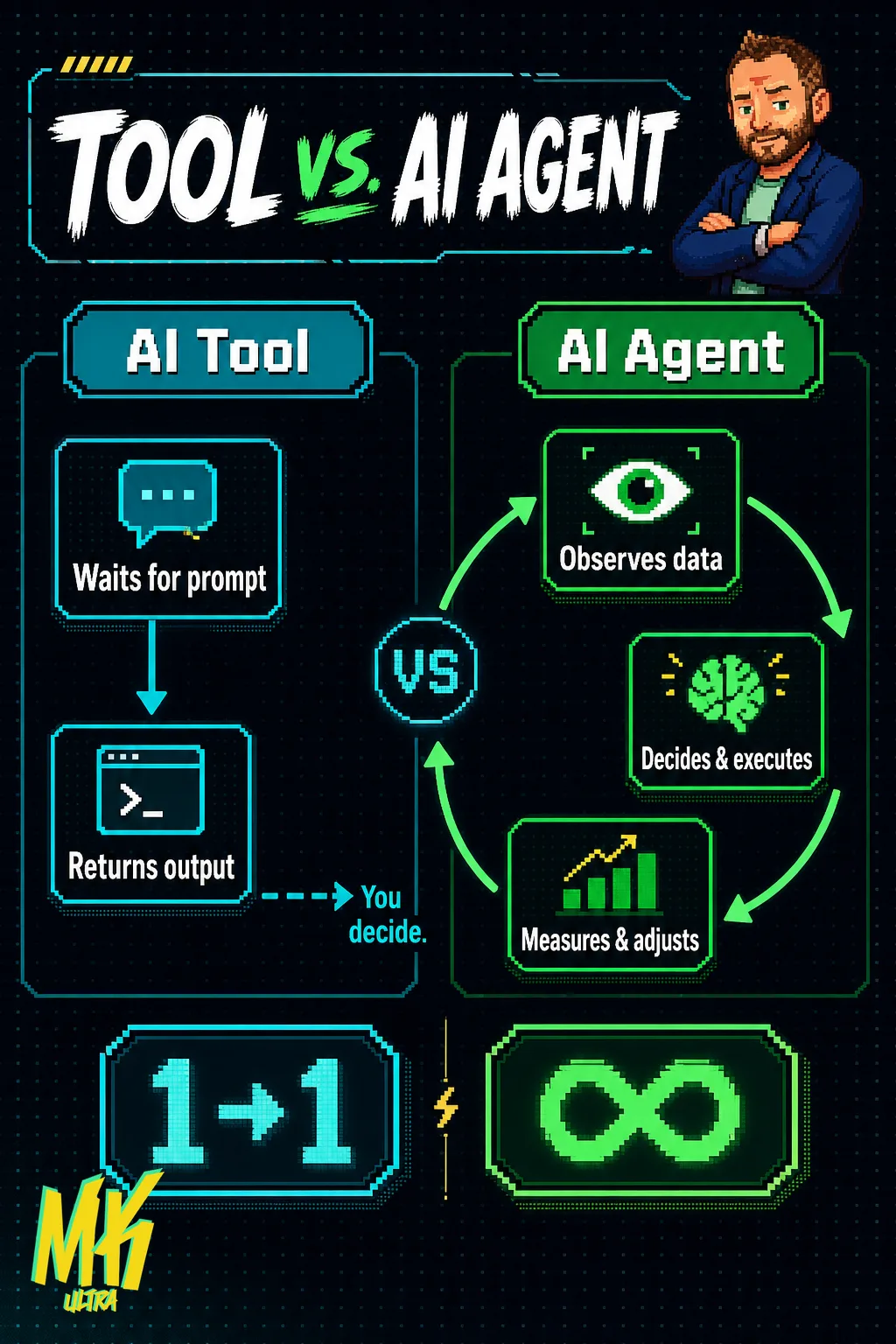
A marketing AI agent is an autonomous system that observes data, makes decisions, and executes actions across an entire workflow, without asking for your sign-off at every step. The difference between this and a conventional AI tool (ChatGPT, Jasper, whatever you use to write ad copy) is a difference in category, not degree.
A tool waits for you to ask it something. You write the prompt, it returns an output, you decide what to do with it. An agent doesn't wait. It has an objective (maximize ROAS, reduce CPA, reach a specific audience), access to your data and the platform's levers, and it operates in a loop: analyze, decide, execute, measure, adjust. Repeat.
And here's the thing: you already have them. You just weren't sold them with that label.
The Platforms Already Running AI Agents on Your Campaigns
Most advertisers have spent months, or years, delegating critical decisions to AI agents without calling them that. Here's a quick rundown.
Google Ads and Performance Max. PMax is, in practical terms, a media buying agent. You define the budget and audience signals. The system decides which channel to use (Search, Display, YouTube, Shopping, Gmail), which creative to rotate, how much to bid, and when. Every auction is an autonomous decision. This has NOTHING to do with asking AI to draft a headline for a Responsive Search Ad. As we explored in our Google Ads 2026 analysis, data drives more than the click, and PMax is the fullest expression of that philosophy.
Meta and Advantage+. Meta's Advantage+ campaigns do the same within their ecosystem: they eliminate manual ad set structure, decide which creative to show to which segment, and optimize bids in real time. Meta claims this lowers cost per purchase compared to manual campaigns. The agent controls audience, creative rotation, and budget. You supervise, or you should.
Salesforce Agentforce. Here the "agent" label ships out of the box. Agentforce, launched in late 2024, is an autonomous agent layer built on top of Marketing Cloud. Give it campaign objectives and it builds segments, sets up nurturing flows, and monitors performance. If a segment underperforms, it can reallocate resources, no button presses required. Classic automation runs on rules you configure ("if X, then Y"). Here, the agent reads the data and writes its own rules.
HubSpot Breeze. HubSpot rebranded its AI layer as Breeze Agents in 2024. The Prospecting Agent researches leads, drafts personalized outreach, and enrolls them in sales sequences. The Social Media Agent schedules posts, analyzes performance, and suggests strategy adjustments. Full workflows, not one-off tasks.
Why Content Generation Is Just the Tip of the Iceberg
The collective obsession with AI for content generation makes sense: it's visible, and anyone with a prompt can test it in two minutes. But the real value isn't there.
The bulk of AI's actual economic impact in marketing is about making better decisions: who to target, how much to spend, when to scale up and when to pull back. Writing faster is fine, but it's the tip.
We've already covered ChatGPT Ads Manager and who should actually try it. That's an assisted management tool. What PMax, Advantage+, and Agentforce do is a different league entirely: autonomous decisions, in real time, over real budget.
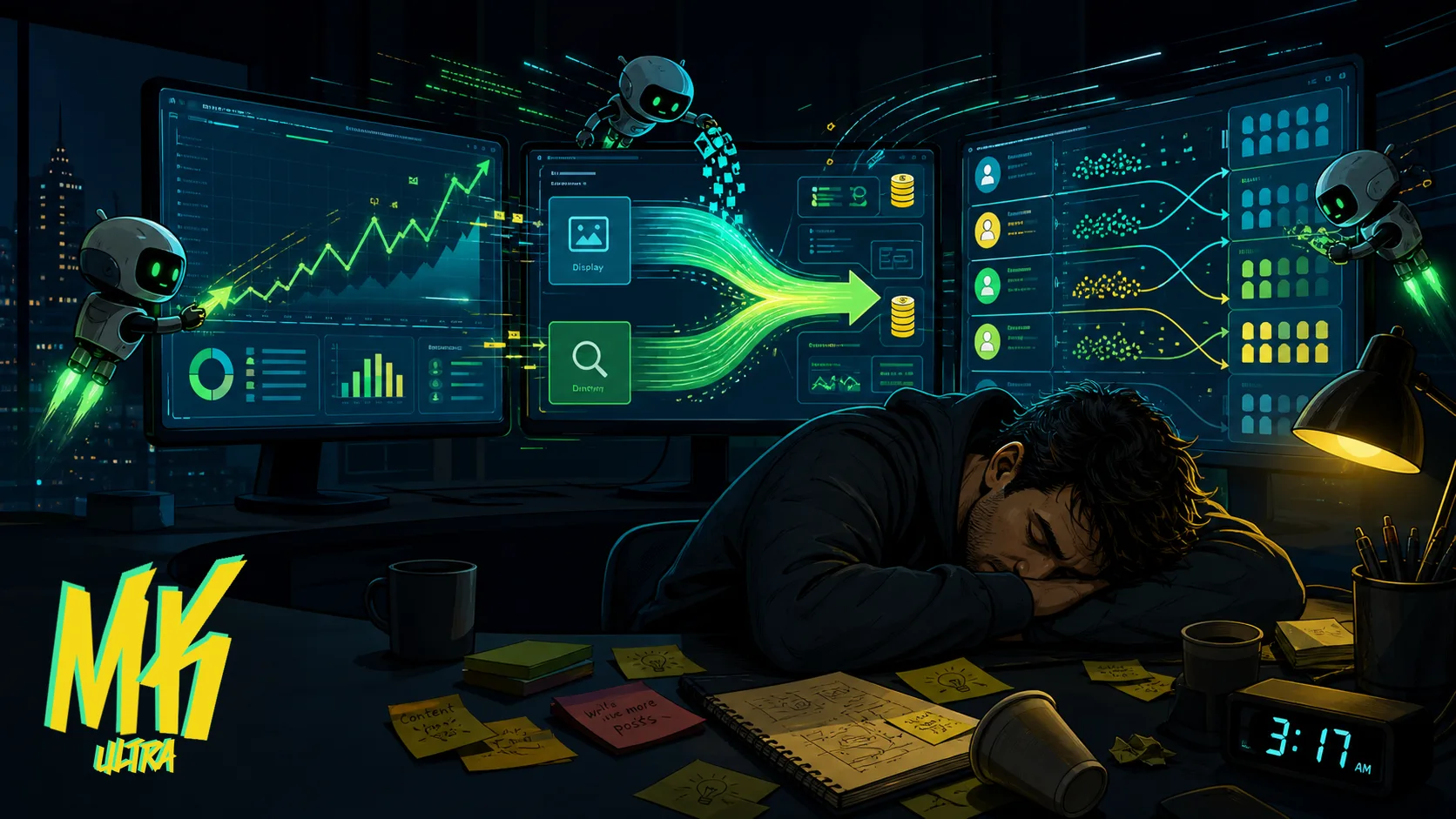
And here's the frustrating part: the second thing doesn't get LinkedIn likes. It's not sexy. Nobody posts "my AI agent shifted budget from Display to Search at 3 AM and saved me money." But THAT is what moves the needle.
Where Humans Still Call the Shots (and Must Keep Doing So)
Hold on. Don't read this as "let the machine handle everything while you head to the beach."
AI agents need guardrails. They need someone to define the actual business objective, not the one the platform wants to optimize for (which tends, conveniently, to be the one that generates the most spend). They need someone to check whether the audience "discovered" by the agent actually fits the brand, or is junk traffic dressed up as conversions.
In our experience managing accounts with heavy automation at agenciaSEO.eu, the professional who reviews, adjusts guardrails, and understands WHAT the agent is optimizing for is the one who extracts real performance. The one who launches PMax, puts blind faith in it, and walks away is the one who gets burned.
AI doesn't replace the manager. It replaces the mechanical tasks of the manager. And it frees up time for what actually matters: strategy and business judgment. Thinking, in short.
The next time someone tries to sell you "AI for marketing" and the first thing they pull out is a text generator, ask them about the other part. The one managing campaigns, audiences, and budget while you sleep. That's the one changing the rules. And if they don't know what you're talking about, walk away.