InteraOne aims to put AI agents, people, contacts and tickets into one inbox, without handing your entire support operation to Intercom or Zendesk. The project describes an open-source core aimed at teams with technical capacity, but the bill does not end with the licence. Infrastructure, models and maintenance also count.

TL;DR: The No-Nonsense Summary
- What it is: according to the project, a support inbox that brings together AI and human agents, contacts, tickets and multiple channels.
- Deployment: the cited documentation covers self-hosting with Docker.
- Real cost: the core is released as open source, but the dossier does not make it possible to calculate the full cost of infrastructure, models and maintenance in euros.
- Decisive limitation: the dossier contains no independent evidence confirming performance, stability or savings.
In this article
| What it is | Open-source customer support platform that combines AI and human agents in a single inbox, with Docker or cloud deployment. |
|---|---|
| Official website | https://interaone.app/ |
| Repository | repo |
| Licence | Apache-2.0 (Enterprise Edition under a proprietary licence in /ee) |
| Price | freemium, free Starter (50 AI messages/month), Pro $9/month, Pro Plus $39/month |
| Alternative to | Intercom, Zendesk |
| GitHub stars | 114 |
| Launch year | 2025 |
| Maintained by | InteraOne (organisation) |
| Platforms | Web (cloud), self-hosted with Docker, embeddable widget for websites/products |
| Requirements | Docker for self-hosting; LLM providers: OpenAI, Google, AWS Bedrock, Hugging Face; Qdrant for RAG |
| Integrations | WhatsApp, Email, Telegram, OpenAI, Google, AWS Bedrock, Hugging Face, Qdrant, Redis, MongoDB |
Reviewed on 2026-10-01
This tool is part of the living roundup Open-source apps that replace paid software →
The Problem It Solves
InteraOne tries to avoid the usual support puzzle: conversations in one place, tickets in another, scattered customer data, and a bot that loses context the moment a person steps in. Its pitch is to keep messages, profiles, tags, notes, tickets and human handoffs within the same operation.

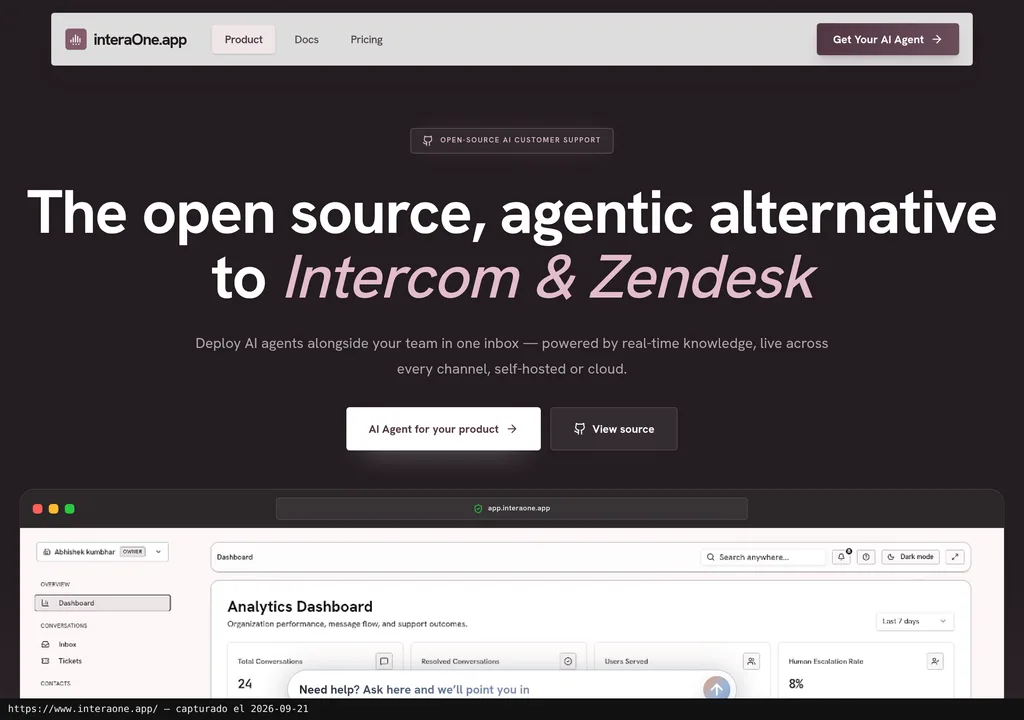
According to the official InteraOne website, the inbox can receive conversations from the product widget, email, WhatsApp and Telegram. The project also claims that a single AI agent shares context across those channels and can use a knowledge base through retrieval-augmented generation (RAG).
In plain English: the customer asks wherever suits them, AI handles the repetitive work, and a person takes over when needed. On paper, it fits digital products and small teams that want to centralise support without getting locked into a vendor.
One important caveat: this describes the features published by the project. It does not prove that context continuity works equally well under load, or that the AI resolves a company’s real cases any better.
Getting Started
Self-hosting requires Docker and a degree of confidence with web services. The InteraOne repository says you need to fork the project, clone your copy, enter its directory, adjust the .env files and run make all. This is not a one-click setup.
According to that repository, the command starts the API gateway, admin console, AI agent, background processes and embeddable widget. The published architecture includes MongoDB, Redis, object storage and Qdrant; it also lists integrations with models from OpenAI, Google, AWS Bedrock and Hugging Face.
The repository declares an Apache-2.0 licence for the core and places an enterprise edition under a different licence in the /ee directory. Review the features you need before deploying anything: an open-source core does not mean every feature shown by the product is included.
Copy this and paste it into Claude Code, Cursor or your favourite coding assistant:
Review the documentation for InteraOne at https://github.com/interaone/interaone and list its requirements before running any command.
Prepare an isolated test environment and explain which variables need configuring without displaying or storing credentials.
Explain how to verify that the widget sends an enquiry to the inbox and allows a handoff to a person.
You need technical judgement. An assistant can guide you, but it cannot replace reviewing configuration, security and backups.
Using It in Real Marketing
The most sensible use case is a small team selling a digital product and receiving questions through its website, campaigns, email and WhatsApp. If the announced features work as the project promises, InteraOne would make it possible to create a shared entry point: a user opens the widget or a link, asks a question, and the conversation remains available to the team.
The official website claims it can also generate branded direct links and QR codes. That would let you place support access on a landing page, in an email, at an event or on packaging, and send enquiries to the same agent. The cited source provides no conversion-rate, satisfaction or time-saving results in the supplied material.
We have not received a documented test of InteraOne. This scenario explains how it could fit into a real operation, not how it performed in a campaign or how much work it saved. And that is the important question: centralising channels does little if the knowledge base is disorganised and nobody oversees the replies. AI speeds up a good operation. It speeds up a mess, too.
The screenshots attributed to the repository show a support console and an architecture diagram. They illustrate the announced interface and system components, but do not prove stability, sustained latency or response quality.
What They Do Not Tell You
Be careful with the word “free”. The supplied material does not include a verifiable table with official prices in euros, billing frequency, billing unit and tax treatment.
I am not going to invent a figure. Hosting, storage, Qdrant, model-provider usage and maintenance are not quantified either. You may avoid a per-resolution fee and end up with a hefty bill elsewhere.
The dossier also provides no verifiable public reviews, commercial case studies, relevant videos or maintainer testimonials. Filling that gap with enthusiasm would be free advertising.
There is also no independent test of installation, updates, backups or disaster recovery. For a team without technical expertise, that burden matters more than any comparison table.
Alternatives
The alternatives listed in the profile are Intercom and Zendesk. They can cover part of the same customer-support problem, although the dossier provides no current, like-for-like comparison of features, euro pricing or deployment terms.
Reducing the decision to “proprietary versus open source” is far too simplistic. If you need to control the infrastructure and modify the system, InteraOne makes sense as a candidate. If you want to buy a service, configure agents and forget about Docker, I would first demand a comparison of total costs, contracted support and operational responsibilities.
Verdict
The documentation presents a multichannel inbox with AI agents, human handoffs, tickets, contacts, several model providers and self-hosting. There is also a published architecture and a concrete installation path. Is there proof that everything works well in a real operation? That is not in the dossier.
Would I recommend it? For a technical team able to test it in an isolated environment, it deserves a place on the shortlist. For an agency or business that needs critical support from tomorrow, not yet: it lacks an independent test, full costs in euros and sufficient public evidence of real-world performance.
InteraOne promises to return control over data and operations. Great. Now it needs to prove that control is worth the work of keeping the machine running.