An SEO consultant in 2026 who only knows how to run technical audits and fill in meta descriptions has a serious problem. AI already does that faster and without charging a monthly retainer. What defines a good SEO consultant today is their ability to translate organic visibility into revenue, not their Screaming Frog skills.

TL;DR: The No-Nonsense Summary
- The role has shifted: the SEO consultant no longer optimizes for ten blue links. They optimize for an ecosystem where AI writes the answers and 60% of searches don't generate a single click.
- The market is growing: $84 billion in SEO services in 2026. In Spain, a senior profile earns between 50,000 and 80,000 euros per year.
- An identity problem: the industry has too many tool operators and too few business strategists. AI widens that gap every quarter.
What an SEO Consultant Does in 2026
An SEO consultant is the professional who designs and executes the organic visibility strategy for a business in search engines, and increasingly, in AI answer engines. That's the clean definition. The reality is messier.
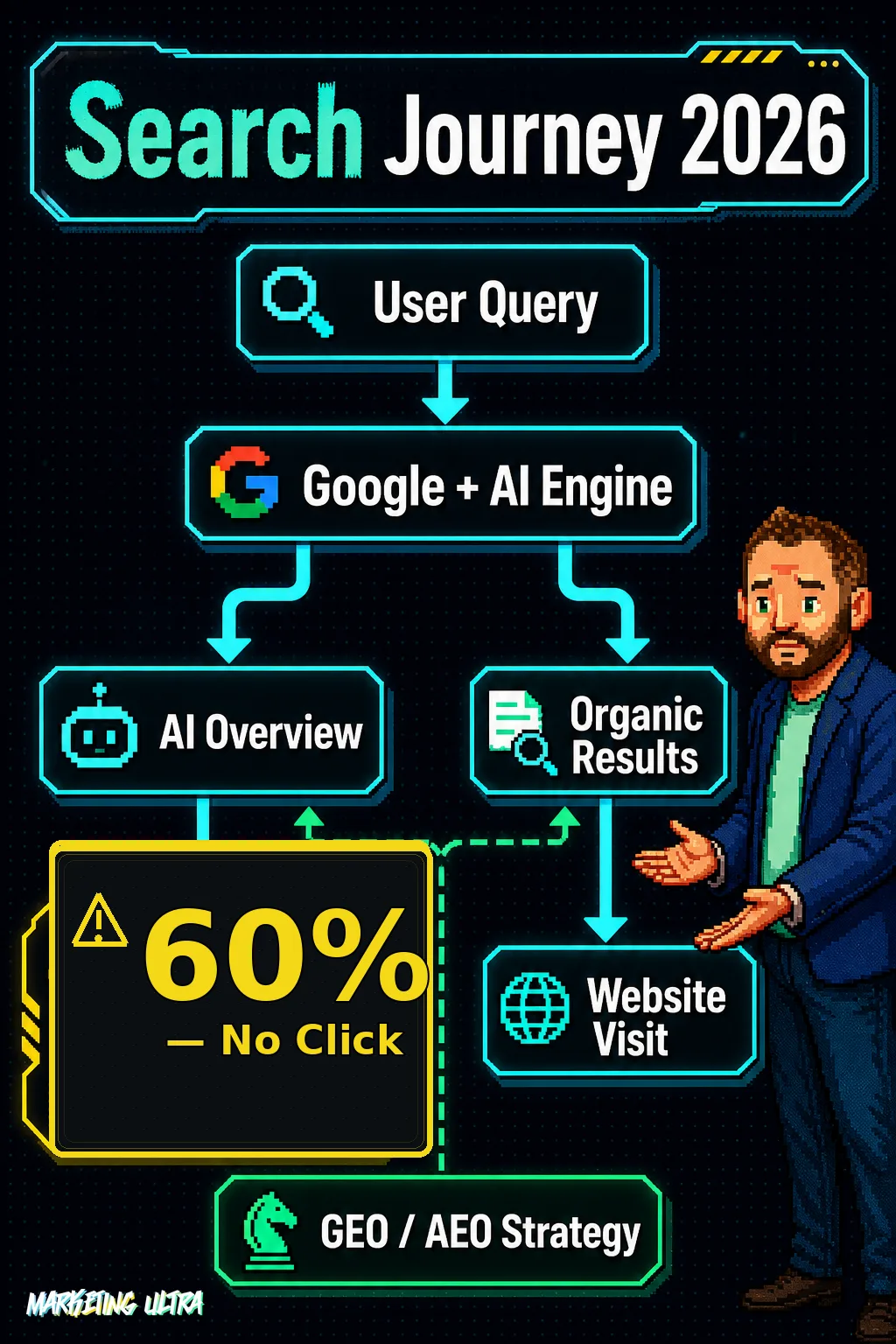
Google no longer returns ten blue links. It now writes complete answers through AI Overviews, while platforms like ChatGPT, Gemini, and Perplexity compete for the same user. The result: between 58% and 60% of searches end without a single click.
More than half. Let that sink in.
That changes the rules for every consultant. Ranking a URL in the top 3 is no longer enough. You need your content to be the source AI cites, your brand to appear in the generative response. That's where disciplines like GEO and AEO come in, they're already rewriting the rules of what it means to appear online.
As I explore in the guide on agentic search and SEO, the search engine is becoming an agent that executes tasks for users, not a list of results. The SEO consultant who doesn't understand that shift is selling a map of a city that no longer exists.
What an SEO Consultant Costs in Spain
The global SEO services market reaches $83.98 billion in 2026, with projections of nearly $149 billion by 2030. Demand isn't falling. It's climbing.
In Spain, salaries reflect a sector that is finally professionalizing. A junior profile starts around 25,000 euros per year. A senior SEO with real strategic capability earns between 50,000 and 80,000 euros. The range is enormous, and that tells you just how immature the profession still is.
For those hiring external consulting, the numbers: between 1,000 and 5,000 euros per month for a retainer, up to 200 euros per hour for senior consulting, or between 2,500 and 10,000 euros for a closed project like an audit or migration.
Watch out for the low end of that range. A "consultant" charging 500 euros per month is probably handing you an auto-generated SEMrush report with their logo slapped on top and calling it done. Profiles that combine technical SEO with programming (Python, JavaScript) see their salaries rise between 15% and 25%. No coincidence: they're the ones who automate, build internal tools, and speak the same language as the dev team.
The Industry's Problem: Too Many Operators, Too Few Strategists
Here's my unfiltered take. The SEO industry has an identity problem that few want to confront: there are too many consultants who are really just tool operators. They know how to configure a sitemap, hunt down a duplicate canonical, and put together a polished report in Looker Studio. All fine. But ask them how agentic search affects the content architecture of an ecommerce site with 40,000 products and they'll stare blankly at the wall.

I'd bet that within two years the industry will have split in two: those who execute increasingly automatable technical tasks (and get paid increasingly less for it), and those who understand how the ecosystem works and can translate what the algorithm does into business decisions. You don't need me to tell you which one has a future. AI already cuts SEO data analysis time in half. That frees up hours. What does your consultant do with them? If they use them to take on more clients and churn out more automated reports, you have a problem. If they use them to think and get ahead, you have an asset.
The SEO consultant who isn't selling you smoke in 2026 needs, at minimum:
- To understand search intent at the micro-intent level, not just generic keyword buckets.
- To master technical SEO AND be able to explain to the CEO why it matters (which is where most fall apart).
- To measure business impact, not just traffic. If they only report sessions, be suspicious.
- To optimize for E-E-A-T and think beyond Google: YouTube, TikTok, generative AI interfaces. Generic content no longer passes any of their filters.
- To know the AI SEO tools available and know when to stop using them.
46% of Google searches have local intent. 92.3% of users are on mobile. AI-indexed video grows every quarter. All of that still runs through SEO. But the SEO that connects all of that to your bottom line no longer looks like it did five years ago.
If your SEO consultant sends you a PDF with rankings and color-coded green dots every month, you're not paying them to think. You're paying them to push a button. And that button keeps getting cheaper.
Frequently Asked Questions About SEO Consulting
What Is E-E-A-T and Why Does It Matter for SEO?
E-E-A-T (Experience, Expertise, Authoritativeness, and Trustworthiness) is the filter Google applies to decide which content deserves to rank. In 2026, with mountains of AI-generated text competing for the same keywords, sites that demonstrate real experience and topical authority gain a direct edge in both organic search and AI engine responses.
What Are Zero-Click Searches?
Zero-click searches are searches where the user gets their answer directly on the results page, through featured snippets or AI Overviews, without visiting any website. In 2026 they account for between 58% and 60% of all Google searches, forcing SEO consultants to optimize not just for the click, but for visibility within the search engine itself.