For years, Shopify's collection system was, to put it charitably, just barely adequate. Manual or smart. Pick one. No blending, no nuance. Zero control over which specific variants appear where. The multi-source collections and variant segmentation update Shopify has shipped to GA changes the rules for any store with a moderately complex catalog. And it was about time.

TL;DR: The no-nonsense summary
- Multi-source: you can now combine automated rules, manual picks, exclusions, and other collections in a single one. The binary "manual or smart" choice is gone.
- Variant segmentation: collections now filter by size, color, or SKU, not just by product. Product cards and filters adjust automatically.
- Inclusion only: you can include specific variants, but you cannot exclude unwanted ones. For large catalogs, watch out for the management overhead.
- Availability: GA and "global" as of July 2026, but with no explicit confirmation for all markets or regions, check your admin before assuming it's live.
What are multi-source collections in Shopify?
Multi-source collections in Shopify are a new catalog management model that lets you combine multiple source types within a single collection: automated rules, manual picks, exclusions, and existing collections.
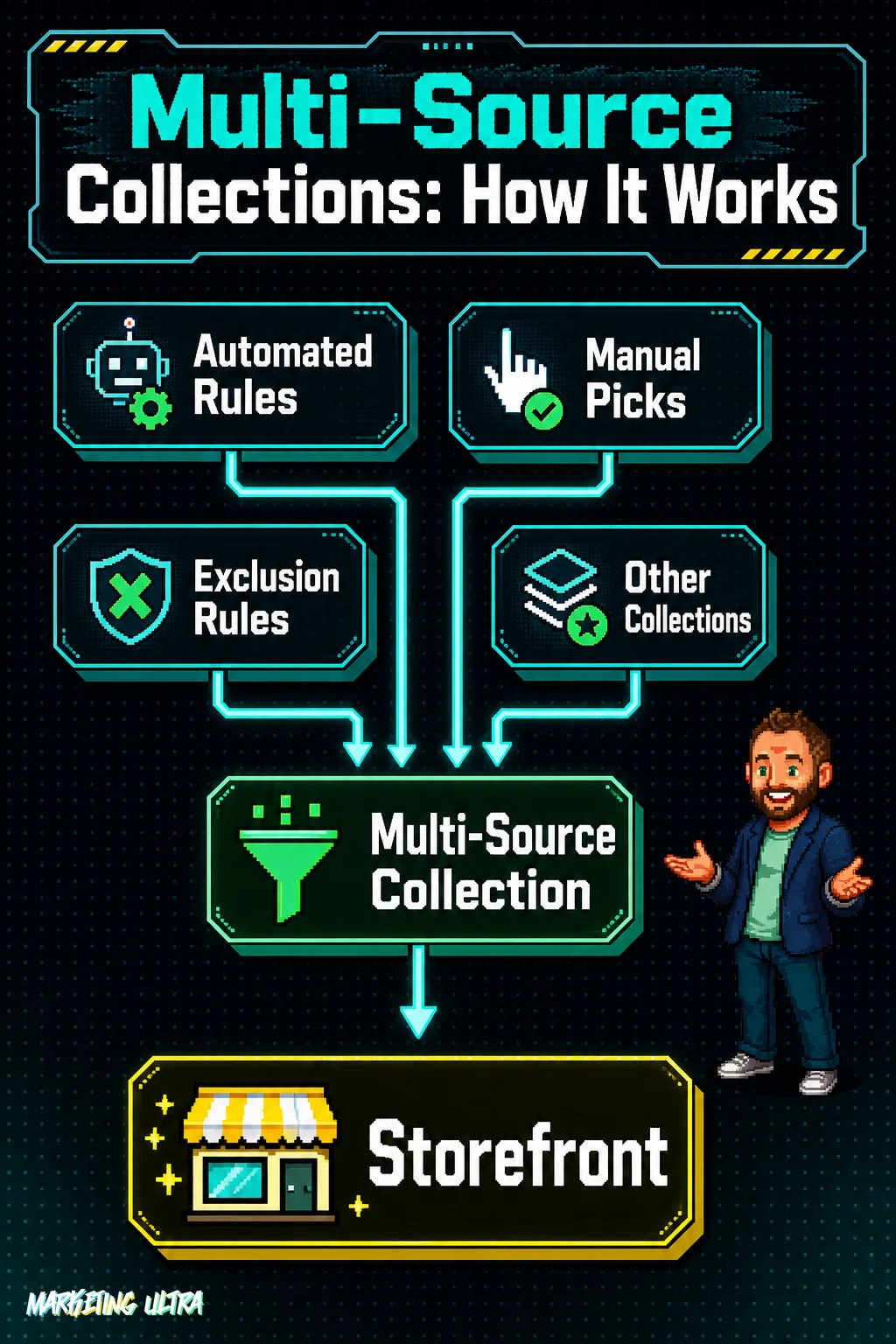
Until now, each collection ran on binary logic: either manual (you pick products one by one) or smart (automated rules based on attributes). No middle ground. If you wanted to combine products from a specific vendor with five hand-picked featured items, you had to build duplicate lists, run parallel collections, or patch things together with third-party apps.
If you followed the Shopify Spring Edition updates, you know the platform had been pushing toward greater product management flexibility. But collections had been left behind.
The new model, according to the official Shopify changelog, lets each source be: automated conditions (vendor, type, price, tag, stock), manually selected products, exclusion rules, existing collections, or products injected by external apps. The final collection is the sum of all of them.
One example: a "Last Chance" collection that automatically includes everything with low stock, plus five products you need to clear out, excluding pre-order items. One configuration. No hacks.
Scenarios where multi-source collections make a difference
The biggest advantage is for stores where the "manual or smart" logic fell short. And as we covered in the Spring Edition analysis, there are more of them than you would think.
Wide catalogs with cross-logic needs: the typical fashion e-commerce store with 2,000 SKUs that needs a "New Arrivals" collection auto-fed with what was added in the last 30 days, but with bestsellers pinned to the top manually. Previously impossible without duplicating work.
Another classic: multi-vendor or dropshipping. You work with three suppliers, each feeding in product their own way, and now you can group everything into a coherent collection for shoppers without exposing the messy plumbing underneath.
And promos that mix criteria: "everything from last season on sale, plus these 10 products I need to move, minus anything on pre-order." That used to require three collections and a spreadsheet. Now it is one setup.
Worth noting: collections can be used as building blocks inside other collections. If the child collection changes, the parent updates automatically. According to Shopify's enterprise blog, this also affects discounts, taxes, and shipping rules tied to them. Real automation, not the PowerPoint kind.
Variant segmentation: this is the big one
Multi-source collections improve management. But variant segmentation is a different beast: it changes how you think about your catalog.

Until now, if a product was in a collection, ALL its variants came with it. A t-shirt in 5 colors and 4 sizes, put it in "Clearance" and all 20 variants showed up. Even if you only wanted to move XS and XXL in blue.
Now you can build collections based on variant attributes: size, color, SKU, whatever you have configured. "XS and XXL sizes in clearance" is a real collection, not a workaround. Product cards in that collection show only the included variants, filters adjust accordingly, and price ranges reflect the actual variants on offer. The customer experience is clean. Your control, surgical.
Variant collections also work with Shopify Functions: you can apply automatic discounts to specific variants only, or set up attribute-specific shipping rules. The level of promotional automation control this unlocks is substantial.
And here is where this hits hardest: paid advertising. If you run Shopping or Meta catalog campaigns pointing at Shopify collections, you can now build collections that contain only the variants you want to push, highest-margin ones or those you need to rotate because you are sitting on excess stock. Before, your feed dragged along all variants and burned impressions on sold-out sizes or colors you were not promoting. That is over.
One caveat: variant selection is inclusion-only. You cannot exclude individual variants within a variant source. If you have 50 colors and want to drop 2, you have to include the other 48. For large catalogs, that can get tedious. It is a design limitation Shopify will need to address.
Availability: GA globally, but with an asterisk
The launch is at GA (general availability) with a declared "global" scope as of July 7, 2026. Sounds clear. It is not entirely: the official source does not specify whether all markets or regions are covered by that rollout. As of now, it cannot be confirmed as live for every Shopify account worldwide.
If you manage a store outside the US, the sensible move is to check your admin directly before reorganizing your collections. If it is not there yet, give it time, these rollouts typically spread over a few weeks.
Shopify is settling a years-long technical debt. Of everything here, variant segmentation is the headline: it changes the quality of the feeds powering your paid campaigns and the way you structure your catalog from the ground up. The inability to exclude individual variants is still a gap, yes. But for once, this is not smoke.