Google has just put a label on AI-made ads. Through "My Ad Center," any user can check whether a creative in Search, YouTube, or Discover was generated or edited by artificial intelligence. The label sounds like transparency, but the mechanism rests entirely on advertiser good faith. And in digital advertising, good faith is in pretty short supply.

TL;DR: The no-nonsense summary
- AI labels on ads: Google now shows in "My Ad Center" whether a creative in Search, YouTube, or Discover was created or edited with artificial intelligence.
- Honor system: if you use Google's AI, the label is applied automatically. If you use third-party AI, you have to self-declare. Google does not verify.
- EU availability: not confirmed. Google says "global," but there is no direct evidence for the EEA.
- EU AI Act: enters into force on August 2, 2026, with fines of up to €15 million. Google's labels do not guarantee compliance.
What Google's AI label on ads actually shows
The labels appear in the "How this ad was made" section inside My Ad Center. To access it, the user clicks the three-dot menu or the info icon that accompanies the ad in Search, YouTube, and Discover.
What exactly does it show?
- Whether the ad was created or edited with AI.
- Whether the elements, text, image, video, audio, were generated or modified by an AI model.
- Whether the AI tools used were Google's own or third-party.
It does not specify which particular tool was used or what kind of assistance the creative received. It distinguishes origin, Google vs. external, and not much else. You get the general picture, sure. But if you want to know how the ad was really put together, forget it.
Where specific regulation applies, EU, India, New York, the label could appear directly on the ad itself, not just inside the panel. More visible, harder to ignore.
The honor system: when Google puts transparency on you
This is where it gets interesting.
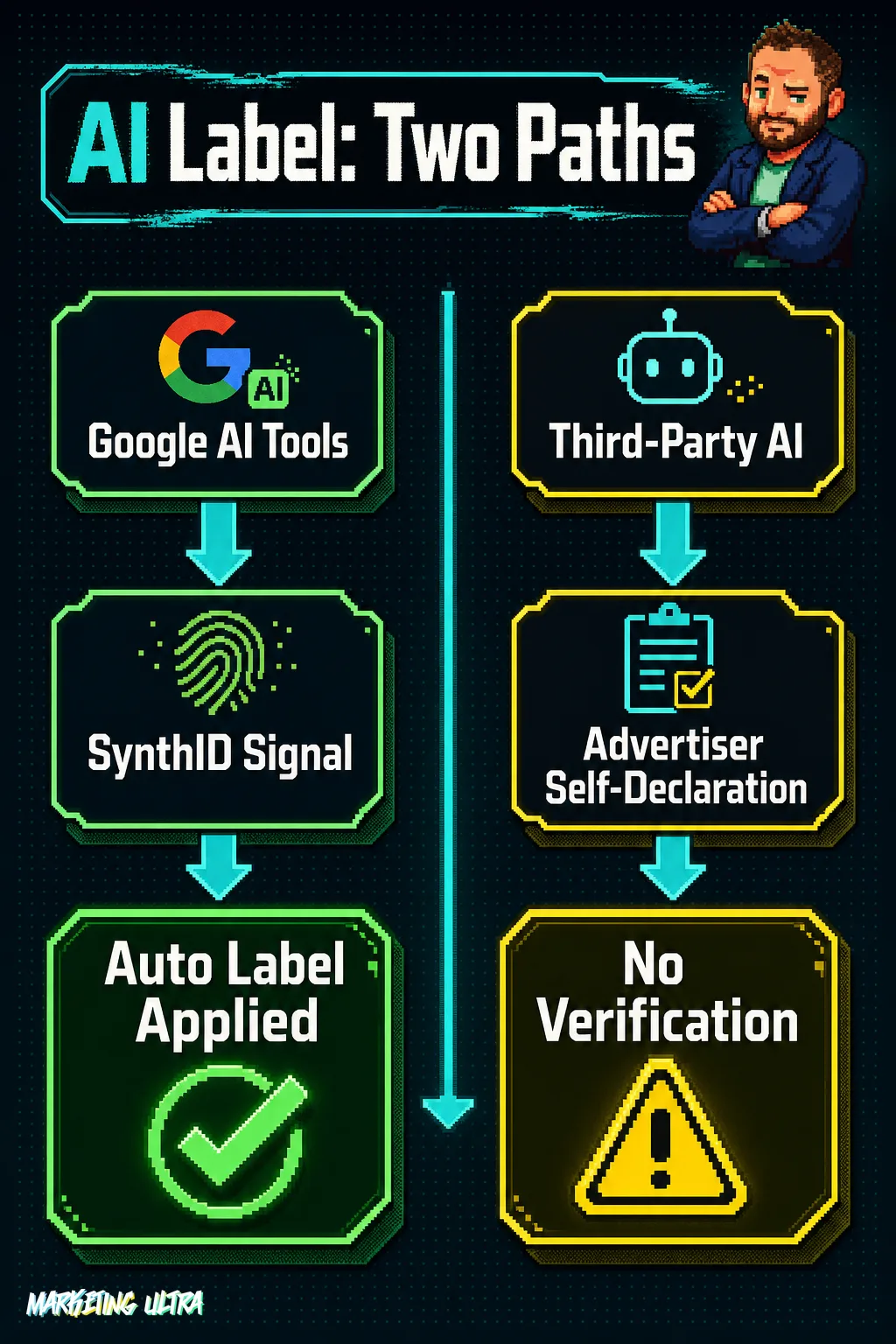
If you use Google's generative AI tools to create ads, the label is applied automatically. Google embeds signals like SynthID into the outputs of its own models, so detection doesn't depend on you at all. Zero action on your end.
If you use third-party tools, Midjourney, a text generator, whatever, you're the one who must voluntarily flag that the creative involved AI. Google has been explicit about it: it will not verify these third-party declarations. Honor system.
And you know what happens with honor systems when there's money on the line?
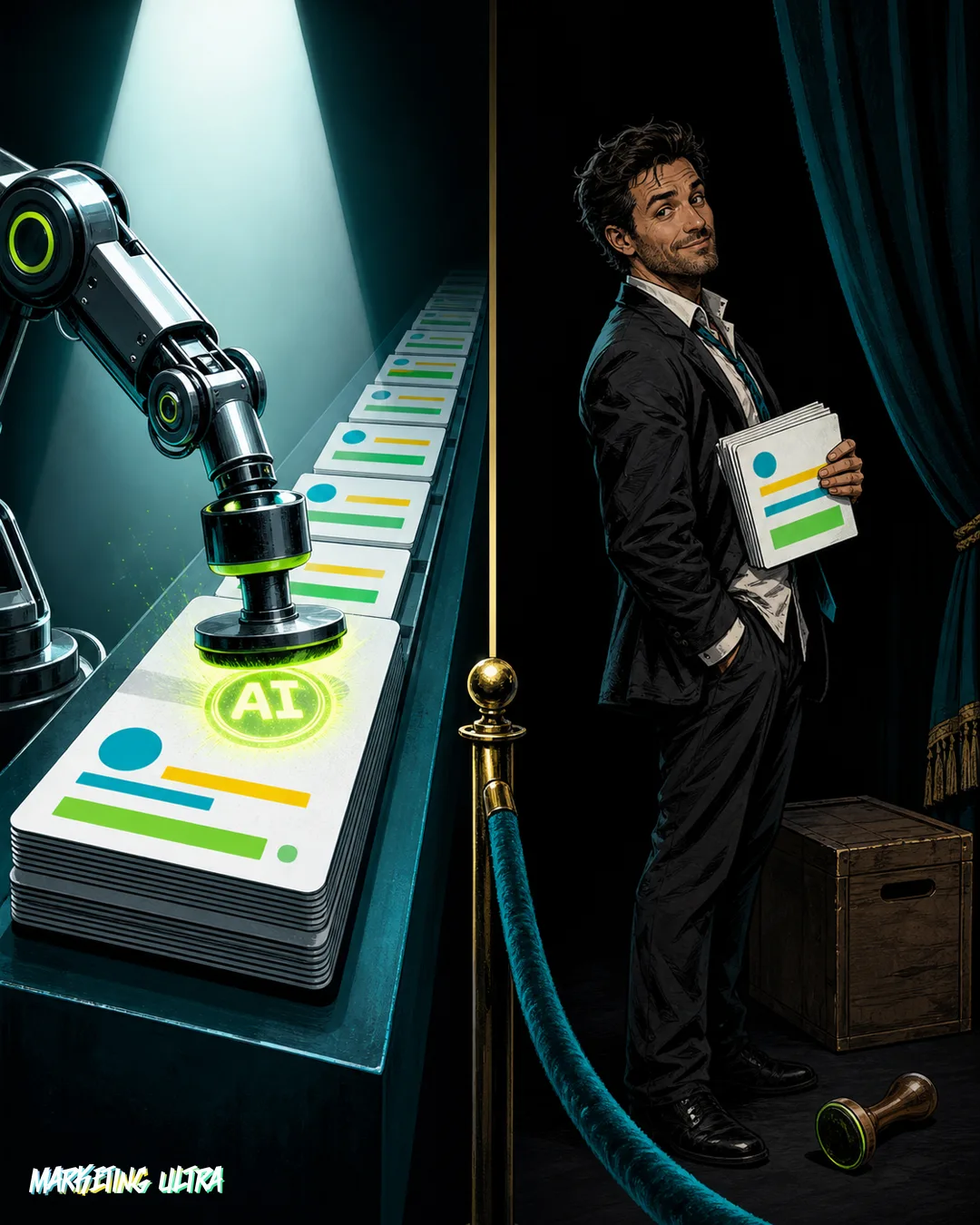
The share of advertisers who voluntarily declare third-party AI will be vanishingly small. There's no incentive to disclose it, and one clear reason not to: nobody wants their ad carrying a label that users read as "a human didn't make this, treat with suspicion." Google knows this. And frankly, it works in their favor: the more uncomfortable advertisers feel about labeling, the more they'll migrate toward Google's own tools, where the label is automatic and you never have to make an awkward call. This isn't the first time Google has moved in its own interest while dressing it up as an improvement. The official announcement talks transparency. The mechanism funnels traffic toward its own AI products.
If your creatives already run through AI tools, and more and more of them do, the debate over whether to disclose is going to stop being theoretical very soon.
EU availability: "global" with an asterisk
Google describes the rollout as "global." The official source does not explicitly confirm the feature is live for accounts in Spain or anywhere else in the European Economic Area.
We cannot say it's working there. Full stop.
What is confirmed: the EU AI Act enters into force on August 2, 2026, with fines of up to €15 million or 3% of annual global turnover for non-compliance with transparency requirements. Google has already noted that where local regulation applies, labels may appear directly on the ad, not just inside the panel.
Status in the EU: Unknown (phase: GA global). Check your own Google Ads account. If you see the "How this ad was made" section in My Ad Center, you've got it. If not, sit tight.
What advertisers should do right now
Watch the fine print: the AI label setting "does not guarantee compliance with specific regulations." Translation: labeling your ad in Google Ads does not give you legal cover under the EU AI Act or any other regulation.
A minimum checklist for anyone managing accounts with any rigor:
- Check whether your account already shows the labels, open one of your own ads in My Ad Center.
- If you use third-party AI for creatives, decide your self-declaration policy and document it.
- Keep an internal record of where each creative came from. When regulation tightens, you'll want it.
- Talk to your legal team before August 2026 if you operate in the EU.
It's not complicated. It is tedious. But the account manager who runs things with discipline, like someone who actually understands smart bidding instead of leaving it on autopilot, is already doing half of this as a matter of professional hygiene.
Google puts up the label and users can check it. Fine, so far so good. The problem is that real verification only works with Google's own tools. For everything else, transparency depends on the advertiser raising their hand and saying "yes, AI made this", with no visible consequence if they don't.
Selective transparency. Not unlike asking Google how much margin it takes on each click and watching it change the subject.
Frequently asked questions about AI labels in Google Ads
What is SynthID and what role does it play in the labels?
SynthID is Google's digital watermarking technology, embedded in content generated by its own AI tools, images, text, audio. It allows automatic detection of whether an ad creative was produced with Google's tools, with no action required from the advertiser. It does not work with third-party tools.
Does the EU AI Act require labeling ads made with AI?
Yes. From August 2, 2026, EU law requires that the public be informed when AI is used in content, advertising included. Non-compliance can result in fines of up to €15 million or 3% of annual global turnover. Google Ads labels do not guarantee automatic compliance: each advertiser must verify that they meet the legal obligations of their market.