Google just blew out 25 candles on Google Images. And it kept the gift for itself. In the same week, it redesigned its image search into an interactive gallery modeled after Pinterest, and integrated AI image generation directly into AI Overviews. The visual traffic that used to land on your site now has every reason to stay inside Google.

TL;DR: The no-spin summary
- Google Images = Pinterest: the redesign turns image search into an interactive gallery. Users browse, save, and stay. Your site gets cut out of the loop.
- Nano Banana in AI Overviews: Google generates the image the user is looking for right inside the results page. No outbound link, no attribution.
- Traffic drops already measurable: Cloudflare reports 35% less human traffic referred by Google. Ahrefs puts the CTR drop at 34.5% when an AI Overview appears.
- Sectors in the crosshairs: e-commerce, travel, home decor, and image libraries. The more your model depends on visual discovery, the more exposed you are.
Two Changes in Google Images and AI Overviews, One Goal
Google moved two pieces at once, and both point in the same direction: keeping users inside Google to resolve their visual queries without ever leaving.
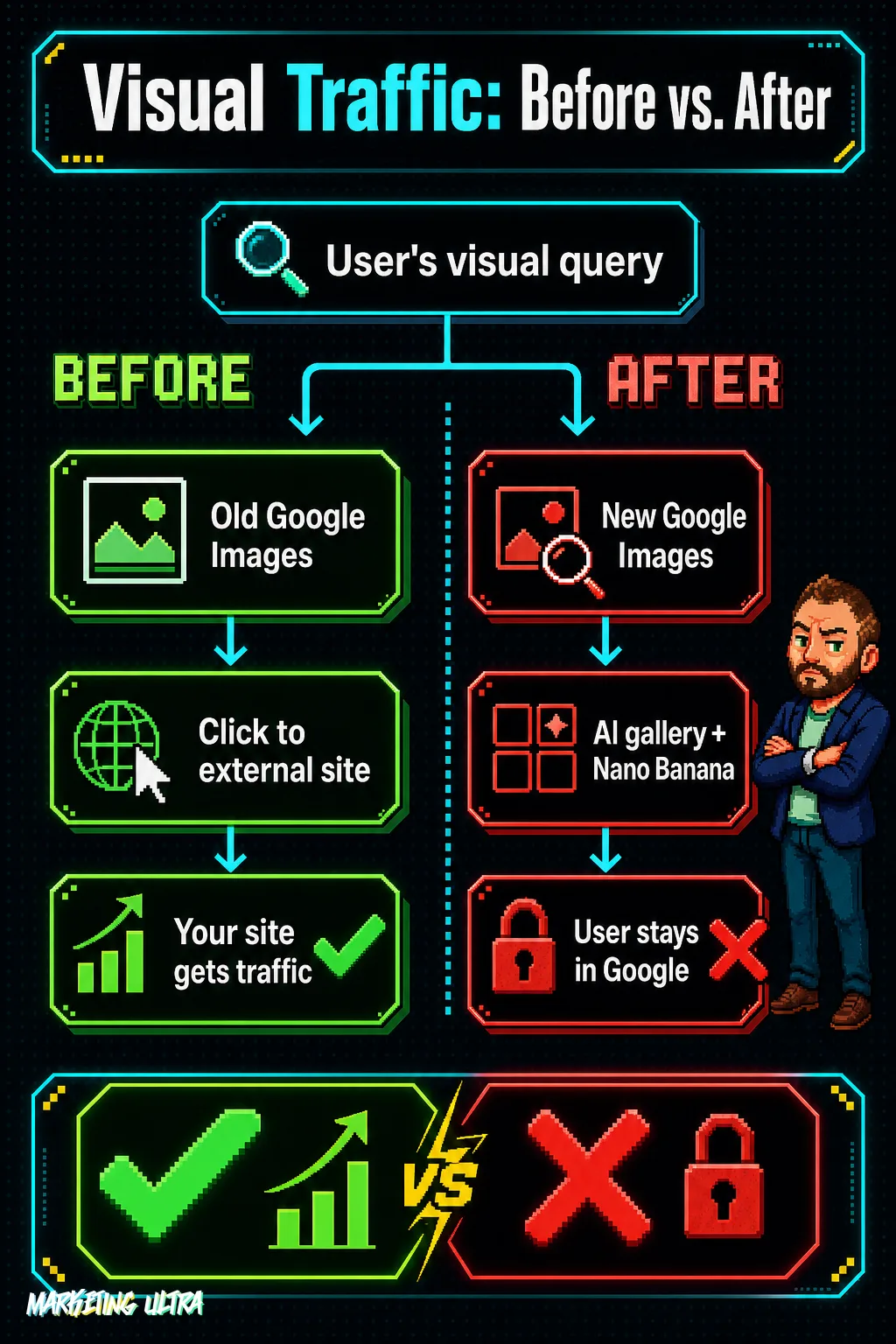
The first: the Google Images redesign. Out goes the clean search box. In comes a personalized gallery with collections, visual exploration, and algorithm-curated ideas. If you have ever used Pinterest, the experience will feel familiar. Users browse, save things, linger. And the site that image originally came from? Pushed to the sidelines.
The second: image generation via the Nano Banana model inside AI Overviews. Search "Scandinavian living room with dark floors" and Google builds it for you. It doesn't show you photos from decor sites. It fabricates the image. No attribution, no outbound link, no click for the photographer or the online store that had the perfect shot.
Google has gone from being the middleman that sent you visual traffic to the destination that resolves the search without anyone leaving the SERP.
Which Sectors Lose the Most Visual Traffic?
The ones that live and die by the eye: e-commerce, travel, home decor, and image libraries. Image search traffic has always been SEO's neglected sibling. Few measure it properly, fewer work it seriously. But for some of these sectors, those visits were a lifeline.
The hardest hit: e-commerce. Visual product searches ("retro white sneakers," "extendable oak dining table") are exactly the kind of query AI Overviews can resolve by generating an image that matches what the user described. Why click through to your product page if Google already shows what it would look like?
Travel and home decor follow close behind. Pure inspiration queries: "small terrace with a chill-out vibe," "European beaches that feel like Southeast Asia." These searches no longer need your travel blog or your interior design portfolio. Google Images' personalized gallery absorbs them, and Nano Banana generates the image the user already had in mind.
Photography and stock image libraries: a direct hit. If someone searches "flat illustration of remote work" and Google can generate it on the spot, the image library has a problem. Not a traffic problem. A business model problem.
And the broader data doesn't encourage optimism. According to Cloudflare data, human traffic referred by Google dropped at least 35% across all major industries between June 2025 and April 2026. Google accounts for 88% of referral traffic. When that tap closes, there is no hose big enough to compensate. Ahrefs research puts the CTR drop on top results at 34.5% when an AI Overview appears. DataSlayer puts it at 61%.
Those figures are for general search. Now imagine what happens when the AI Overview doesn't just answer your query, it generates the exact image you were looking for.
Google Isn't Innovating: It's Closing Doors
I'll say it plainly. Google's official narrative, the one you'll read in its anniversary post, is "celebrating 25 years of making visual search more useful." For the user, yes, it's more convenient. But calling this innovation is like saying a supermarket innovates when it pulls third-party brands off the shelf and replaces them with its own label.
Google Images was never a massive traffic driver compared to web search. But it worked if you put in the effort, and few did: quality photography, careful alt text, solid metadata, fast load times. Now they're turning it into an entertainment destination. And entertainment destinations don't distribute traffic. They consume it.
It's the same pattern we examined when covering how Google is accelerating agentic search, except this is worse: in text, Google summarizes the answer and sometimes links to the source. In images, Google generates the answer. It doesn't need your photo. It doesn't need your site. It doesn't need to link to you.
My bet: within a year we'll see studies specifically on the Google Images traffic decline. And the numbers will be worse than those for web search, because the alternative Google offers here, generating the image, is more complete than what it offers in text, which is summarizing the answer. A summary competes with your article. A generated image replaces your photo.
How to Actually Protect Your Visual Traffic
The standard "improve your image SEO" advice still holds, but it's no longer enough on its own. Time to get more granular.
- Invest in visuals AI cannot replicate. Real product photography with context, with people, with details that prove first-hand experience. Nano Banana can generate "grey sofa in a Scandinavian living room." It cannot generate YOUR sofa in YOUR store with a real customer sitting in it. Authentic visual content is your last line of defense.
- Diversify your visual traffic sources. Pinterest, Instagram, TikTok. If Google is cloning Pinterest's experience, your content should be on the real Pinterest, where clicks actually reach your site.
- Structure your product data down to the last detail. Complete product schema: price, availability, reviews, high-quality images. It guarantees nothing, but it's your strongest card for getting your products to surface when AI Overviews answer a visual commercial query.
- Track Google Images traffic separately. In Analytics, segment traffic from images.google.com and monitor it month by month. If it drops, at least you'll see it coming and can calculate the real impact before it's too late.
And the uncomfortable recommendation: if a meaningful share of your strategy depends on Google Images traffic, plan for a scenario where that traffic simply doesn't exist. As is already happening with blogs losing organic traffic, it's not a matter of if. It's a matter of when.
Google has done what it always does: improve the user experience and make the ecosystem that sustains it pay the bill. It did it with featured snippets, it did it with text-based AI Overviews, and now it's doing it with images. If your business runs on visual traffic, the clock is ticking. And Google is not going to stop it for you.
Frequently Asked Questions About Google Images and AI Overviews
What is Google's Nano Banana model?
Nano Banana is Google's image generation model integrated directly into AI Overviews. It creates custom images from inside the results page itself, "nautical-style bedroom," "color comparison for a bathroom remodel", without the user visiting any external site.
What is product schema and why does it matter now?
Product schema is structured data markup added to your product page code so Google can understand price, availability, reviews, and key attributes. With AI Overviews increasingly serving generated responses, a complete and detailed product schema is the most direct route to getting your products to appear when AI answers commercial queries with a visual component.