Every week a new AI SEO tool appears, promising to do the heavy lifting for you. One-click audits, content that ranks on its own, keywords raining down from the algorithm. The problem is that most of them solve the easy part and leave the hard part exactly where it was: in your head.

TL;DR: The No-Fluff Summary
- Volume and speed: AI SEO tools process massive datasets in minutes, but they do not replace strategic judgment.
- CTR in free fall: with AI Overviews, organic CTR drops from 1.76% to 0.61%. Six out of ten clicks simply vanish.
- Autopilot is the trap: 70% of companies that integrate AI with a clear strategy see higher ROI; those that just plug it in and walk away do not.
- No E-E-A-T, no game: Google does not penalize AI content, it penalizes generic text with no real experience or authority behind it.
What Do AI SEO Tools Actually Solve?
AI SEO tools apply artificial intelligence to positioning tasks: keyword research, technical audits, backlink analysis, content optimization. Their real strength is volume and speed: they process enormous amounts of data in minutes that used to eat up entire working days.
Semrush works with a database of over 26 billion keywords. Ahrefs turns raw analytics into actionable recommendations. SE Ranking automates audits with language models that interpret the real impact of each issue, not just list them.
That works. It saves you hours of spreadsheet work nobody misses.
The problem starts when someone confuses "processing data fast" with "doing SEO." A tool can tell you that you have 347 crawl errors, but it cannot decide which ones actually matter for your business. It can suggest 200 long-tail keywords, but it has no idea whether your team has the topical authority to rank for them. The judgment call is still yours.
Autopilot Is the Trap, Not the Tool
I'll be direct. 72% of companies already use AI in their workflows, according to McKinsey. And those that have integrated it into their SEO strategy see higher ROI in 70% of cases, with conversion rates 8.5 times higher than with traditional methods (14.6% versus 1.7%). That is a big number.
And you know what happens with those who misread that stat? They switch on autopilot, let the tool generate "optimized" content, and three months later they are wondering why their organic traffic is still in free fall.
Google has made it crystal clear: it does not penalize AI-generated content, but it does penalize thin, scaled-up content created without real judgment. Most tools that promise "ready-to-rank content" produce exactly that: technically correct text with no first-hand experience, no opinion, no E-E-A-T. The digital equivalent of a generic brochure.
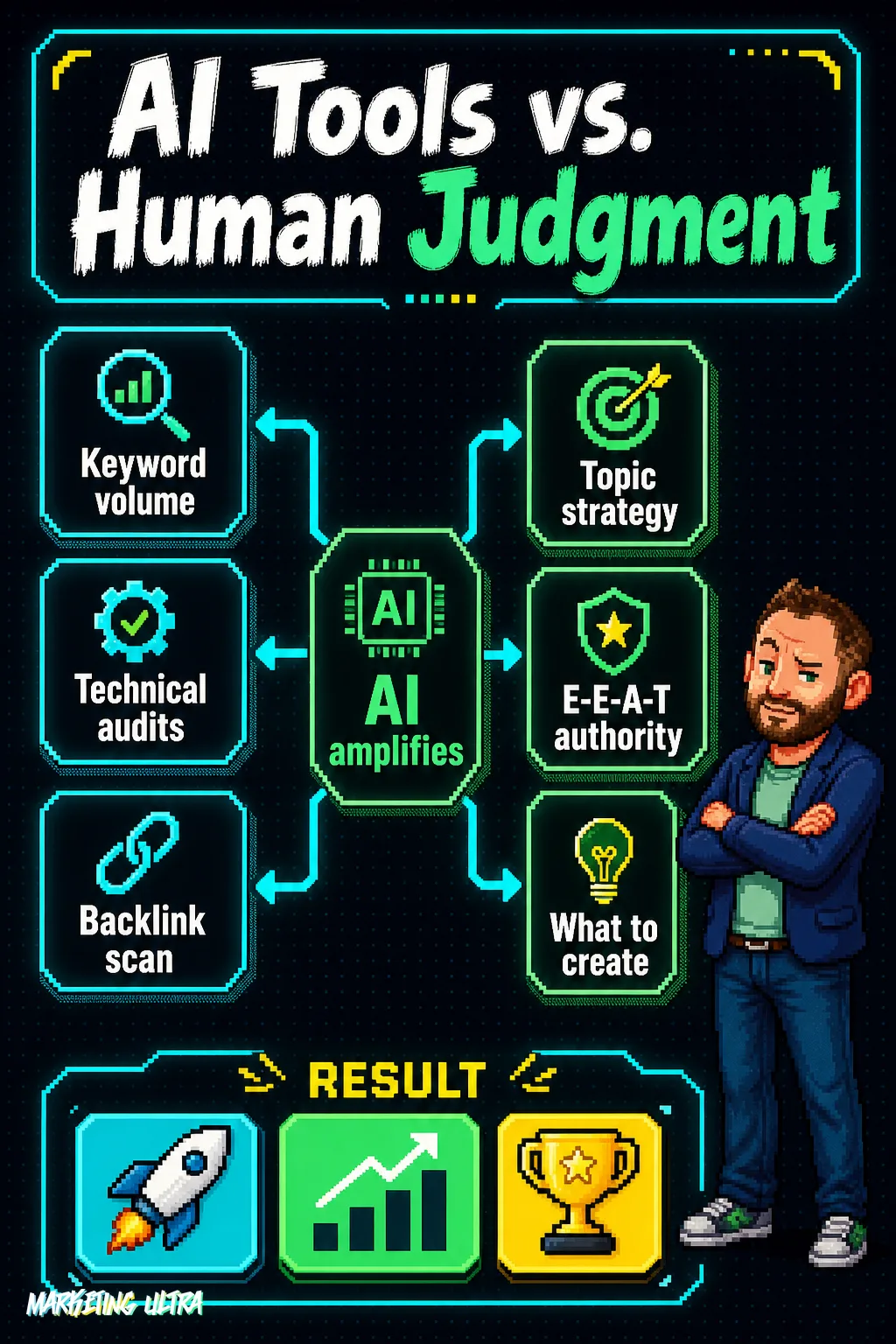
I'd wager the real trap is not that these tools fail. It's that they work JUST ENOUGH to make you complacent. They produce a decent draft, suggest reasonable keywords, catch real technical errors. And that creates the illusion that the job is done. But the real work, deciding what to create, for whom, and from what position of authority, is still 100% human. AI amplifies what you already know how to do. If you do not know, it amplifies the mess.
Where It's Worth Investing (and Where It's Just Smoke)
I'll be straight. Not every category of AI SEO tool delivers equal value. There are three areas where the return is real and measurable.
Technical audits at scale. Tools like SE Ranking detect orphan pages, crawl issues, and internal linking architecture problems in minutes. That used to require a dedicated consultant for days. This is where AI genuinely saves time.
Keyword research and semantic clustering. Semrush and Ahrefs have improved significantly at grouping search intents and predicting trends. They do not give you the strategy, but they give you the map to build it.
Backlink monitoring. AI automates link discovery, flags opportunities, and identifies toxic links. Any consultant who has worked with these tools will tell you the same thing: the manual prospecting work shrinks to a fraction of what it was.
And what is just smoke? "SEO" content generators with no editorial oversight, they produce volume, not quality. Tools that promise to "rank in AI Overviews" as if it were a switch you flip. And anything that sells "automated SEO." If SEO could be reduced to a button, consultants would not exist. Buttons would.
CTR Is Collapsing and the SEO Rulebook Has Changed
The numbers are brutal. When Google shows an AI Overview, organic CTR plummets from 1.76% to 0.61%. Six out of ten clicks disappear. 60% of searches no longer generate any click at all. And the trend is clear: visitors from AI-powered search are on track to overtake those from traditional search.

What does this mean for anyone investing in AI SEO tools? That the game has changed. Ranking in the ten blue links is no longer enough. You need your content to be what the AI cites and recommends. We covered this in the article on agentic search and the new SEO: the rules are different now. And that requires something no tool automates: real authority and first-party data. If you sound like a template, the AI ignores you.
Companies that have integrated AI with genuine strategic intent into their SEO are seeing real improvements in organic traffic and conversions. But be warned: the risks of using AI for SEO without oversight are just as real as the benefits. There is a world of difference between integrating AI and just plugging it in and hoping for the best.
Essential in 2026, nobody disputes that. But if you think these tools are going to think for you, the problem is not the tool.
If you want the AI to cite you and not your competitors, the subscription you pay is irrelevant. What counts is the mind behind it. And if you need to take care of the basics first, start by optimizing your website to get cited by AI search engines.
Frequently Asked Questions About AI SEO Tools
Does Google penalize AI-generated content?
Not directly. Google penalizes low-quality content created to manipulate rankings, regardless of how it was produced. Its official guidelines make clear that AI-generated content is acceptable as long as it delivers genuine value and meets E-E-A-T standards.
How much does an AI SEO tool cost?
Pricing varies widely. Semrush and Ahrefs start at around $100, $130/month on their basic plans. SE Ranking offers plans from $40/month. Content tools like Surfer SEO range from $50 to $200/month. The real cost is not the subscription: it is the learning curve and the human oversight these tools need to actually deliver results.