If you've ever stared at a Meta Ads campaign's click data and thought "these numbers don't match Analytics", congratulations, you were right. Meta has just redefined Link Clicks to count only actual link clicks, tacitly admitting that what it measured before was something else entirely. The change is the right call. The way it was communicated is another story.

TL;DR: The No-Fluff Summary
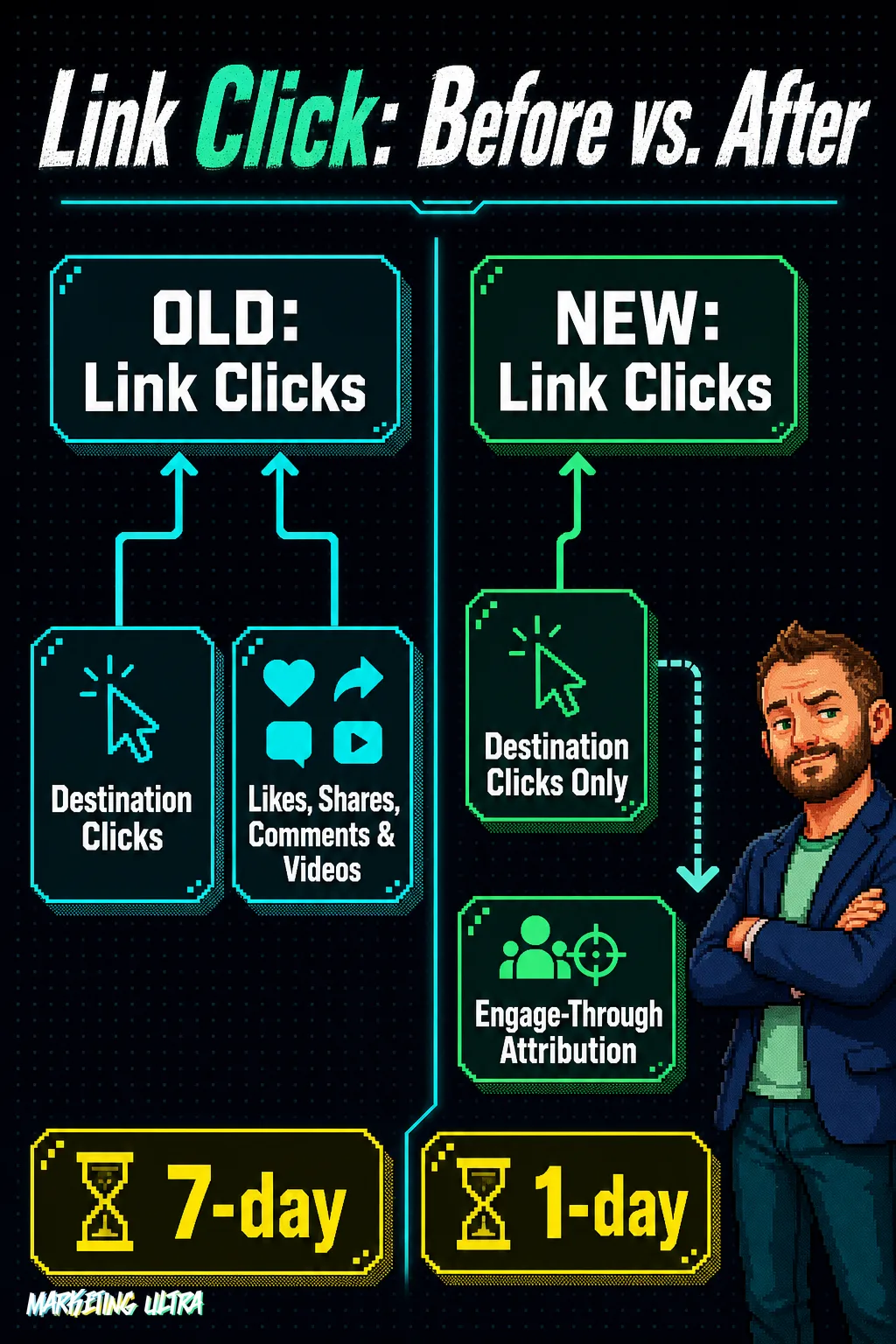
- New definition: Link Clicks now only counts clicks that take users to a destination (website, app, form). Previously it included likes, shares, and even video plays.
- 30-40% drop: attributed click metrics will fall, not because your campaigns are performing worse, but because the old definition was far more generous.
- Broken historical data: any month-over-month or year-over-year comparison crossing March 2026 mixes two different definitions. Those comparisons are invalid.
- Billing unchanged: Meta confirms what you pay doesn't change. Only what you see in the report does.
What Changed with Meta Ads Link Clicks?
Link Clicks in Meta Ads now exclusively registers clicks that take a user to a destination outside the platform: your website, an app store, or a lead capture form. Meta announced the change on March 3, 2026 and the rollout began in late March for campaigns optimized for website conversions or physical store visits.
The goal? To align with Google Analytics and industry standard, where a "click" has always meant "a click that takes you to a URL." So far, so sensible.
The problem is what Meta was counting as a "click" before.
What Did Meta Count as a "Click" Until Now?
The previous click attribution definition included likes, reactions, shares, saves, comments, image expansions, and video plays. If after any of those interactions a user converted within the following 7 days, Meta attributed it as a click-through conversion. Jon Loomer documented this in detail when the change came to light.
Read that again.
A "like" could count as a click if the user made a purchase a week later. A sarcastic comment on your ad, too. Meta was dressing up engagement as purchase intent, and so Ads Manager reports painted a far rosier picture than any external analytics tool would show.
Now those interactions move to a new category: "Engage-Through Attribution," which replaces the old "engaged view" and runs on a one-day attribution window instead of seven.
30-40% Fewer Clicks in Your Reports (and the Historical Data Headache)
Meta has confirmed billing is unaffected. What does change is the number you see on screen. Industry estimates put the drop at between 30% and 40% in attributed clicks and click-through conversions.
Is your campaign performing worse? Not necessarily. You were being credited with clicks for things that weren't clicks. Now you're seeing what's actually there.
The real trap is comparability. If you cross April 2026 data with February's, you're mixing two different definitions. Any month-over-month or year-over-year analysis that straddles the cutoff date is, flatly, invalid. And that hits anyone who has agreed performance benchmarks with clients around this metric.
In my experience, rule changes like this separate the sharp operator from the hands-off account manager. The technical part is an adjustment. The headache is the noise window it opens.
I've seen agencies lose accounts over this. Clicks drop one month, the client asks questions, and the account manager has no idea Meta quietly changed the definition under the hood. The one who's on top of the account picks up the phone before the client does.
Why Is Meta Changing Link Clicks Now?
Meta has been carrying a credibility problem with advertisers since the video metrics scandal back in 2016. The platform rewrites its attribution rules precisely when it most needs to project transparency to keep ad spend flowing in. Aligning with Google Analytics is a pure credibility play.

And you know what? This pattern repeats. Google did something similar with ad spend distribution and ad scheduling: a technical tweak that doesn't derail the attentive manager, but can cost real money for anyone running on autopilot. Platforms rewrite the rules at their own pace. Anyone not paying attention pays the price.
And if you're running Meta campaigns where Advantage+ is making decisions by default, take note: trusting without reviewing your metrics has a cost that never shows up on the invoice. It's the awkward conversation with a client when the numbers don't add up and you have no explanation.
Measuring only real clicks? That should have been the standard from day one. What's questionable is rolling it out with only weeks' notice, no transition period, and no acknowledgment that the previous data was inflated. Meta aligns itself with reality, sure. And in doing so, quietly washes its hands of years spent selling engagement as clicks.
Frequently Asked Questions About the Meta Ads Link Clicks Change
Which campaigns are affected by the new Link Click definition?
The change applies to campaigns optimized for website conversions or physical store visits. If your campaigns focus on in-platform engagement (brand awareness, video views), Link Clicks is not your primary KPI and the impact will be minimal.
How do I recalibrate my historical performance benchmarks?
You can't backfill the old data with the new definition, Meta has not applied it retroactively. Mark March 2026 as your cutoff point and build new benchmarks from April onward, leaving at least 2-3 months to stabilize your baseline before locking in client targets.