Google just pulled your Instagram, TikTok, YouTube, and X profiles into Search Console. The tool you've spent 20 years using to measure your website now measures how your social accounts appear in Google results. And before you cry foul with a "how cynical, they drain our traffic and now hand us this," hold that thought. Because what this tool actually measures is not what most people assume. And the backstory is a lot more interesting.

TL;DR: The no-fluff summary
- Platform properties: Search Console now lets you add and verify your YouTube, TikTok, Instagram, and X profiles to track their performance in Google Search.
- Not what you think: this does not measure outbound traffic from your website to social media. It measures how many impressions and clicks your social profiles get inside Google's search results.
- The blog keeps sliding: informational landing pages are being consumed by AI-generated results. Social profiles are emerging as the new engine for audience discovery.
- Only 4 platforms: YouTube, TikTok, Instagram, and X. LinkedIn, the one that matters most in B2B, is not included.
What's dying isn't the web, it's the blog
What's declining isn't "the web." It's one very specific slice of it: the blog and informational landing pages, being steadily consumed by AI-generated results. There's a narrative I've been hearing for months that needs to be killed: "the web is dead." It isn't.
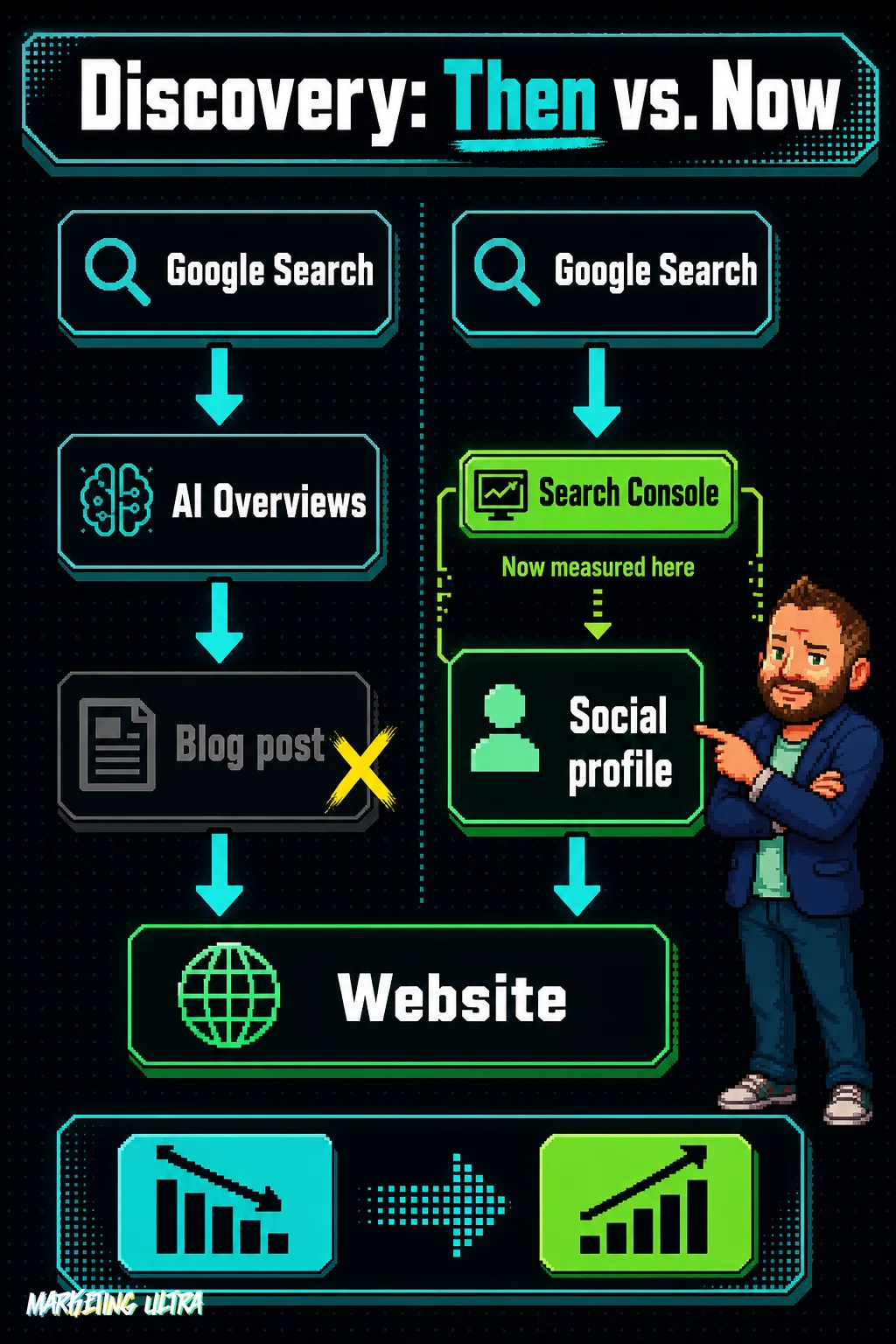
Your online store is still converting. Your services page is still generating leads. What's collapsing is the front door: the blog post that ranked for "how to choose X" and funneled informational traffic that eventually converted. Blogs are hemorrhaging organic traffic at a rate that can no longer be ignored. The culprits have names: AI Overviews, ChatGPT, Perplexity.
The knock-on effect most people underestimate: less informational traffic doesn't just kill the blog. It kills discovery. Without discovery, the transactional side of your site sees less flow. Your product page works just as well. But fewer eyes reach it.
So what's filling the gap?
Social profiles. They're still the way to build audiences, grow followings, establish a brand, and drive people toward your website or wherever you want them to land. The website remains the final destination, but social is now the fuel. In that context, Google giving you tools to measure how your social accounts perform in search makes complete sense.
Will the blog die entirely or just transform? Probably the latter. Informational content is migrating to video, newsletters, and communities. The blogs that survive will be the ones offering something AI cannot replicate: proprietary data and genuine first-hand experience. The generic niche blog is finished. The one with a real voice might hold on. But the traffic volumes of the past are not coming back.
What "platform properties" in Search Console actually measure
Platform properties in Google Search Console are a new property type that lets you add and verify YouTube, TikTok, Instagram, and X profiles to measure how many impressions and clicks those profiles receive inside Google Search results. They do not measure outbound traffic from your website to social media. They measure the search visibility of your social profiles within Google.
That distinction matters. A lot of people read "Search Console for social media" and assumed "now I can see how many people click through from my website to my Instagram." No. You already have GA4 with outbound click events and UTMs for that. What this report measures is something else entirely: how many people find your social profile when searching on Google. Impressions, clicks, search queries.
And why is this even more powerful than it sounds? Because it lets you answer a question that was previously unanswerable: how much visibility does my brand have in Google beyond my own domain? If your TikTok profile is getting more impressions in Google search than your blog, that tells you something very clear about where Google is allocating visibility, and where you should be allocating your effort.
Announced by Brand van der Hallen, Search Developer Advocate at Google, the feature evolves from the "social channels" experiment Google launched in December 2025 inside Search Console Insights. That version auto-detected profiles. The July 2026 version requires manual verification but is considerably more complete. According to 9to5Google, available reports include performance (clicks, impressions, and queries), insights (trends and standout posts), and achievements (growth milestones tracked over 28-day windows).
To set it up: open Search Console, go to the property selector, choose "Add property," select the platform, and follow Google's verification steps to authorize the connection. If you don't see it in your account yet, be patient: the rollout started on July 7 and full coverage is expected within weeks.
Google's strategic power move
Google is acknowledging, in practice, not just in words, that your digital presence no longer begins and ends at a domain name. Search Console is expanding to reflect that reality. And in 20 years of this tool's history, that has no precedent.
We're getting less and less traffic in Search Console, but now we have additional tools to measure what value we're actually generating across other channels. Search Console has been with us for nearly two decades, back when it was still called Webmaster Tools. For two decades it measured one thing: how your website was performing in Google Search. Including social profiles as first-class properties is anything but cosmetic. The perimeter has changed.
This is a strategic signal. A tacit admission that Google needs to provide different kinds of support and functionality for a world where the traffic we're accustomed to is drying up.
"Drying up" is not hyperbole. Google knows its own AI Overviews are eating into informational traffic. It knows creators are migrating to social formats. It knows Search Console, as it existed, was losing relevance for a growing chunk of the industry. If traffic tanks, Search Console loses much of the utility it used to have, and so does Google's hold on the measurement layer.
The more honest reading of this move? Google isn't expanding Search Console for you. It's expanding it for Google. If you stop measuring your social media there and migrate entirely to each platform's native analytics, Google loses its position as the central dashboard of digital marketing. And for a company that monetizes by being the starting point of everything, that's an existential threat. Keeping Search Console as the place where you make decisions means keeping professionals inside Google's ecosystem. Search Engine Land frames it as an expansion of the concept of "property" in search. Smart play, not charity.
Neither cynicism nor charity: this is evolution
This isn't about cynicism or handouts. The ecosystem is shifting: blogs are losing ground, social profiles are gaining search visibility.

I'm not here to cast Google as the villain. My honest read is that this is ecosystem evolution, whether we like it or not.
It's tempting to frame it as a villain story: Google guts your traffic with AI and then throws you a band-aid so you don't walk away. Neat. And lazy. Reality has more layers. Google needs the web to stay alive because without content to index, its AI has nothing to feed on. It needs you to keep measuring your Google performance because the day you stop, Google stops being the center of the ecosystem.
For once, Google is giving us tools to help navigate the transition. I'll take it.
Only 4 platforms? Yes. YouTube, TikTok, Instagram, and X. LinkedIn is not included, yes, the same network where Brand van der Hallen published the announcement is absent from the product itself. The irony writes itself. For many B2B businesses, LinkedIn is the network that actually moves the needle. Pinterest, Threads, and Bluesky are also missing. The real-world utility of this feature depends entirely on the roadmap expanding. Right now there's a glaring gap for anyone whose business lives on LinkedIn.
Does it arrive late? Yes. It could have existed years ago.
But it's here.
AI is coming out of every corner, and you have to play the hand you've been dealt. That's what marketing is: adapt to the situation in front of you.
What to do with this starting today
Verify your social profiles in Search Console today and start building your Google search visibility data. Here's what that looks like in practice.
- Verify your profiles now. The rollout is gradual. Open Search Console, find "Add property," and connect YouTube, Instagram, TikTok, and X. Whoever verifies first will have more historical data when the reports are fully populated.
- Audit which queries lead to your social profiles. The performance report shows what people search for when they end up on your Instagram or YouTube. Those terms are gold for your social content strategy.
- Compare against your website performance. Is your TikTok profile getting more impressions in Google than your blog? If the answer is yes, you know exactly where Google is placing its visibility bets, and where you should be placing yours.
- Use the data to justify social investment. Search Console data is Google data. When a client asks "what's the point of our Instagram account?", you show them impressions and clicks coming directly from Google Search. That ends the conversation.
- Don't abandon GA4 for outbound traffic measurement. This report does NOT measure how many people go from your website to your social accounts. Keep using GA4 with outbound click events and UTMs on your social profile links. These two tools measure different things and you need both.
Search Console just redefined what "your property" means in Google. It's no longer just your domain. It's your YouTube, your Instagram, your TikTok. And as I break down in the analysis on agentic search and the new role of SEO, the search ecosystem is moving at a speed that waits for no one.
Google calls it evolution. Some will call it cynicism. I call it the hand we've been dealt. And in this business, you learn to play it.